Armada
The Defence of Harwich
Oxford, piqued at not being offered a more senior role in the Armada crisis of 1588, refused to organise the defence of Harwich, failing to understand its crucial military significance, being the only possible landing place for the Armada on English soil once it had reached Boulogne. After the Armada set sail heading north, Harwich, rapidly fortified, was the only landing place, wide enough, sheltered enough and deep enough to allow the Armada to land its troops. Moving North, the Armada was obliged to circumnavigate the whole of the British Isles at great cost in ships and men. A furious Earl of Leicester, made no secret of his feelings and effectively ended Oxford’s military career.
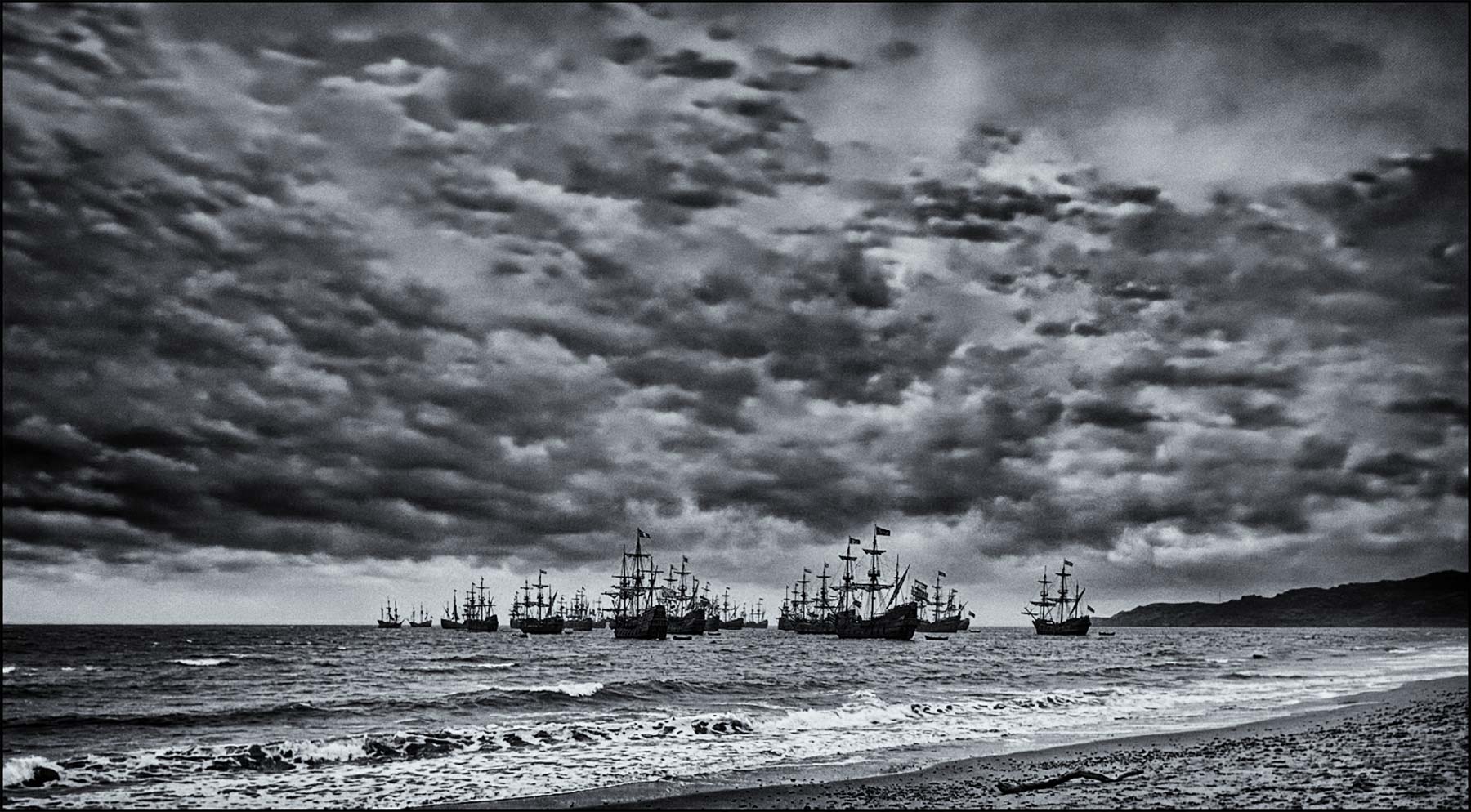
“I am gladd I am rydd of my Lord Oxford, seeing he refuseth this & I pray you lett me not be pressed any more for him what sute so euer he mak[e]” The Earl of Leicester
| Title | Description |
|---|---|
| Burghley’s Propaganda Pamphlet (1588) | The earliest source placing Oxford among the Armada heroes is a 1588 propaganda pamphlet commissioned by Burghley. Nelson’s examination of the original manuscript in the British Library — Lansdowne MS 193 — reveals that Oxford’s name was not in the first draft but was added by Burghley himself as a late interlineation. All subsequent literary accounts of Oxford’s Armada service derive, directly or at second hand, from this single document. |
| Laughton: The State Papers Evidence | John Knox Laughton, the foremost Victorian authority on the Armada, examined the complete State Papers and concluded that of all the nobles named in the literary tradition, only Cumberland, Charles Blount, and Thomas Gerard appear in the actual documentary record. His verdict on Oxford — that presence in the fleet remains extremely improbable without corroborative testimony — has not been successfully challenged in the century since. |
| Leicester and the Refusal of Harwich | Leicester’s letters to Walsingham in July and August 1588 are the only reliable contemporary documents recording what Oxford actually did during the Armada crisis. They show that Oxford refused the governorship of Harwich — a hereditary obligation of the Earls of Oxford and a position of genuine strategic importance — on the grounds that it offered insufficient credit. Leicester’s postscript is unambiguous — “I am glad I am rid of my Lord Oxford.” |
| Matus: The Documentary Foundation | Irwin Matus was the first scholar to present the Leicester-Walsingham documents in their complete form, in Shakespeare, In Fact (1994). His work established that the only primary evidence for Oxford’s conduct during the Armada crisis directly contradicts the heroic literary tradition. Nelson’s account builds on Matus’s documentary foundations and extends the analysis to include the manuscript evidence in Lansdowne MS 193. |
| The 1589 Propaganda Pamphlets | Two propaganda pamphlets published in 1589 — one in English, one in Spanish — repeat and embellish the list of noble volunteers first circulated by Burghley. The English pamphlet celebrates Oxford in verse alongside the Earls of Northumberland and Cumberland. Nelson identifies the author as James Lea or Leigh, possibly a Burghley pseudonym, and not John Lyly as Ward had claimed. The Spanish pamphlet derives its list directly from the English one. |
| The Armada Playing Cards (c.1680) | A pack of playing cards printed around 1680, now in the National Maritime Museum at Greenwich, commemorates the Armada campaign. The Five of Clubs depicts Oxford, Northumberland and Cumberland on horseback “going to visit the English Fleet.” The card illustrates how, by the late seventeenth century, the literary tradition initiated by Burghley’s pamphlet had passed into popular culture — long after any possibility of independent verification. |
| The Pine Tapestries: Oxford Absent | The memorial tapestries woven to commemorate the Armada victory hung in the House of Lords until destroyed by fire in 1834. Known from John Pine’s 1739 engravings, their border medallions name the heroes of the campaign — including Oxford’s peers the Earls of Northumberland and Cumberland, and a long list of knights and commanders. Oxford’s name is entirely absent. |