Shakespeare in Italy
Elite knowledge, lucky guesses and taxi drivers as sources
Roe’s book is a sort of travelogue about his journeys throughout Italy, tracing the locations he believed that the author of Shakespeare’s plays visited in the early 1570s.1 The date makes it obvious that Roe does not believe that Shakespeare, who was active as a writer from the late 1580s through the early 1610s, was the person who wrote the works bearing his name. The book’s objective is to convince readers that someone else was the “real” author, a person who had to have been to Italy. Roe is coy about who he thinks the real author was, but he drops hints that he thinks that it was Edward de Vere, 17th Earl of Oxford. Roe attempts to prove that his author could only have written what he did from personal experiences in Italy.
The Foreword, Introduction, and Preface to Guide were written by anti-Shakespeareans who assert a number of standard denier shibboleths intended to discredit both Shakespearean scholars and the glover’s son from Stratford. Their bias and disregard for the historical record is easily shown.
The Introduction, written by Daniel L. Wright, Director of The Shakespeare Authorship Research Center at Concordia University, Portland, Oregon, asserts that:
“Roe helps us to recognize that if we are to pursue a better understanding of Shakespeare, we cannot probe the life of a dull and almost assuredly illiterate man (Shakspere of Stratford neither wrote nor received so much as a single letter in his lifetime, and none of his children could write either).”
One would think that someone in Wright’s position would comprehend that the absence of evidence does not equate to evidence of absence, but apparently not. It is true that any letters that Shakespeare (by whichever spelling of his name one chooses to use) may have written or received haven’t survived these intervening 400+ years. But as Robert Bearman writes:
“There is nothing ‘suspicious’ about this poor harvest [of personal documents, etc.]. The survival of documentary evidence from this period depended overwhelmingly on whether or not it remained in the hands of either an institution or a great landed family with the resources to provide a safe haven over a period of time."
--Shakespeare’s Money (2016)
Wright doesn’t acknowledge that a letter addressed to Shakespeare (1598) exists that may or may not have been delivered—most scholars think not. Its existence implies that the writer, fellow Stratfordian Richard Quiney, knew that Shakespeare could read.
A signature by Shakespeare’s daughter, Susanna, is extant, a strong sign that she had received some education. People that couldn,t write signed with a mark, and Stratford’s petty school accepted female students. Reading was taught before writing in Tudor schools, so it is highly probably that Susanna was at least partly literate. No evidence to the contrary has ever been presented; just negative evidence—the idea that if something can’t be seen, it must not have existed. That is an extremely ego-centric view. The same goes for Wright’s asserted image of the dullard Shakspere he chose to believe in.
Roe’s Preface has pretty significant problems, too. Referring to books about the authorship question, he writes:
“All such publications, including the multitude declaring William of Stratford to be the”true author,” have the same shortcoming: their arguments are only conjectural.”
Like Wright in the Introduction, Roe seems to have a problem with historical evidence if it contradicts his beliefs. Taking him at face value, it would be news to Roe that:
Shakespeare’s name, with some variations in spelling, is on the title pages of 12 of his plays (in 27 editions by my count) published during his lifetime, not counting various editions of his poetry. Shakespeare is also named as the author on the title page of the First Folio, and two of the encomiums inside link Shakespeare, the author, with Stratford. One explicitly mentions his Stratford monument. Correspondingly, Shakespeare’s Stratford monument has inscriptions that refer to him as a thinker and writer.
Shakespeare is named for the excellence of his writing in Francis Meres’ Palladis Tamia: Wits Treasury in multiple categories. Meres names Shakespeare to be the author of 12 plays (including 1 lost play), and of “Venus and Adonis, his Lucrece, his sugred Sonnets”. Meres also lists de Vere once in one of the same lists that includes Shakespeare. Meres knew they were different people.
The coat of arms awarded to John Shakespeare, William’s father, was challenged because it was being worn by William Shakespeare (as a matter of right, being John’s son) because William was a mere player. William Camden, one of those defending Shakespeare’s right to the arms, identified William as a writer in his Remaines of a greater work concerning Britain (1605, 1614, and later), a supplement to his Britannia.
Shakespeare was included in a list of the members of the King’s Men when King James I took the throne and assumed patronage of the former Lord Chamberlain’s Men—the only name preceding his on the charter was that of an actor that James had brought with him from Scotland—and cloth for the making of livery was issued to him.2
Of Shakespeare’s six extant signatures, three are on his Stratford will which includes bequests of money for mourning rings to members of the King’s Men, and two are connected with the purchase of the gate house at Blackfriars (close to the theater at Blackfriars, one of the King’s Men’s venues) which he acquired with the assistance of John Heminges, a member of the King’s Men. Shakespeare’s remaining signature is for a deposition in the Bellott v. Mountjoy lawsuit regarding his involvement in an incident that occurred when he lived on Silver Street in London. Another deponent in that case was George Wilkins, one of whose occupations was playwright—an interesting association.
None of the items listed above are either arguments or conjectural. They are all facts drawn from the historical record. They show connections between the Stratford glover’s son and the player, the poet, and the playwright in London, whose signatures, incidentally, are believed to be a match for the handwriting of Hand D in the manuscript of the play, Sir Thomas More. There are other historical facts about Shakespeare that reinforce that identification; many more than are acknowledged by anti-Shakespearean compilers of lists that understate the number of items in the historical record relating to him. The refusal to acknowledge, let alone attempt to refute, these facts speaks volumes.
In an additional challenge to the idea that the glover’s son from Stratford was the author of the works bearing his name later in the book, Roe states that Shakespeare’s interest in Italy is inexplicable. In its Roman days, Italy was part of English history. Classical Roman authors were studied in grammar schools. Italian cities were some of England’s most active trading partners. Italian commedia dell,arte troupes toured the countryside. Italian clothing fashions were all the rage. Plays set in Italy brought pence into the theaters to see Italian plays, and not just those written by Shakespeare. It would have been inexplicable if Shakespeare had not had an interest in Italy.
The clearest statement of Roe’s thesis is contained in the Foreword, written by Hilary Roe Metternich, Roe’s daughter. She writes about the correspondences between statements in the plays and Italy that:
“… the only conclusion possible was that the descriptive references uttered by the characters in Shakespeare’s Italian plays reflected, to a surprising degree, realities on the ground.” (My emphasis).
She ends by asserting that:
“… the only possible conclusion one can come to … is that whoever wrote the Shakespearean plays set in Italy … could only have seen Italy with his very own eyes.” (My emphasis)
A necessary corollary of that claim is that “words, words, words,” to quote Hamlet, are incapable, whether communicated orally or in print, of conveying the knowledge about Italy contained in the plays.
So, how well does Roe defend that thesis?
Roe’s Evidence
Whatever else might be said of Roe, it can’t be disputed that he diligently approached his task with a single mindedness that produced an amazing amount of detail. The predominantly Italian plays appear to have been thoroughly scanned to extract references, large and small, that might help to support his thesis—that his author had to have been to Italy. He spent years of research and travels throughout Italy in search of confirmation.
Which way am I facing
One of the earliest confirmations Roe documents occurs in his chapter on Romeo and Juliet, set in Verona. He writes, almost breathlessly:
“I leapt from the car to get a closer look at the broad-lobed leaves and mottled pastel trunks, to make absolutely certain that it was true; that the playwright had known, and had told the truth. Benvolio was right. And I was not a fool.”
What Roe is talking about relates to something Benvolio, a friend of Romeo’s in the play, tells Romeo’s mother; that he recently saw him “underneath the grove of sycamore / That westward rooteth from the city,s side.” Roe had taken a cab to a surviving gate, Porto Palio, that was once part of the city’s wall on its western side and found sycamores, remnants of the old grove that Benvolio mentions.
Roe’s write up of the discovery helpfully provides two supporting photos. One is of the gate, Porta Palio. It depicts a structure with an archway through which can be seen part of a tree on the other side. There is no vegetation visible on the viewer’s side of the gate. Though Roe doesn’t explicitly say so, the impression given is that the photo was taken on the city side, the eastern side of the old gate looking west toward the outside of the old city where Benvolio’s grove of sycamores was located in the play. The second photo is mostly of heavy shade from a clump of trees, plus a few cars and vaguely seen walls in the background. Could that be a photo of the sycamore grove’s remnants on the western side of the gate?
Thanks to Google Map’s satellite view and street view features, a computer can be used to see the gate, “drive” all the way around it to inspect every side, and to pull back to get a longer view. The first thing one discovers is that Roe’s photo was taken from the western side of the gate, looking east toward the inside of the old city, not the other way around as Roe allows us to believe. The tree seen through the gate in the photo and in Google’s street view is not where the author put the sycamore grove. When the tree is seen from the other side, the east side, without the gate obscuring the view, it turns out to be one of a double row of identical trees resembling sycamores that line both sides of a modern avenue. That part of town has clearly been rebuilt since Roe’s author’s day, and the trees were obviously planted as part of a beautification project. The closest trees to the gate on that side as well as to the north and south are across adjacent roadways, not rooted “from the city,s side”.
On the western side of the gate where Benvolio placed the sycamore grove is a mostly open area, kind of a plaza, with scattered trees of different kinds, planted in a more or less symmetrical arrangement. It is not the remnants of an old grove. The two trees closest to the gate, symmetrically placed, appear to be approximately 30 feet away from it. Sycamores are deciduous trees. Those two closest trees appear to be conifers; they definitely do not have the broad-lobed leaves of sycamores.
The other photo with the heavy shade? From looking at all sides of the gate with Google’s street view, the location from which that photo was taken can’t be identified. It could have been taken from numerous locations, but it isn’t a picture of trees adjacent to the gate.
There is another issue with Roe’s “discovery” of sycamores at the gate. People knowledgeable about trees say that there are no sycamores there, though some are scattered about Verona. The planted trees that resemble sycamores lining the street inside the old city’s boundary are really plane trees. Roe may have inadvertently verified this by saying that his sycamores had “mottled pastel trunks”. That description seems to more closely match photos of plane tree trunks than it does the very different sycamore trunks.
Too much investigation
Roe frequently delves deeply into history and relations between nations to support his arguments, and the Oxford English Dictionary, 2nd Ed. (OED) is frequently referenced for word usage in early modern England. There are instances in which Roe doesn’t reference it enough. See also Noemi Magri[Magri2014]
The word “argosy”, used by Antonio in The Merchant of Venice to describe his fleet of ships, prompts Roe to launch into pages of exposition to explain that an Argosy was a specific type of sailing ship associated with “the Illyrian city once known as Ragusa” (now Dubrovnik, in Croatia). He follows up with more pages of historical information up to the 1570s (when de Vere was in Italy) about how Antonio got around violating a Venetian rule against the use of foreign ships by a Venetian merchant, and how he was able to work around political barriers to send his ships to various international destinations named in the play. Antonio also makes reference to “my wealthy Andrew” which Roe claims is another type of ship, flying the flag of Andria (Andrew) Doria, a wealthy ship-owning family. Roe offers no evidence for that.
What Roe apparently didn’t do was to check for alternate definitions of “argosy” and how else Shakespeare may have used the word. “Argosy” is a general word for a merchant ship or a fleet of them under a single ownership. The word didn’t need to be associated with any particular place to have that meaning. (To paraphrase Roe, Elizabethans would have known that.) Shakespeare clearly uses the word in its general sense in Henry VI, Part 3 and in The Taming of the Shrew. It doesn’t require either a great stretch of the imagination or pages of exposition to think that it was meant that way in Merchant, too. Further, the OED says the following in the entry for argosy:
“That argosies were reputed to take their name from Ragusa, is stated by several writers of the 17th c.”
The OED lacks any citation for any connection of the word “argosy” with Ragusa earlier than 1600, undermining Roe’s whole rationale for delving so deeply into the use of that one particular word.
As for “my wealthy Andrew”, a Spanish galleon named San Andrés (Spanish for Andrew) was captured by the English in the Cadiz expedition of 1596. It is possible that Antonio’s ship was named Andrew as a reference to one of the many contemporary events that Shakespeare alluded to in his plays. The date of its capture is consistent with the approximate period that scholars think Merchant was written; 1596–1599.
Richard Roe, meet William of Occam.
A similar issue on the too little side has to do with “Scamel”. Roe points to a speech by Caliban in The Tempest in which he says, “sometimes I,le get thee young Scamels from the Rocke”. Scholars generally consider the second letter in “scamel” to be a typographical error, and the word should have been “seamel” or “sea-mell”, alternates for “sea-mew”, a kind of seagull. Instead, Roe claims that a scamel is really an alternate word for a bar-tailed godwit. He gives no source for his claim, nor does he mention scholars’ views.
A search for conformation of Roe’s claim uncovered a reference to a book titled Folk-lore of Shakespeare (1883) by Thomas Firminger Thiselton-Dyer that was supposed to provide support, but that attribution turned out to be wrong. Thiselton-Dyer initially reports scholars’ views that scamel means “sea-mew, or sea-gull”. Then it quotes from another book, Birds of Norfolk, by a Mr. Stevenson:
“… the female bar-tailed godwit is called a ‘scammell’ by the gunners of Blakeney. But as this bird is not a rock-breeder, it cannot be the one intended in the present passage, if we regard it as an accurate description from a naturalist’s point of view.”
In other words, neither Thiselton-Dyer’s book or its source, Mr. Stevenson’s Birds of Norfolk, supports the bar-tailed godwit claim. And it appears that “scammell”, or alternatively “scamell”, is merely a local colloquial term.
The OED has two citations for “scamel”. The first is The Tempest, but no definition is provided. The second is Stevenson’s book, Birds of Norfolk II, published in 1866, more than two and a half centuries after The Tempest was written. Roe doesn’t hesitate to cite the OED when it supports his claims, but when it doesn’t, he seems to find it too inconvenient to bother with.
As a side note, a reason why Roe might prefer the bar-tailed godwit over seamel or sea-mew is to distance Prospero’s island in The Tempest from Bermuda, as described by William Strachey in his 1610 letter, A True Reportory¸ something written years after de Vere had died and that scholars have identified as a major source for The Tempest. A passage in it reads:
‘“… sea-meawe” which can be caught by standing on the rocks or sands … where of the birds would come flocking to that place near and nearer.’
Remember that Caliban needed to get “young Scamels from the rocke.” In any case, flocks of bar-tailed godwits have been reported on Bermuda but not on Vulcano, Roe’s stand-in for Prospero’s island, possibly because of a lack of observational data from the latter.
Water on the brain: Another area that Roe spends a considerable amount of time and ink on is his rationalization of the use of a water route to travel from Verona to Milan in The Two Gentlemen of Verona, though the land route seems much simpler and has a number of stopping places on the way. Roe says that his author knew that, but that route had “dangerous difficulties”, justifying the gents’ need to travel by water.
Roe then moves on to Julia’s determination to walk to Milan—via the land route. Roe quotes a line spoken by Lucetta, Julia’s waiting-woman, who was trying to discourage Julia from going. In the passage, we learn what those “dangerous difficulties” were that necessitated the men’s travel by water. Lucetta says, “… the way is wearisome and long.” Possibly not wanting Roe’s author, the route planner here, to be thought callus about Julia’s upcoming “dangerous” trek, Roe helpfully adds that the land route was “the cheapest and most common route between the two cities.”
Roe has undermined his own argument that Two Gents’ protagonists needed to travel by water, a more expensive and much more “wearisome and long” route. By implication, it was also a much less commonly traveled way to get to Milan from Verona.
Scholars have long pointed out the impracticality of traveling between the play’s cities by water in Two Gents>, given the necessity to travel downstream from Verona to the Adriatic on the Adige River, then upstream on the Po and through Milan’s extensive canal system, a long, slow journey of several hundred miles. Roe’s research uncovered a pair of obscure and long forgotten canals (I’m giving him the benefit of the doubt for the discovery) that could shorten the distance by water from Verona and Milan, reducing the time the journey would take by water. The shortcut still required travel to begin toward the Adriatic, the opposite direction from Milan, and it would still be much longer, both time and distance-wise, than the approximately 100 mile direct journey by land.
Two Gents is silent about the route taken by the play’s protagonists. We just know that they left Verona by water and ended up in Milan. If Roe is right that his author would only have written the play that way if real travel by water was practical, the shortcut Roe found must have been unremarkable and in common use. However, Roe doesn’t explain why it fell out of use and so thoroughly from memory that it took an extensive amount of research to rediscover its mere existence.
Rewriting Shakespeare
A major problem with Two Gentlemen of Verona is its several references to tides. There are none to speak of in the Mediterranean, let alone on the Adige River at Verona at an elevation of 194’ above mean sea level and more than 100 river miles from the Adriatic Sea. Roe attempts to explain away these references by claiming that his author was referring to “time”, not “tides”. Roe’s argument would be pointless except that he wants to show that his author was never wrong about Italy. Because his author was never wrong, he must have meant something other than the literal meaning of “tides” when he wrote “tides” and when he used “flood” as a synonym.
Roe’s discussion includes excerpts from Two Gents’ uses of “tide” and “flood” to illustrate his claim. Prior to Roe’s first excerpt from the play, Proteus is about to leave on a journey, implicitly following in the footsteps of his friend Valentine who had already departed Verona by ship, but Roe doesn’t explain that. Here is Roe’s excerpt:
Proteus: My father stays my coming. Answer not. The tide is now.
Nay, not thy tide of tears! That tide will stay me longer than
I should. Julia, fairwell!
The meaning of “tide” as it is used here is partly allegorical, and out of the context of Proteus’s need to catch a soon-to-depart ship, partly ambiguous. Roe takes advantage of that by rewriting it the way he wants readers to understand it.
My father stays (awaits) my coming. Answer not.
The time is now. Nay, not thy rush of tears!
That flood will stay me longer than I should.
Julia, farewell! (Roe’s italics)
Eventually, Roe gets around to describing the play’s other usages of “tide” and “flood”. He attempts to impose his interpretation on those passages, too, but relevant excerpts from the scene are quoted below without his running narrative:
Panthino: Launce, away, away, aboard! thy master is shipped
and thou art to post after with oars. What,s the
matter? why weepest thou, man? Away, ass! You,ll
lose the tide, if you tarry any longer.
Then comes some comedic wordplay on “tide” and “tied”, followed by:
Panthino: Tut, man, I mean thou,lt lose the flood, and, in
losing the flood, lose thy voyage, …Launce: Lose the tide, and the voyage, and the master, and
the service, and the tied! Why, man, if the river
were dry, I am able to fill it with my tears; if the
wind were down, I could drive the boat with my sighs.
Roe would not agree that the tide and flood being referred to here was the watery kind because that would ruin his thesis of the perfection and absolute accuracy of his author, but there seems little justification for believing that Shakespeare meant anything else. In looking over Shakespeare’s other uses of “tide” in the canon, it always seems obvious when he is referring to water tides or is using the word allegorically.
This is one of many occasions in which Roe, in essence, rewrites Shakespeare to suit his purpose.
For support, Roe references Shakespeare’s Language, A Glossary of Unfamiliar Words in His Plays and Poems by Eugene Shewmaker, but the entry for “tide” doesn’t support Roe. The main entry defines the noun as:
flood tide; the most opportune moment. “I have important business. / The tide whereof is now.” (Troilus & Cressida—V.1)
This has nothing to do with a set time for something like the departure of a ship. The secondary usages of “tide” in Shewmaker are even less supportive. The only definition of “flood” in Shewmaker that has anything remotely to do with time is the third:
person’s prime; “His youth in flood,/ I’ll prove this troth with my three drops of blood.” (Troilus & Cressida—I.3)
A scan of the many usages of “time” in Shewmaker doesn’t help Roe either. The support that Roe claims Shewmaker provides doesn’t exist.
A chapter end note cites the OED is another source of support, though Roe doesn’t say how. The OED does cite a number of instances in which “tide” can take on obscure time-like meanings. The one that comes the closest is from Edmund Spencer’s The Fairy Queen, published in 1590, around the same time as Two Gents was written. : “There they alight … and rest their weary limbs in the meine tyde;” a usage essentially meaning a span of time.
Roe’s redefinitions of “tide” and “flood” to mean “time” to show that the play isn’t in error are his and only his; not those of any authoritative source.
Another instance of Roe rewriting Shakespeare in Two Gents has to do with the direction toward which some of the play’s characters flee in Act IV. Silvia wants to join the banished Valentine when she says to Sir Eglamour:
Sylvia: I would to Valentine / To Mantua, where I hear, he makes abode.
Later, the Duke says:
Duke: … meet with me / Upon the rising of the Mountain foot / That leads toward Mantua.
Roe is aware that there are no mountains in the direction of Mantua from Milan which is quite a long distance away, E by SE, across a flat plane. However, there are mountains to the north of Milan. Roe talks about city gates, travel conventions, and marshes—things that he says only someone who had been to Italy would understand—to explain why his author wrote “toward Mantua” instead of simply, “toward the North” or something equivalent. Roe is again asking us to accept that his author had perfect knowledge and wrote perfectly accurately of everything about Italy based on Roe’s rationalizations. But for some reason, Shakespeare didn’t write it in a way that reflected real geography, or that suggested that he knew of Roe’s rationalizations. Instead, he wrote “toward Mantua.
Less than it seems
The sheer number of the correspondences that Roe finds between what is in the plays and that also occur in Italy seems very impressive. However, when looked at closely, there are fewer of them than there seem to be. I give credit to Roe for locating such things as St. Gregory’s Well, mentioned in Two Gentlemen of Verona (again, Roe gets the benefit of the doubt), which he found in the outskirts of Milan. If Roe is right, that particular “well” is unique. Such things appear to be inextricably connected with Italy.
But a penthouse in Venice as in The Merchant of Venice? It matters not that Roe found a penthouse in Verona’s Jewish ghetto. Penthouses were generic structures that were located all over, including in London. The idea that his author would only, only, only use the word, if he had seen a penthouse with his own eyes, at a real world location, corresponding to the locale of a scene in a play being written, is ludicrous. Besides, judging from the play, we have no reason to believe that his author even knew of the Jewish ghetto. The scene in which Jessica climbs down from the gallery above the back of the stage (excuse me; Shylock’s penthouse) seems to be a place where gentiles feel free to wander, and to which Shylock’s activities do not seem to be restricted as would be the case for Jews in the real Venice of the time.
Roe finds lots of generically named or referenced locations in the plays that he attempts to connect with specific Italian sites, “proving” that his author knew of them. In one case, wordplay on “grave” in The Taming of the Shrew about a character from Pisa shows, Roe says, that a cemetery named Campo Santo (aka Camposanto Monumentale) in Pisa is being referred to. Could he be right? Yes. Should we accept that unconditionally? No. The play just has some wordplay on “grave”.
Vincentio, a character in Shrew, says that Tranio’s father is a sailmaker in Bergamo. At the end of a several paragraph long discussion about Bergamo, Roe concludes:
“The playwright knew that Bergamo was the principal source of sails for the Mediterranean world, and knew that Tranio’s father could, indeed, have been a sailmaker there.”
Roe is correct about Bergamo. Roe says Mediterranean, but I understand that Bergamo was well known throughout Europe for its sailmakers. What Roe fails to explain is why something that all of Europe knew required his hypothetical author of Shakespeare’s plays to have been to Italy in order for him to know it, too.
In Shakespeare’s version of All’s Well That Ends Well, there is a stage direction calling for a tucket, a type of trumpet blast that signals the approach of military troops. That leads to a decision by some women to go to see them arrive. Roe uses those two things to segue into an extremely long and complicated argument to support a claim that his author knew the layout of the city of Marseilles. The play just has a tucket and women going to see arriving troops. And Marseilles isn’t even in Italy. (“Yes, but de Vere was in France, too”, I seem to hear in the distant background.)
Roe’s example of ordinary things posing as something specific in Italy that I like the best is the “Duke’s Oak”. According to Roe’s account, he practically had a case of the vapors when he heard the name applied to a passageway, part of an architectural structure, leading to an oak forest in a small Italian town named Sabionetta. The real name of the passageway was is Quercia dei Duca; “Duke’s Oak” is Roe’s translation. Furthermore, an alternate name for Sabionetta is “La Piccola Atnea” or “Little Athens”. Roe writes:
“A world of understanding burst in my brain. Of course. It made so much sense.”
A Midsummer Night’s Dream wasn’t supposed to be set in Greece, Roe says, it was set right there in Sabionetta, Italy. The connection with the “Duke’s Oak” is that that is where the rude mechanicals were to meet to rehearse Pyramus and Thisbe. To reinforce his claim, Roe also says that Dream makes “no references to Greeks, Greece, Grecians”, etc. I wonder what nationality he thought Theseus, Hippolyta, Titania, Demetrius, Helena, Hermia, and Lysander were supposed to be.
Elsewhere, Roe tells us that we should pay close attention to small details like the capitalization of Shakespeare’s words because they have meaning—they signify that a specific real world location is meant. Roe consistently writes “Duke’s Oak” with both words capitalized. A quick check with the First Folio, however, shows that the phrase is written “Dukes oake” without a capitalized tree name (or an apostrophe, either). By Roe’s own criteria, the phrase does not refer to a specific real world location. Judge for yourself whether or not Dream is an Italian play; whether or not Theseus, Hippolyta, Titania, Demetrius, Helena, Hermia, and Lysander are Greek names; and whether or not the “Dukes oake” is supposed to be a tree in the forest where most of the action of Night takes place or a passageway of an architectural structure in Italy.
Further comments by Roe have him questioning how Shakespeare, the glover’s son, could have known of Pyramus and Thisbe in the first place, it being a Greek story, as if a knowledge of the Greek language was a prerequisite. Roe never mentions Ovid’s Metamorphoses, a Latin work that contains the story and which was a standard Tudor grammar school text.
Convenient Omissions: Again, Roe often emphasizes that it is important to closely pay attention to things like capitalization in his author’s printed works. He says that words are capitalized because they are proper words that most likely (a rare qualification for Roe) refer to something unique. One thing that Roe neglects to tell us is how capitalized words are supposed to be pronounced when spoken on stage. Theater is performance art, and words are intended to be spoken by actors, not read by individuals. So, how was an actor supposed to pronounce the word “Temple” in Much Ado About Nothing, for example, so that the audience would know that it was supposed to reference, according to Roe, Il Tempio di San Giovalli Battista detto di Fiorentini in Messina, Sicily? The same question applies to all of the many times in which Roe cites the importance of capitalized words in Shakespeare’s text.
Plays sometimes made it into print, but that was generally an afterthought and often against the wishes of the acting companies who owned them. In the case of Much Ado About Nothing, the play was prepared from Shakespeare’s foul papers according to scholars, but we don’t know who, if anyone, oversaw its printing. Couldn’t the capital “T” in “Temple” have been the work of a compositor or some other intermediary? If we accept Roe’s view that the printed version of Much Ado (1600) precisely represented his author’s wishes, then we need to understand why his author wanted us to see that he sometimes substituted actor’s names for character names in speech prefixes. By my count, he does this twelve times for William Kemp who played Dogberry; nine times it is spelled “Kemp”, twice spelled “Kem”, and once spelled “Kee”. The actor Richard Cowley played Verges. Cowley’s name is substituted for Verges’ three times in speech prefixes; twice as “Cowley” and once as “Couley”.
These name substitutions with their inconsistent spellings seem to represent something with far more significance than whether a single word is capitalized or not. Roe has overlooked a great opportunity to enlighten us about what his author was covertly telling us. Given Roe’s silence on the issue, we might be tempted to think that this was a strong sign that the author was a working member of the Lord Chamberlain’s Men, writing parts for specific actors. Also, that a capital “T” in print was at most a sign of respect for a generalized institution having nothing to do with any specific location. Another possibility is that Roe wants us to pay attention to the capital “T” when he thinks it supports his thesis and ignore the rest when it doesn’t.
When discussing The Taming of the Shrew, Roe says that he is bypassing a discussion of the Induction because that takes place in England, not in Italy, the focus of his book. It is a convenient omission because it removes the need to explain all the references the author makes in it to locations in the vicinity of Stratford, England, Shakespeare’s hometown.
Roe’s discussion of The Winter’s Tale claims that it is set it in the 13th century because that is when the real Bohemia had a coastline, something that it has in the play, too. Roe uses that to assure us again that his author was all-knowing about Italy. He fails to tell us that a source for the plot of The Winter’s Tale was Robert Greene’s Pandosto (1588), and that it, too, represents Bohemia with a coastline. Shakespeare didn’t need to know anything about Bohemia and coastlines; he only needed to take the information from his source. If Roe had told us that, then he might have felt compelled to explain why his author was so meticulously precise in his geographic references (according to Roe) on some occasions and was careless about them on others.
Roe admits that The Winter’s Tale has anachronisms. (A great many of Shakespeare’s works do.) That could be seen as a subtle way of saying that the plays are not totally accurate in all of its Italianate detail without actually acknowledging it.
Tempest in a Teapot: In Roe’s Preface, he says that his objective is to show that his author had to have been to Italy; not to identify who he had chosen the “real” author to be. Regardless, on one occasion he mentions the Earl of Oxford, Edward de Vere, in a seemingly incidental way. Perhaps Roe couldn’t help himself. The Earl, a favorite anti-Shakespearean alternate to the man who wrote the works bearing his name, traveled to Italy in the early 1570s, which helps to explain why that time frame pervades so much of Roe’s book. For anti-Shakespeareans, it is especially important in The Tempest.
In the play, Prospero and Miranda are hustled aboard a bark in Milan and set adrift in a frail vessel a few leagues at sea with meager supplies and no way to maneuver the craft. No mention is made of the long journey through Milan’s canal system and down the Po River to the Adriatic Sea, the only logical drop-off point. Roe decided that Prospero’s island, too, is a real place; an island named Vulcano off the northeastern tip of Sicily. Though insistent that his author was perfectly accurate in everything he wrote, Roe fails to point out that unlike Prospero’s isolated island, Vulcano and Sicily are within sight of each other.
Roe appreciated that it is highly improbable that a drifting boat could manage to float down the Adriatic all the way along the eastern coast of Italy to the boot, around the boot, through the less than 2 mile wide Strait of Messina, and finally make its way north past Sicily to Vulcano. Roe’s solution? His infallible author didn’t write “Milan”, he wrote “Tuscany” instead, and someone later changed it to Milan “by high authority”. From Tuscany’s capital, Florence, the western coast of Italy is fairly readily accessible, and then Prospero’s boat only needed to drift more or less directly to Vulcano (setting aside issues like ocean currents and the need to dodge shipping traffic to avoid a rescue that Roe doesn’t trouble himself with—Roe is the one insisting on perfect accuracy).
Replacing Prospero’s exile from Milan with Florence, besides solving Roe’s geographical problem (created by himself by assuming his author had perfect knowledge of Italy and had never once created imaginary locations) is where the 1570 dating comes in again. Roe explains that a political situation around that time would have caused great offense to certain foreign powers and embarrassment to Elizabeth if The Tempest was performed with Milan as a setting. Ergo, his author wrote one thing, and “by high authority”, someone changed it. No evidence of Roe’s assertion is provided, unless one wants to consider cooking up a rationale for the sole purpose of removing Prospero’s inconvenient drift around the boot of Italy to be evidence.
The composition dates of many of Shakespeare’s plays present devotees of Edward de Vere problems because the earl died in 1604 before the dates that many of Shakespeare’s plays were written; dating confirmed by numerous criterion. That is the major reason why alternate dating schemes for the plays have been pushed by anti-Shakespeareans, the lack of meaningful supporting evidence notwithstanding. The Tempest presents a special case because scholars have identified a 1610 letter by William Strachey, published as A True Reportory, as a major source of inspiration for it.
The letter reports a great storm in 1609 that caused the shipwreck of a vessel on Bermuda that had been bound for the Virginia colony. Besides describing the storm, the letter also describes measures the crew took to save the ship, features of the island, abortive attempts to mutiny, and a variety of other things that correspond at many points with The Tempest; dozens of them in all. Though not published until 1625, Strachey’s letter circulated among members of the Virginia Company in manuscript form, several of whom Shakespeare had connections with, possibly including Strachey himself.
Roe tells us nothing of this. Instead, he asserts that Vulcano was Prospero’s island and that it and only it, unique among all the islands in the world, has a combination of features that match those described in the play. There isn’t any evidence that Roe actually made comparisons between Vulcano and other islands, and he steers well clear of any mention of Bermuda except for an unsupported assertion that the play’s mention of “Bermoothes” is supposed to refer to an area in London.
The support for his claim that he does provide is to describe his own set of correspondences between the play and Vulcano; far fewer of them than between Prospero’s island and Strachey’s letter. Roe provides supplementary information—sometimes a lot—to help make the connections clear or to make them specific to Vulcano; e.g. Shakespeare writes “berries” and Roe says “mulberries”.3
Summing Up
The objective here has not been to find and refute every one of the problems with Roe’s book but to identify classes of errors with examples. The book has many many more problems than just the ones that have been discussed.
Problem categories highlighted by claims of Roe’s that were explored are:
Rejecting or discounting historical evidence by calling facts arguments or conjectures.
Making discoveries that don’t match visual evidence, like the so-called sycamore grove at Verona’s Porta Palio gate.
Elaborating extensively on historical background to explain usages, like the word “argosy”, when much simpler explanations are available.
Referencing resource material like the OED when it supports arguments and ignoring it when it doesn’t, like the etymology of “argosy”.
Presenting an argument to justify one situation and then a contradictory argument when a slightly different situation arises, as when some characters choose to travel by water and another one by land.
Rewriting Shakespeare to attempt, for example, to erase errors like tides at Verona.
Adding information to create the impression that more is meant than what was actually written, like claiming that wordplay on “grave” was a reference to a specific location.
Omitting information that might contradict an argument, like the fact that Bohemia with a coastline was contained in the source material for A Winter’s Tale.
Elevating the significance of trivial details like a capital letter on a generic word without evidence that the author intended anything by it or was even personally responsible for it.
Contriving ridiculous explanations to explain away problems of one’s own making, like assigning a real-world location to an imaginary island and having to rationalize away concomitant imaginary difficulties.
This litany of horrors illustrates the kind of thinking that Roe’s book is riddled with. Roe undoubtedly knew a lot about Italy, but what Roe was doing much of the time was a form of free association. He found something in a play and matched it with something in Italy. What he didn’t seem to appreciate was that something more was required to show that a valid connection existed outside his own imagination.
So, how well does Roe defend his thesis that his author had to have been to Italy in order to write what he did? He doesn’t defend it at all. He just asserts it.
Knowledge is hard to corral. It doesn’t stay put. Books were written and atlases were available. Englishmen traveled to the continent for extended stays, and some studied in universities before returning to England. Traders with wide knowledge of Europe moved back and forth, and sharing brews and tales in local ale houses with sailors from trading ships wasn’t unheard of. Some of Shakespeare’s acting fellows, like William Kemp, had traveled on the continent, and Shakespeare lived for a time with a French Huguenot family on Silver Street. There were innumerable sources of information about foreign countries available to Shakespeare without requiring him to leave England to get it, including Italy.
In order to defend his thesis, Roe needed to explore alternative means for how knowledge of things written in the plays could have been attained, fairly present them, and honestly weigh them against the travel idea. Roe shows no interest in doing that. The closest that he comes is to make occasional disparaging remarks about scholars and a few of their conclusions with no more than a passing glance. Scholars’ conclusions are falsifiable; Roe’s aren’t.
Additionally, by insisting that his author had to have personally witnessed every Italian scene, always wrote accurately, and by extension, never created fictitious locations, Roe effectively discredits his author’s ability to utilize a creative imagination, at least not about Italy, or to deviate from Roe’s reality for the purpose to telling a story on stage. And if not about Italy, why should he be allowed to exercise his imagination about places and things other than Italy?
Contradictory Implications
Roe’s author had to have been to Italy, he said, in order for him to have written what he did. Only by seeing Italy with his own eyes could he have learned what he knew about the place. After reading Roe’s book, we now know what his author knew, too, assuming that we accept what Roe says he knew. We know that because Roe told us. Roe used the printed word. Spoken ones would have done as well. We didn’t have to go to Italy to know it because Roe told us in his book. We were sitting in our easy chair at home or at our desks, far from Italy, while we read Roe’s book and learned what Roe says his author could only have known by traveling to Italy. We must be smarter than Roe’s author.
Offered in final response to Roe’s claim that his author couldn’t possibly have written Shakespeare’s plays without having been to Italy is Olfert Dapper (1636–1689). Dapper became well known in his own time for writing authoritative works about foreign lands, including China, India, Persia, Georgia, and Arabia. His Description of Africa (1668) is still an important book for African studies today. (He also reported the existence of unicorns in America, but one can’t have everything.) Dapper never left his native Holland.
Tracking Oxford and Roe.
Our editor made his own pilgrimage to Italy in 2014, visiting many of the locations that Roe identifies as being referenced in the plays. The following photos are from that trip.
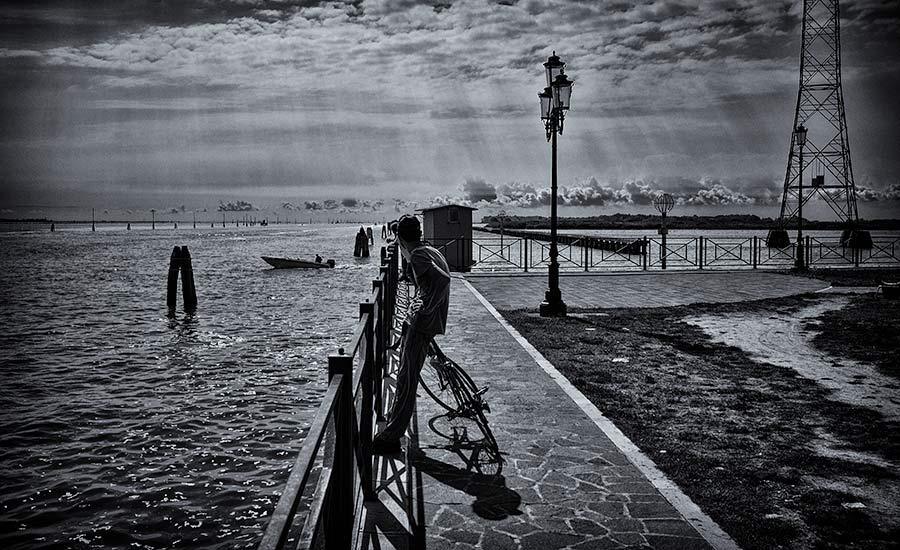
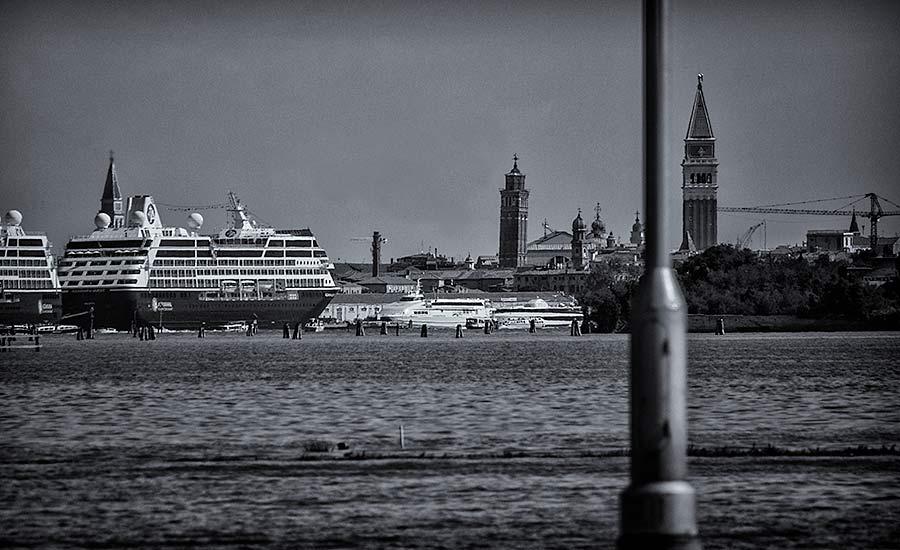
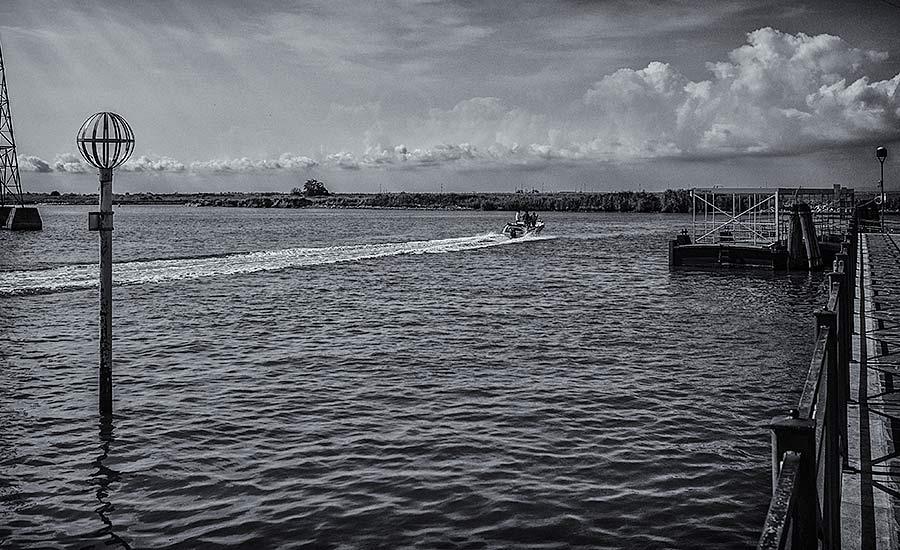
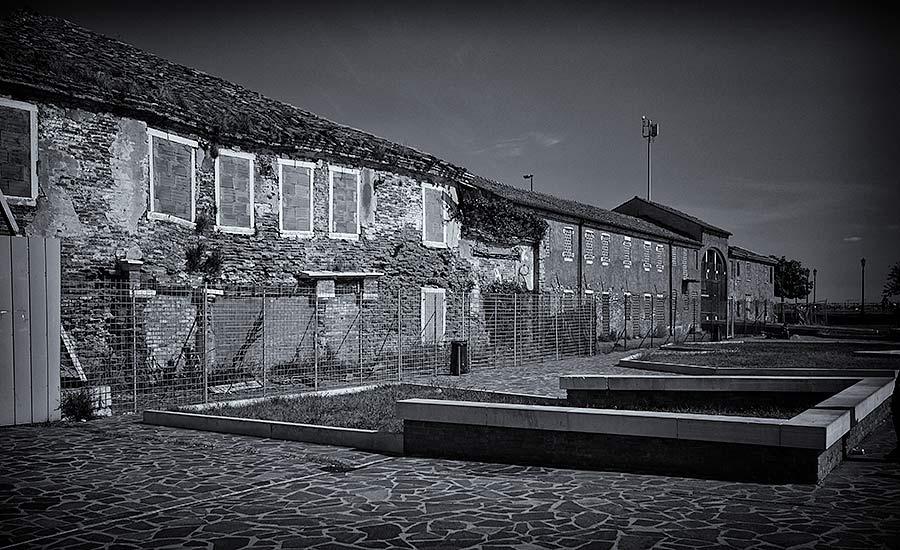
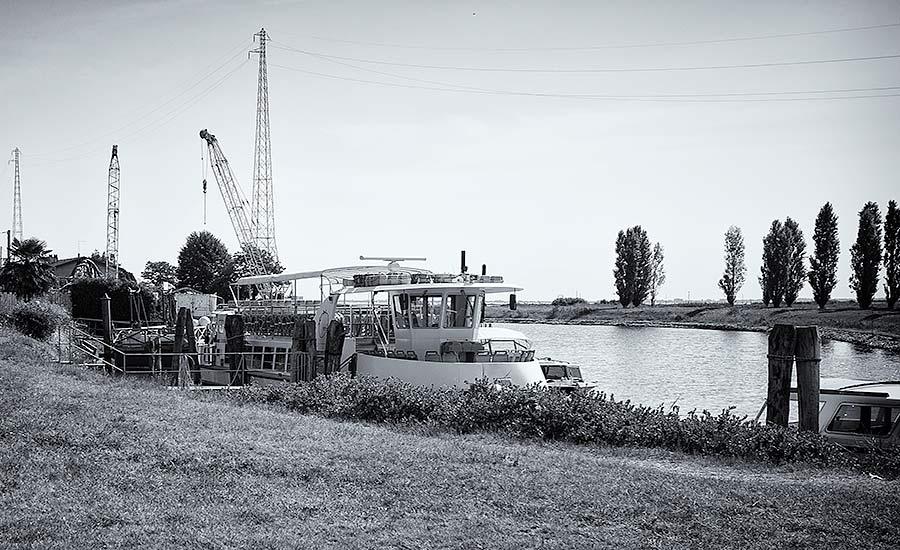
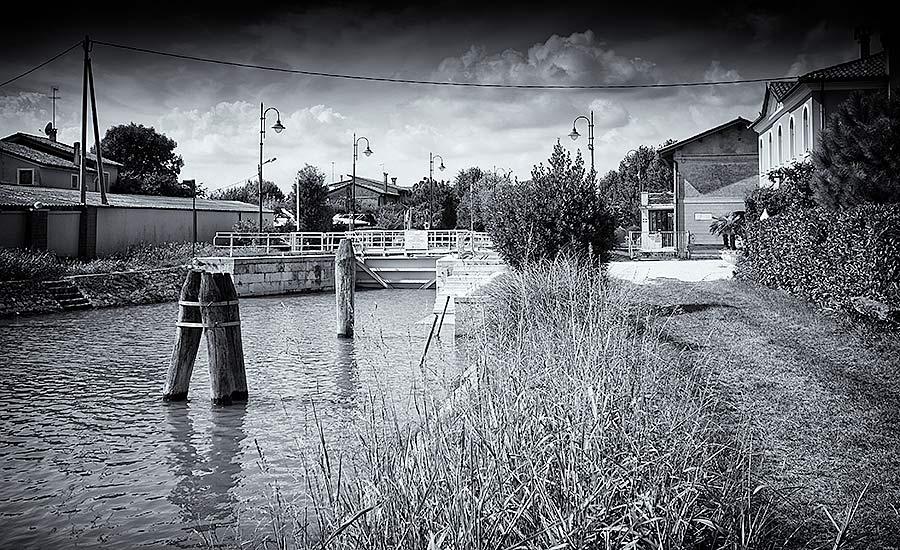
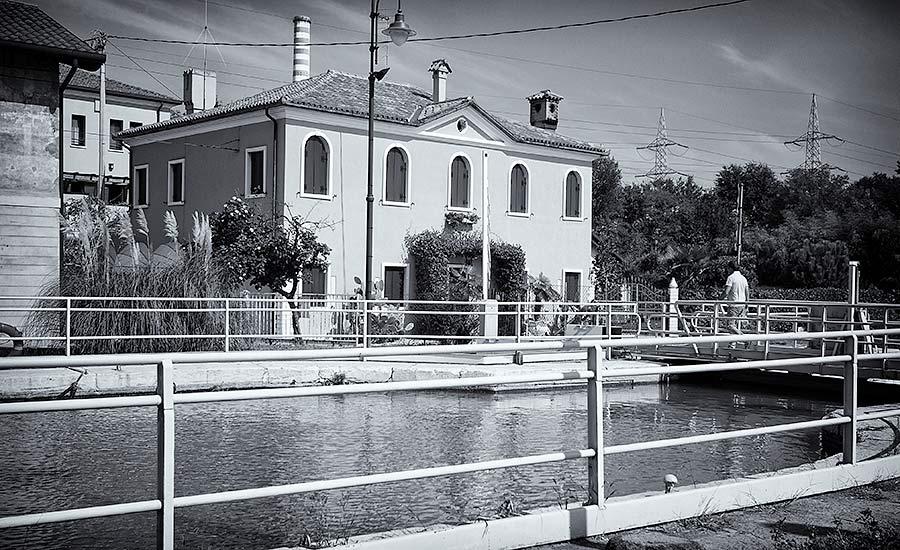
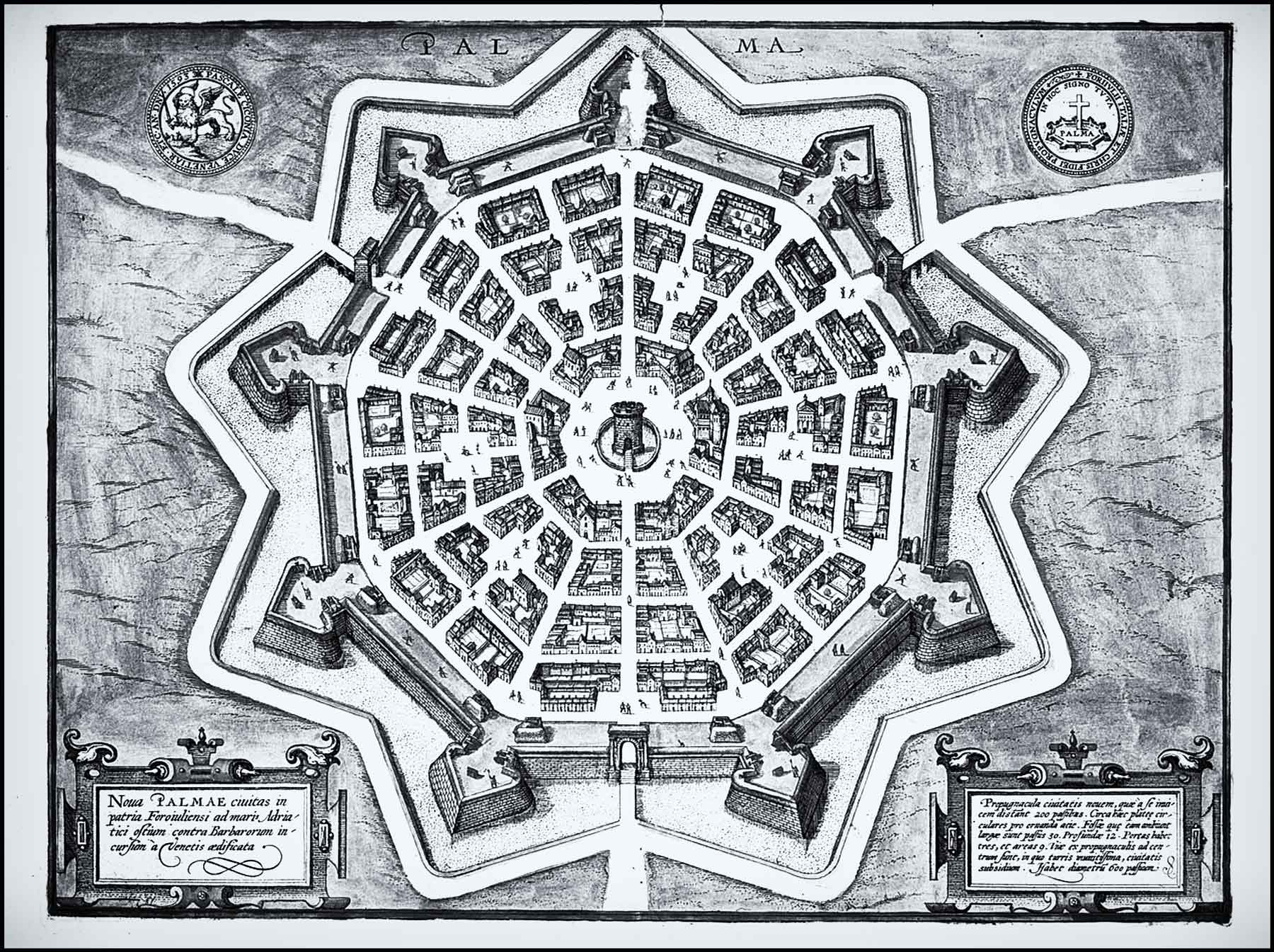
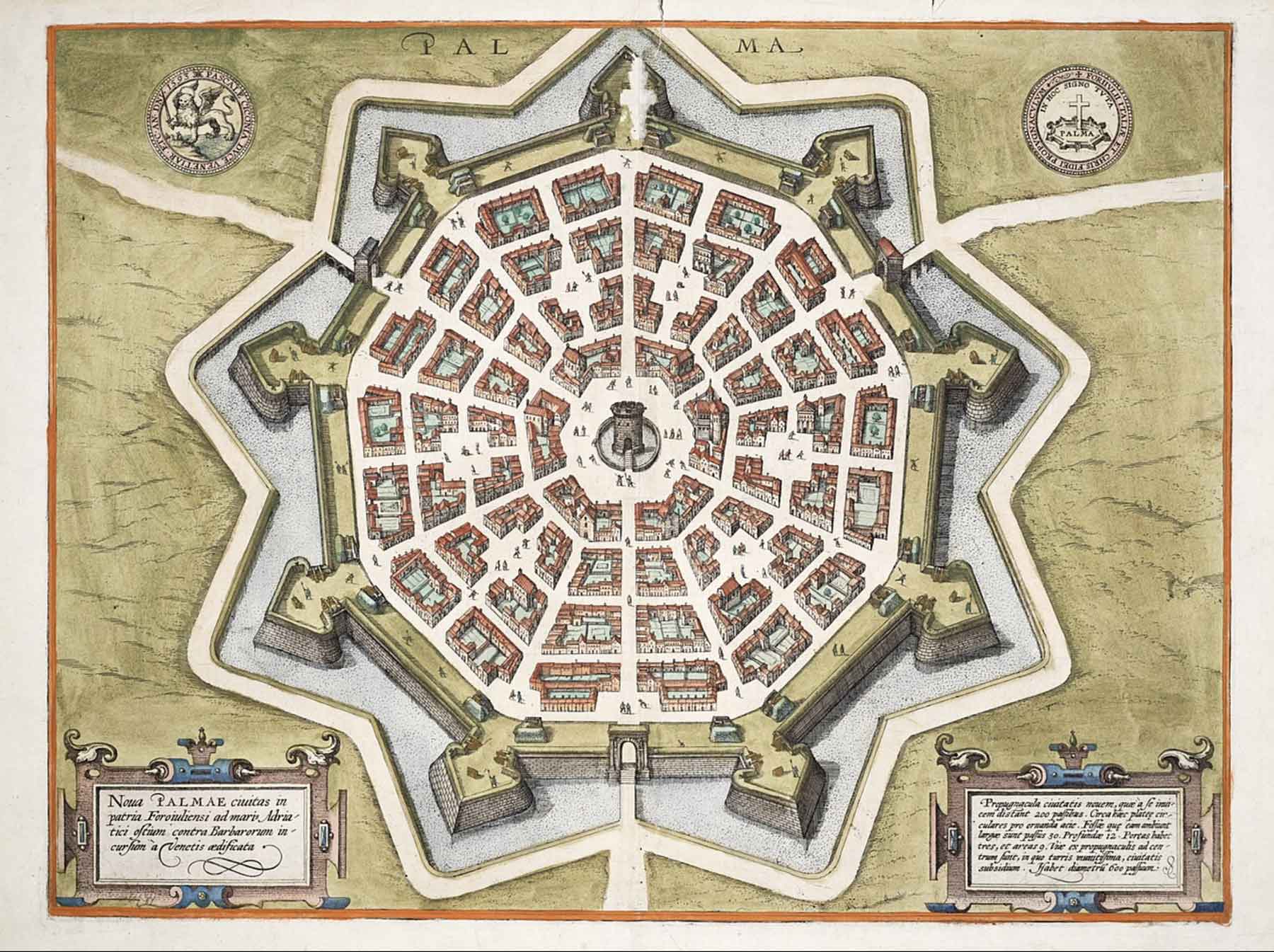
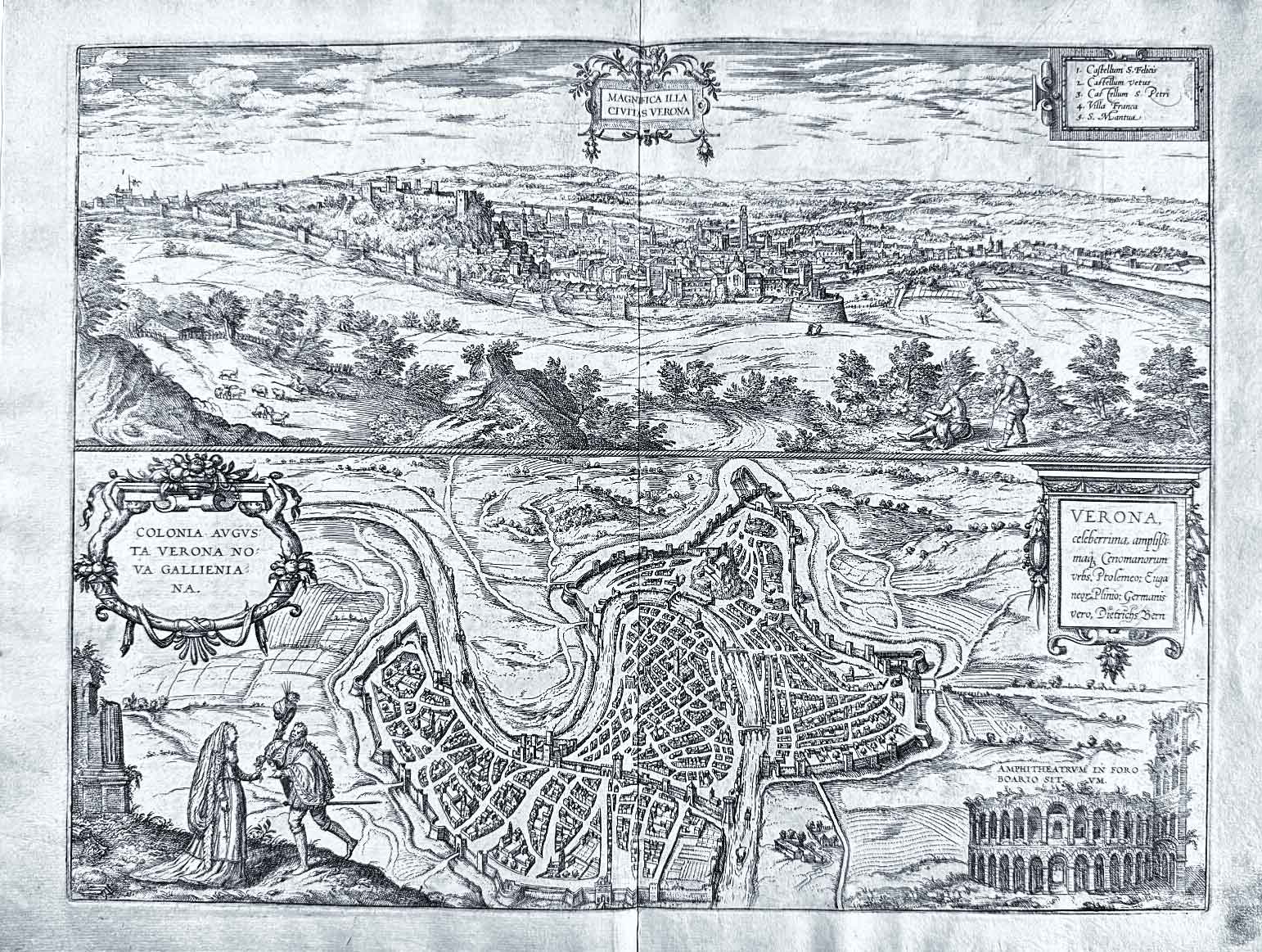
Palmanova, Italy, 1593—a fortified Venetian dependency demonstrating the complete absence of any sort of tree in the artillery sightlines of the fortifications (walls). Any miscalculation in design correctly read by invading artillery engineers would guarantee a breach. Engravings from the time of Oxford’s vist show the walls of Verona equally clear of obstacles. ⌕
Footnotes
Richard Paul Roe, The Shakespeare guide to Italy: Retracing the Bard’s unknown travels, (Harper Perennial: New York [u.a.], 2011).↩︎
My intention in assembling these bullet points was to juxtapose facts that, when viewed together, challenged denier views. I originally included mention of the Shakespeare vs. Addenbrooke law suit in this point in which the following text appears: “William Shakespeare, gentleman, lately in the court of the lord James, now king of England, of the said borough”. It seems now that that phrase may have been standard boilerplate and not evidence that Shakespeare of King James’ court was the same man as Shakespeare of Stratford, so I have removed it, though emotionally, it is hard to let it go.↩︎
The following comments about Roe and The Tempest were offered by Ben Hackman who saw an earlier version of this review:
↩︎Sometime soon I,ll run down Roe,s take on The Tempest, a paerodelian fantasy that provides a perfect coda to his imaginative masterpiece. For starters, the flora and fauna of Vulcano perfectly describe the English countryside. Prickling gorse and sharp furzes, hedgehogs and blue jays, the royal English mulberry, scamels (which Roe concedes are found in England), pignuts and crab apples. England? Or a volcanic island in the Med? Hmmmm.
My favorite, though is how Roe mistakes a cesspool for a hot sulfur pool (pp. 281-2). He writes about “hot mud pools” on the island, but for evidence cites Ariel’s report of Caliban, Stephano, and Trinculo “I’th’ filthy-mantled pool beyond your cell.” There is no sense of heat, no sense of hotness, except the trio was “red-hot with drinking.” Instead, it seems like just plain old filthy mud, and rather cold mud at that. Then Roe emphasizes the “volcanic sulfur dust” covering the pools. Yet the trio smells not of sulfur. Says Trinculo, “Monster, I do smell of Horse piss.” Now that smells like a stable, a cesspool, a London gutter, a country barnyard--but not rotten eggs.
Roe then places special emphasis on the “filthy-mantled” nature of the stinking pool, claiming that the mantle is actually a "floating crust of dry sulfur." But the pool is not yellow-mantled, Shakespeare says it is "filthy-mantled." And we all know what floats. And . . . . uh . . . . nope . . . . my chaster muse for shame doth blush to write what I,m thinking. =O)
Besides, there,s no mention of a sulfur smell in the play. Nor is there any mention of anything yellow except the yellow sands early in the play (I,ii)--which are also found in England, i.e., the popular yellow sands of Holkham Bay where QEII used to walk her corgis on holiday.
http://www.theguardian.com/travel/2010/aug/07/best-beaches-in-the-uk
So the hot sulfur springs are only in Roe,s imagination, because he really really wants Prospero,s island to be Vulcano, because, well, because he just knows Oxford visited there, saw it all, and folded the details, consciously or unconsciously, into The Tempest. Even though there,s zero evidence that Oxford every got any farther south than Naples. And that so many details about the island describe England--except for the marmosets that Roe carefully avoids, cuz there are no marmosets on Vulcano, thought it looks like there actually were some in England, brought back by English explorers (see pix of Margaret Tudor, top left, in link below).