Off-wavelength Frequency
Connections that eyes do not hear, ears do not see
⎙ Save as PDF 
The Evidence Hunting of an Evidence-Free Malignity
In a field crowded with appalling work, Roger Stritmatter1 offered a new compilation of poems by the 17th Earl of Oxford, He that takes the pain to pen the book . The poems of Edward de Vere. It is a strong contender for worst ever. This article deals with he first edition since a second has appeared, correcting, no doubt, some of the many errors listed here. The book is an edition of 20 poems claimed to be written by the Earl, accompanied by commentary and a lot of startling claims based on what the author identifies as “parallels” between Shakespeare and De Vere. These are further explored in the hope that their rarity might establish them as authorial connections, measuring their incidence in Early English Books Online, using the basic, vocabulary search features. The idea is not just to find direct comparisons but to use frequency analysis to show that Shakespeare and Oxford writers use the same unusual or idiosyncratic expressions, identifying them as stylistic markers before concluding, when he believes he has enough of them, he has sufficiently overlapping linguistic patterns to reveal Oxford and Shakespeare are the same writer.
Like Stritmatter’s work on The Geneva Bible, the premise is not entirely made of vapour. His work involves actual analysis of the two poet’s work rather than suggestive, diaphanous biographical coincidences. Once again, it all goes wrong through faulty process, lack of rigour with data and a characteristic rush to judgement.
Edward de Vere is a poet of modest achievement. An early Elizabethan courtier poet with a reputation based on a slender volume of work that stands comparison with other courtier poets of his day but comes nowhere close to the quality of the competition amongst the Bankside poets and playwrights who made their living with the pen. The Professor is, sadly not on Shakespeare’s wavelength and his attempt to reduce the distance between The Earl and The Bard fails comprehensively through poor use of his chosen instruments.
The parallels he ‘discovers’ are not parallel. His boldest statement, outside his search parameters comes before page 20. On Page 19 he correctly identifies a figure of speech in Oxford’s work and produces another example from Shakespeare. The sample of Oxford’s work is the usual, self-pitying, plodding, mediocre complaint, asking in every line “What plague is greater than grief of mind”. Though it follows the structural pattern for anadiplosis, each line expresses the same thought. Shakespeare’s leads the reader up a staircase, step by step, to a conclusion. Oxford just repeats himself.
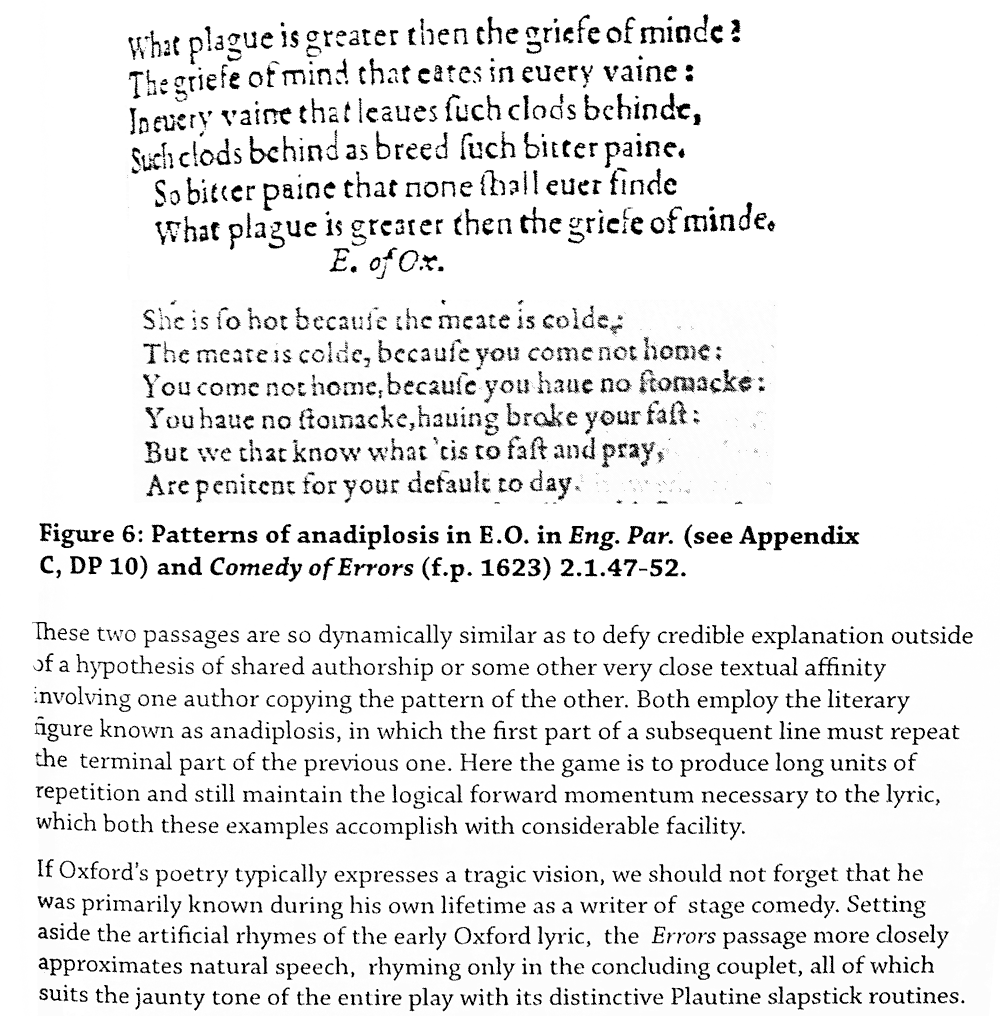
Looking at the two passages and ignoring the qualitative differences that even high school seniors could describe; forgetting that Oxford’s ‘grief of mind’ is personal rather than a plague; forgetting that all The Earl means (and says) is “I’m a bit distraught at the moment”–we don’t find out about what–it’s the step Stritmatter takes next that reveals the nature of the confirmation bias that will undermine the whole of his work. He concludes:
“These two passages are so dynamically similar as to defy credible explanation outside the hypothesis of shared authorship…”
Having identified the form as a literary construct (and therefore used by writers generically), Stritmatter leaps to the conclusion that because both writers have used the same device, they must be the same writer. This is no sort of connection at all. It’s like saying that because two gardeners use the same hosepipe attachment to water their lawns, they must be twins.
Here’s another comparison. Stritmatter links “eyes do see” to Bottom’s Dream.
And hide myself from shame,
Since that mine eyes do see,
Ah a lalalantida, my dear dame
Hath thus tormented me.
Oxford, Poems
The eye of man hath not heard,
the ear of man hath not seen,
man’s hand is not able to taste,
above his tongue to conceive,
nor his heart to report what my dream was.
Midsummer Night’s Dream 4.i.211
If words were a writer’s employees, Shakespeare’s each do the work of 10 of Oxford’s. Oxford’s verse is a song refrain, simple enough. Shakespeare writes refrains: “golden lads and lasses must, as chimneysweepers come to dust”. But there’s barely a name for this powerful figure of speech, multiplying impossibilities by transcending Bottom’s comic presence (and loss of his man’s ears) with a new variety of what? Synesthesia, hypallage? Triple wrongness in a triple transposition of the senses. It’s a famous speech in Midsummer Night’s Dream 4.1, it has its own name. It’s Shakespeare making the strangeness of Bottom’s imagination self-evident through a perversion of language.
“[all] education can do is determine the direction this activity shall take” Schopenhaeur on genius
Shakespeare is not just perverting language. This is a famous misquote of a famous verse 1 Corinthians 2:9. It’s one of a series of Bottom’s maladroit attempts at an elevated thought. Yet look how much work it does outside straightforward wordplay. What it is not, under any circumstances, is a connection to Oxford.
A longer leap comes next.
“If Oxford’s poetry typically expresses a tragic vision, we should not forget that he was primarily known during his own lifetime as a writer of stage comedy”.
This is a pontification, an invitation to take his ideas for granted. “Look at me, the expert at work”. If Oxford was known as a writer of stage comedy in his lifetime, why don’t we all know it? Shakespeare was known as a writer of stage comedy in his non-overlapping lifetime. Oxford was known as an ineffective dabbler in politics and the tin trade, a misogynist, an Italianate foppish dabbler in forbidden arts and proscribed pleasures, and a constant seeker of money for nothing—a dilettante who squandered his fortune, welched on his debts and had to be bailed out by the Queen. No one ever suggested he was a Bankside Playwright. A producer of the odd dainty device for the court, maybe. Professional playwright, never. If you asked 20 experts on Elizabethan poetry to list their favourite Elizabethan poet, none would agree but no list would feature Oxford.
If you asked 20 experts on Elizabethan poetry to list their favourite Elizabethan poets, none would agree but no list would feature Oxford.
The statement contradicts itself. Stritmatter is selling Oxford as the artfully hidden hand behind Shakespeare, yet everyone knew him as a comic playwright? And in a book on his canonical poetry, Stritmatter ought to be able to show, not just claim, the tragedy in Oxford’s vision yet he makes no such attempt. He is simply inviting his readers to add another to the prejudices he is sharing.
I note that Stritmatter intends another volume. If it turns out to be popular I might finish my own book listing the parallels between T S Eliot’s work and the 1926 timetable of the Acheson, Topeka and Santa Fe Railroad. Railway enthusiasts love parallels.
There are grave implications in all of this.
The book should reveal the Oxfordian mind in an entirely new light. But there isn’t any light at all. Stritmatter is turning the lights off. There’s little enough understanding of why we read and write poetry.
As David Kathman, Tom Veal, Oxfraud and others who have written about Stritmatter’s thesis on Oxford’s Geneva Bible can affirm, most of the work in any kind of statistical analysis goes into defining boundaries. Stritmatter does not trouble himself with this effort. He never draws any benefit from his excavations because he doesn’t know what he is excavating or what lies either side of his flimsy seams. From other detailed reviews of his book on Amazon.com, it’s apparent that he isn’t aware that different versions of EEBO exist and he has been working with the smaller version.
He mistakes subsets for sets, confuses occurrences of similar words with similar writing styles and worst of all, bends the data he can see to suit his conclusions. In the absence of accurate data definitions, his results can all be dismissed. This book offers a purportedly statistical analysis based on EEBO but only half of the poems in this version of the canon are included in the database. The other poems in this volume have come down via manuscript without being printed or are not by Oxford at all. Stritmatter adds the results from the other poems directly to his outputs, invalidating the boundaries of his searches.
As a consequence, almost all his numbers are wrong.
| Metric | EEBO Phase I & II (approx.) | Contextual Significance |
|---|---|---|
| Total Records | ~146,000 works | The total “universe” of printed English, 1473–1700. |
| Unique Authors | ~30,000+ individuals | The “30,000 PhDs” equivalent of the early modern world. |
| Word Count | ~3.5 Billion words | Allows for precise “stylometry” and frequency analysis. |
| Oxfordian Hapax | wowld (21 hits) | Highlights the extreme rarity of Oxford’s idiolect. |
| Shakespearean Normal | would (100,000+ hits) | Shows Shakespeare’s alignment with standard usage. |
Here’s an example of how far out his calculations are. What I’m about to do is unfair as I will use a later version, EEBO V3 with the algorithmic query front end CQP, hosted by Lancaster University—a much better query interface than was available to Stritmatter. The CQP front-end adapted for EEBO and maintained by Andrew Hardie at Lancaster University is a transformative and accurate new tool. It hardly makes sense to use outdated tools now when better are available. When I first did the calculations, I was using the same tools as the Professor. However the results then reflect the more accurate results now.
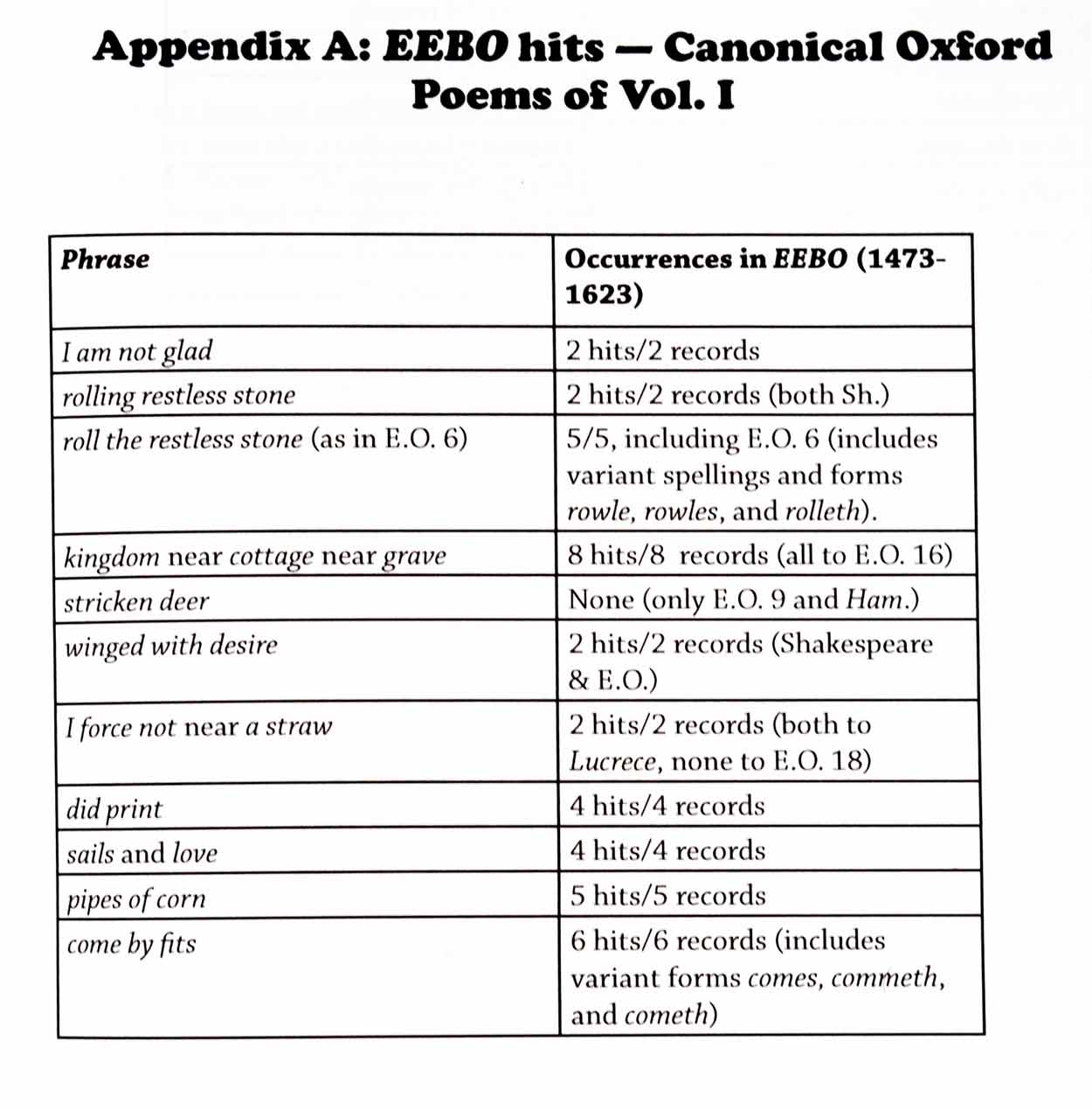
Searching for his markers, his connections between Shakespeare and Oxford, he does not search for patterns among the two author’s unconscious use of function words. He collects phrases with two or three items of identical vocabulary and tries to claim that because of the rarity of that particular combination in EEBO, they identify one author as the other. He is willing to use phrases that look like commonplaces. They are hardly probative if we don’t know which parts if EEBO he uses, and whether the incidences in Oxford’s work are in EEBO or lie outside. He is certain to miscount. His argument is certain to miscarry. He is certain to base his assumptions (and there will be lots) on inaccurate data but that will not prevent him from serving them up as conclusions.
eyes do see
Well, yes, that’s what they do. Unless you’re Shakespeare gifted with adding meaning with transposition: “The eye of man hath not heard, the eare of man hath not seen, mans hand is not able to taste, his tongue to conceiue, nor his heart to report, what my dreame was.
Look at the last entry in the table from Appendix A, ‘comes by fits’. He finds six hits in six records. EEBO V3 is smaller than V1 and V2. The 44,422 clean English texts produce very low levels of rejection and if not exactly like for like, certainly close results for the same searches. Perhaps a few less, usually a few more because we are now looking at the data through a higher resolution lens.
Here’s the EEBO V3 result. Stritmatter includes three variant forms of ‘come’ but misses the variant forms of ‘fit’. My search string caught “comfort by fits” and “commonly by fits” in error. Nevertheless there are 30 instances in the table, and discounting the three false positives and the three which occur between 1623 and 1630 (the search filtered by decades for speed), his count is still out by 18. And there are no hits at all for Oxford.
| Year | Author (Abbr.) | Concordance Line (EEBO V3) | Title (Short) |
|---|---|---|---|
| 1554 | Hilarie, H. | …as it come by fyttes . At your mass… | The resurreccion of the masse… |
| 1576 | Gascoigne, G. | …and fancy comes by fits . The foe in… | The steele glas. A satyre… |
| 1578 | Dodoens, R. | …shyuering coldes that come by fits , like as in… | A nievve herball… |
| 1578 | Dodoens, R. | …such fevers , as come by fits . Of Cheruill… | A nievve herball… |
| 1578 | Cooper, T. | …quartaine coming by fits . Interuello… | Thesaurus linguae Romanae… |
| 1580 | Lyly, J. | …it comes by fits not like a quotidian… | Euphues and his England… |
| 1583 | Viret, P. | …falling sickness , which comes by fits… | The vvorlde possessed with deuils… |
| 1592 | Gyer, N. | …fevers that come by fits . In which… | The English phlebotomy… |
| 1595 | Greenham, R. | …comfort by fits ; yea , almost to have… | A most sweete comfort… |
| 1597 | Langham, W. | …fevers that come by fits . ( See Camomile… | The garden of health… |
| 1597 | Langham, W. | …Matrix , and for fevers that come by fits… | The garden of health… |
| 1597 | Langham, W. | …fevers that come by fits . 56 It is good… | The garden of health… |
| 1597 | Langham, W. | …cold that comes by fits and courses… | The garden of health… |
| 1597 | Greenham, R. | …kind of comfort by fits ; yea almost… | Propositions containing answers… |
| 1598 | Greenham, R. | …means of comfort by fits : yea , almost… | Paramythion: tvvo treatises… |
| 1598 | Florio, J. | …head coming by fits . Hemicrnio… | A vvorlde of wordes… |
| 1599 | Du Laurens, A. | …dotage which commeth by fit , happens… | A discourse of the sight… |
| 1605 | Wirsung, C. | …pain do come by fits , and there abates… | General practise of physicke… |
| 1605 | Wirsung, C. | …cholic comes commonly by fits , ceasing… | General practise of physicke… |
| 1609 | Ammianus M. | …agues , coming by fits , her he put… | The Roman historie… |
| 1612 | Greenham, R. | …means of comfort by fits : yea , almost… | The workes of Richard Greenham… |
| 1612 | Greenham, R. | …means of comfort by fits : yea almost… | The workes of Richard Greenham… |
| 1616 | J. Bullokar | …disease coming by fits , either in the… | An English expositor… |
| 1619 | Guevara, A. | …lust since it comes by fits , and not… | The diall of princes… |
| 1621 | Burton, R. | …but come by fits , fear & sorrow… | Anatomy of melancholy… |
| 1621 | Burton, R. | …Vertigo & giddiness come by fits… | Anatomy of melancholy… |
| 1623 | Shakespeare | …fitness comes by fits : therein I must… | First Folio (1623)… |
| 1625 | Robinson, J. | …which comes by fits only , and when… | Oberuations diuine and morall… |
| 1626 | Taylor, J. | …care that comes by fits ; or on the… | NO_TITLE_LISTED |
| 1627 | Sanderson, R. | …heat come by fits and starts… | Ten sermons preached… |
You cannot tackle attribution issues like this. There is nothing to be learned much less concluded from this scattergun comparison exhibiting little appreciation for sanitary data technique, poor knowledge of the tools, and excessive, biased manipulation of the results.
Nor is this nitpicking. Because it involves metrics, we can use the same data to see where Stritmatter’s proposition moves forward using reason and logic, and where it leaps to conclusions unassisted by support. Every single doubter argument can be deconstructed this way, removing claimed progressions which are actually acts of faith. It is easier to demonstrate where these take place when mathematical proof is attempted. However hard Deniers work to make their claims unfalsifiable, there is never anything left of them after close scrutiny.
And the process has stopped, at least for now. There has been no more Oxfordian ‘frequency analysis’. The new data resources at Lancaster University have a carefully curated digital edition of Shakespeare’s works linked to those of his Bankside colleagues. Each of the 2 million words knows where it was used, who by, and what part of speech it is. CQP allows users to upload corpora. Two Oxfraud colleagues uploaded a tagged corpus of Oxford’s work and a partial Bacon Corpus, also tagged and ready for use. Five years ago. New analysis tools for comparing the two top candidates to Shakespeare and the Bankside Regulars. Both are untouched, save by the authors.
There are certainly no answers in this book. There are no reasoned arguments. No detailed appreciation of what makes a Shakespearean quality. The answer, as I think we knew all along, is that Professor Stritmatter, when he is wearing his Oxfordian lab coat, is unequipped to point out Shakespearean qualities anywhere.
Even in Shakespeare.
The correct results from a search of the whole EEBO database
Here’s a detailed table compiled without the assistance of EEBO V3 as part of Nat Whilk’s original review of the book for the Oxfraud site, shortly after it appeared. Stritmatter refused to say what version of EEBO he used for his searches, but he universally misses all hits and records belonging to EEBO-TCP Phase 2. That global error, at a stroke, invalidates every figure in his tables, but for one. He is correct that “kingdom near cottage near grave” is unique to Oxford2 No one using the resources Whilk and Stritmatter used could gainsay this. It has nothing to do with Shakespeare.
The Earl of Oxford has nothing to do with Shakespeare.
|
|
Phrase |
EEBO (1473-1623) RS published figures |
EEBO (1473-1623) NW var. sp. |
EEBO (1473-1623) NW var. fm. |
Oxford |
Shakespeare |
|
1 |
I am not glad |
|
8/8 |
11/10 |
4/4 (PDD: same line) |
1/1 |
|
2 |
rolling restless stone |
2/2 “(both Sh.)” |
3/3 |
3/3 |
0 |
2/2 |
|
3 |
roll the restless stone |
5/5, “including E.O. 6 (includes variant spellings and forms rowl?e, rowles, and rolleth)” |
5/5 |
8/8 |
3/3 (PDD: same line) |
0 |
|
|
restless NEAR stone |
|
41/39 |
|
|
|
|
|
roll NEAR restless NEAR stone |
|
|
32/32 |
3/3 (PDD: same line) |
2/2 |
|
|
restless stone NEAR Sisyphus |
|
31/31 |
31/31 |
0 |
0 |
|
4 |
kingdom NEAR cottage NEAR grave |
8/8 “(all to E.O. 6)” |
2/1 |
|
1/1 (repeated in musical score) |
0 |
|
|
kingdom NEAR cottage |
|
25/16 |
32/23 |
1/1 (repeated in musical score) |
0 |
|
|
cottage NEAR grave |
|
17/6 |
18/7 |
1/1 (repeated in musical score) |
|
|
|
kingdom NEAR grave |
|
|
[118/92] |
1/1 (repeated in musical score) |
2/2 |
|
5 |
stricken deer |
“None (only E.O.9 and Ham.)” |
33/31 |
|
2/2 (PDD: same line) Phase 2 |
2/2 EEBO; 3/3 (with HQ2) |
|
|
stricken NEAR deer |
|
56/54 |
|
2/2 (PDD: same line) Phase 2 |
4/4 ; 5/5 (with HQ2) |
|
|
stricken hind |
|
6/6 |
|
0 delete this change |
0 |
|
|
stricken hart |
|
2/2 |
|
0 |
0 |
|
|
striken, stricken |
|
45/43 |
|
1/1 |
1/1 “bad” Quarto of Hamlet |
|
|
strooke(n), strucke(n) |
|
11/11 + 8/8 |
|
0 |
4/4 |
|
6 |
winged with desire |
2/2 “(Shakespeare & E.O.)” |
7/6 |
7/6 |
0 hits in EEBO: Manuscript only
|
2/1? 1/1? (1 Henry VI 2.1 is currently ascribed to Marlowe) |
|
|
winged desire |
|
2/2 |
|
0 |
0 |
|
7 |
I force not NEAR a straw |
2/2 “(both to Lucrece, none to E.O. 18)” |
7/3 (1/1 x 5) |
9/5 |
0 for Oxford; 1/1 (x5) for Anon. |
2/2 (both Lucrece) |
|
|
I force not NEAR a pin |
|
|
7/7 |
0 |
0 |
|
|
I force not NEAR a whit |
|
|
4/4 |
0 |
0 |
|
|
I force not NEAR a rush |
|
|
3/3 |
0 |
0 |
|
8 |
did print |
4/4 |
11/11 |
25/23 |
0 hits in EEBO: Manuscript only Print ed. has “did paint” |
1/1 |
|
9 |
sails and love |
4/4 |
Incorrect search |
|
Incorrect search |
Incorrect search |
|
|
sails NEAR love |
|
57/52 (incl. fails) |
|
1/1 |
0/0 This EEBO search does not return “Purple the sailes loue-sick.” The terms are too distant. |
|
10 |
pipes of corn |
5/5 |
6/6 |
7/7 |
0 for Oxford; 1/1 for Churchyard |
2/2 |
|
|
pipes NEAR corn |
|
|
13/13 |
0 for Oxford; 1/1 for Churchyard |
2/2 |
|
11 |
come by fits |
6/6 “(includes variant forms comes, commeth, and cometh)” |
10/6 |
32/27 |
0 hits in EEBO: E.O. wrote “cometh but by fitts” |
1/1 |
|
|
cometh but by fits |
|
1/1 |
7/6 |
1/1 (PDD) |
0 |
|
|
but by fits |
|
41/32 |
|
1/1 (PDD) |
0 |
|
12 |
when wert thou |
9/8 |
10/9 |
22/20 (wast) |
1/1 |
0? 1? (in Titus1.1, ascribed to Peele) |
|
|
when wert thou born |
|
|
5/4 (wast, werte) |
2/2 (same line) Tr. “Quando nascesti” |
0 |
|
13 |
hound NEAR horn |
8/8 |
15/14 |
84/65 |
0 for Oxford; 3/3 for Churchyard |
13/3? (2/2 from Titus 1.1, Peele) |
|
|
hound to horn |
|
3/3 |
3/3 |
0 for Oxford; 3/3 for Churchyard |
0 |
|
|
peascod time |
unique to E.O. & W.S. |
8/8 |
|
0 for Oxford; 3/3 for Churchyard |
2/2 (same line) |
|
14 |
Thousand cupids |
13/8 |
16/11 |
16/11 |
1 |
0 not Shakespeare |
|
15 |
taught NEAR thy tongue |
9/9 |
5/5 |
14/14 (incl. teach) |
1/1 taught |
1/1 teach |
|
16 |
pluck NEAR weed |
11/9 |
19/17 |
|
0 |
1/1 |
|
17 |
pluck NEAR weeds |
35/30 |
61/53 |
|
0 |
0 |
|
|
plucks NEAR weeds |
|
5/5 |
|
1/1 |
0 |
|
|
pluck[s] NEAR weed[s] |
|
87/73 |
137/104 |
1/1 |
1/1 |
|
18 |
quiet breast |
10/10 |
16/16 |
16/16 |
4/4 (PDD: same line) |
1/1 |
|
19 |
I muse why |
12/11 |
18/17 |
20/19 |
1/1 (PDD) |
1/1 |
|
20 |
her soft hand |
12/12 |
13/13 |
15/15 |
0 hits in EEBO: Manuscript only |
1/1 hands |
|
21 |
each passion |
13/12 |
14/13 |
15/14 |
0 hits in EEBO: Manuscript only |
1/1 |
|
22 |
When I am alone |
14/14 |
24/24 |
33/33 |
3/3 (PDD: same line) |
1/1 |
|
23 |
who taught thee |
14/14 |
21/21 |
25/25 |
1/1 |
1/1 |
|
24 |
Thy mortal foe |
16/14 |
27/23 |
33/33 (foes) |
4/4 (PDD: same line) |
1/1 |
|
25 |
blushing NEAR morning |
16/14 |
22/18 |
46/41 |
3/3 blushing |
2/2 a blush |
|
26 |
I am abused |
15/15 |
27/26 |
34/33 |
0 hits in EEBO: Manuscript only
|
3/2 |
|
27 |
these beauties |
19/17 |
27/23 |
29/25 |
3/3 (same line) |
1/1 |
|
28 |
make me die |
30/19 |
64/30 |
83/42 |
3/3 (same line) |
4/4 |
|
29 |
speedy haste |
22/20 |
26/23 |
32/28 |
1/1 |
1/1 |
|
30 |
happy star |
24/20 |
34/30 |
59/47 (stars) |
4/4 (PDD: same line) |
5/5 |
|
31 |
carnation NEAR colour |
30/24 |
77/38 |
106/56 |
1/1 (PDD) |
1/1 |
|
32 |
Thy nurse |
28/25 |
40/36 |
88/84 |
2/2 (same line). |
5/3 |
|
|
who [was] thy nurse |
|
5/5 |
|
2/2 (same line). Tr. “Chi fu la tua nutrice” |
0 |
|
33 |
gentle hearts |
28/27 |
31/30 |
253/166 (heart) |
1/1 Tr. “Il gentil core.” |
11/5 |
|
34 |
eyes do see |
30/27 |
44/40 |
171/140 |
2/2 (PDD: same line) |
3/2 (do + did) |
Notes to Table
2. & 3. rolling restless stone — roll the restless stone
Stritmatter believes that “Both [Oxford and Shakespeare] employ the same description of fortune’s ’rolling restless stone.’“
They do not.
Both make unusual use of that conjunction of words, but in very different ways.
Oxford: “My haplesse happ doeth roule the restlesse stone.”
Shakespeare: “That Godes blinde that stands vpon the rowling restlesse stone.”
Stritmatter finds only Shakespeare’s two uses of “rowling restlesse stone” (strictly just one, appearing in the Quarto and Folio texts of Henry V). Somehow, he’s missed “and Sisyphus with thy rowling restles stone, waile ye no more” (from the much-read Philotimus, 1583), and with a slight infix, “the rolling and restlesse stone of Sisyphus” (1566). Either by design or abject ignorance, he’s managed to keep the appearances of “roll the restless stone” down to 5/5. He really really needs that EEBO tutorial. By mis-designing his search, he’s missed the whole point of the exercise.
Between 1494 and 1623, the phrase “restless stone” appears 37 times in 35 books, and “restless” near “stone,” 41 times in 39 books. Setting aside the reprints, that’s 36 unique instances in 34 books. Thirty-two of them use some variant of “roll,” but that’s not strictly necessary: others tumble or turn. Thirty-one of them name Sisyphus explicitly. The others (save the two by Oxford and Shakespeare) speak of futility, of labour in vain. Even the mention of moss is Sisyphean. As Lyly writes in Euphues (1580): “there wil no mosse sticke to the stone of Sisiphus, no grasse hang on the héeles of Mercurie.”
“Restless stone” or “rolling restless stone” is almost an Homeric epithet for Sisyphus, playing on two meanings of “restless”: the stone is at once constantly in motion (OED 2b.) and yielding no rest (OED 1b.) to Sisyphus. In icongraphic terms, it’s his attribute, his instrument of pagan martyrdom, his emblem. And the equivalence goes on through Dryden, to the very end of EEBO’s texts. The first “restless stone” I found that wasn’t Sisyphus’s rock (it was a slingstone), was in 1657.
Fortune’s icongraphy is quite different. Northampton writes in 1583: “The Paynters alwayes paynte out fortune, eyther standyng on a rowlyng stone, which mooueth and remooueth still, but neuer gathers mosse, or wyth a sayle ouer head, which wayteth and attendeth vppon the chaunge of euery wynd, or sitting in her wheele, whose turnes are swifter then the thoughts of man.”
“Stoode fortune reeling on a rowling stone” (Middleton, 1600).
“Fortune fleeting as the restlesse wind.” (Greene, 1590)
“Fortune blind doeth kepe no state, her stone doth roule, as floodes now flowe, floodes also ebbe” (1563).
“Fortune some say shee hath a restles wheele” (1637).
“Here and there on rolling bal enforceth fortune blinde” (1565).
Neither “Fortune” nor “goddess” ever appears in conjunction with a “restless stone”: only her wind and her wheel are called “restless.” Yes, she stands upon a rolling stone. But it rolls of itself; she does not roll it. The image here is not of restless labour, but of haphazardness.
So what on earth does Oxford mean by “My haplesse happ doeth roule the restlesse stone”? The sense of the poem is that he “loves alofte,” desires an unobtainable woman and hopes to get lucky. “My haplesse happ” would be his personal misfortune, not the goddess. Fortune herself is not hapless, but randomly cruel or beneficent. Nor does she belong to Oxford, or to anyone. Hap is what Fortune deals out, as several poems in PDD point out. There R.D. writes: “To what hard hap, doth Fortune here me binde.” Another poet that year wrote succinctly: “And fortune framde this hap.”
(“Hapless hap,” by the way, was quite the catch phrase, appearing 53 times in 29 books by 1623, 15 in 9 in the twelve years before The paradyse of daynty deuises. Shakespeare never uses it.)
So this isn’t about Fortune in the classical sense: Oxford’s hapless hap is a condition, not a deity. Misfortune may stand upon a rolling stone, but it has no power to roll it, to direct its course. Nor is this an image of Sisyphus: Oxford is frustrated in his desire to make his Phebe, but he isn’t working to win her, toiling hopelessly. He’s whingeing (making “secret mone”) and languishing. What he seems to be rolling are dice:
Yet lucke sometymes dispairyng souls doeth save, A happie starre made Giges joye attaine
So what is ” roule the restlesse stone” doing in this poem? Not much. I think Oxford just heard a well-sounding phrase—he adored alliteration—and stuck it in his poem as an ornament. He does that sometimes in his letters, sometimes garbling the sense or spelling: “I see it is but vayne calcitrare contra li buoi [to kick against the oxen, instead the ox-goad],” “fyre facias.”
As for Shakespeare, consider whose speech this is:
Pistol. Bardolph, a Souldier firme and sound of heart, and of buxome valour, hath by cruell Fate, and giddie
Fortunes furious fickle Wheele, that Goddesse blind, that
stands vpon the rolling restlesse Stone.
Pistol’s speeches are made up of tatters of old bombast in “King Cambyses vein.” And he mangles them fearfully. Think of: “shal pack-horses, and hollow pamperd iades of Asia which cannot goe but thirtie mile a day, compare with Caesars and with Canibals, and troiant Greekes? nay rather damne them with King Cerberus, and let the Welkin roare.”
He’s begun by mangling Marlowe, confused Hannibal with anthropophagi, and melded Greeks with Trojans. Cerberus, of course, is the three-headed dog that guards hell, not its king. It was Pistol’s style to botch his classics: a joke for those in Shakespeare’s audience who’d been to grammar school. So in his speech to Fluellen, the swaggerer has got his emblems all mixed up. Picture Fortune trying to stand on the rock as Sisyphus rolls it.
Shakespeare sets out brilliantly to do for his characters what Oxford does feebly for himself: bungle his allusions. De Vere is more like an invention of Shakespeare’s, more like Pistol or like Peter Quince with his relentlessly alliterative fourteeners—than like Shakespeare himself.
4. kingdom NEAR cottage NEAR grave
Not in Shakespeare, what’s the point?
The invidual pieces aren’t especially rare.
The count of “kingdom NEAR grave” is approximate, as a number of homonyms (“grave counsellor,” “graven in stone”) are returned, and I haven’t the time to weed them out.
Though it’s not in EEBO, do not forget Sidney’s sharp retort in Chetham MS.8012:
An easy choys of three things one to crave, Noe kingdome, nor a cottage, but a grave.
5. stricken deer
Dr. S. is exquisitely careful not “trip up readers” by quoting original texts. For all they know—for all he knows—Oxford and Shakespeare really “are the only two to use” the phrase “stricken deer” in his period 1473-1623. Actually, no one did, not in that exact spelling: which may be why he failed to discover it in EEBO. What actually appears in the first three editions of PDD is “striken Deare”; what is printed in the 1604 Quarto of Hamlet is “strooken Deere,” and in the First Folio, “strucken Deere.” These are not just “variant spelling[s],” as Stritmatter airily says, but represent a genuine paradigm shift in the later 16th century: they belong to the old and new conjugations of the irregular verb “to strike.” Shakespeare’s English belongs to the new paradigm; Oxford’s is hopelessly mid-century. What this unschooled editor’s modernized spelling conceals is a mismatch in their linguistic DNA. Ironically, his attempt to link them through a commonplace common phrase has only pointed up their incompatibility.
“As the stricken deer withdraws himself to die” is proverbial, a common topos of the Renaissance. (The entry in the illustration is from Morris Palmer Tilley’s A dictionary of the proverbs in England in the sixteenth and seventeenth centuries.) It appears in poetry, in natural histories, in sermons, plays, and emblem books. (The one illustrated here is Henry Peacham’s Minerva Britanna.) Has Stritmatter never read As You Like It, with Jacques’ descant on the sobbing deer? Or Hamlet?
Not for their content, no. He insists on stripping Early Modern literature of meaning, and treating it as a field for an anti-scavenger hunt: he who returns with the fewest hits wins. He’s pretty smug about this one: “Indicating the extreme rarity of the phrase’ stricken deer,’ EEBO (1473-1623) returns no hits for it, or for the variant spelling ‘strucken deer.’” (72) And in his tables: “None (only E.O. 9 and Ham.)”
No hits? If you can’t make EEBO return a phrase that’s in front of you, maybe something is wrong with your search. Just saying. Up through 1623, I get 34 hits in 32 titles, 26 in 25 not counting reprints, plus 6/6 for hinds and 2/2 for harts, with 23 post-placed verbs, like Shakespeare’s “how like a Deere, stroken by many Princes.” In short, “stricken deer” is about about as rare as “flat tire.”
It’s such a fine line between unique and ubiquitous.
“Stricken” even has its own special definition: OED II.2. “Of a deer ... : Wounded in the chase.” The first citation under that is from Eneados (1513), Gavin Douglas’s Middle Scots translation of Virgil’s AEneid. He writes of unhappy Dido “Our all the cetie enragit scho heir and thar / Wandris, as ane strikin hynd” (throughout the city, she wanders in a frenzy, like a stricken hind). That’s a pretty close translation of the Latin, where the key phrase is “coniecta cerva sagitta” (a deer stricken with an arrow). After that, a punctured deer was de rigueur in epic: Phaër’s AEneidos has a “striken dere”; Surrey’s Aeneidos has a “strycken Hynde”; Spenser’s Faerie Queene announces its ambition with a “striken hind” and a “stricken Deare.”
So the would-be poet Oxford had plenty to borrow from, in the best Drab Age tradition. His models would have been Surrey (later, Puttenham would quote Surrey with approval), Gascoigne, the 1573 edition of Phaër’s Aeneid.
His stricken deer, however, is from a slightly different parable in the tradition, best described by Robert Greene: “The Deare being strooken, though neuer so déep, féedeth on the hearb Dictamnum [dittany of Crete], and forthwith is healed.” Oxford,s figure is flawed: he compares himself to a deer who can be healed, to a hawk who can be subjugated, to a tower utterly destroyed. He is merely heaping up figures of the self-pitying lover borrowed from other Drab Age poets, without thinking how they fit together. Argument would never be his strongest skill.
Those better acquainted with Shakespeare than Dr. Stritmatter will remember Hamlet’s maliciously exultant chant: “Why, let the strucken Deere go weepe...” He’s either singing a snatch of a popular ballad, or extemporizing one. He’s mocking both poor poor wounded Claudius—for the moment the prince thinks he’s got the bleeper nailed—and the whole pathetic trope. Vernacular ballads, of course, were far more widely circulated than anthologies of courtly poetry, and even more ephemeral. It’s likely that “stricken deer” was spoken or sung far more often than it appeared in print.
Like so many Drab Age poets, Oxford merely bewails his fortune as a stricken deer. Shakespeare being Shakespeare, he interrogates the phrase. It is the slippery rhetorician Antony in Julius Caesar who says, “How like a Deere, stroken by many Princes / Dost thou here lie!” (III.i). Cassius knows that tongue will make trouble at the funeral, and begs Brutus not to let him speak. And Hal’s eulogy—half rueful, half mocking—on Falstaff’s feigned death up-ends the whole topos: “Death hath not strooke so fat a Deere to day.” (That’s 1 Henry IV Q1; F has “strucke”). That, by the way, is the sole recorded use of “hath not strooke” in EEBO, the very first use of “hath not strucke.” Not only the irreverence, but the verb form is new.
Sharper eyes and ears than the professor’s will have noticed that Shakespeare uses “strucken” and “stroken” and “strooke.” Either with intention to deceive, or by simple error, Stritmatter has used the anomalous “stricken deere” from the problematic 1603 Quarto, the one with the startlingly strange soliloquy: “To be or not to be, I there,s the point / To Die, to sleepe, is that all? I all: / No, to sleepe, to dreame, I mary there it goes.” It has dubious textual authority, to say the least. Shakespeare overwhelmingly favored forms of that past participle with back vowels: mostly “strooke” and “strucke,” but “strooken” in Romeo & Juliet and Love’s Labours Lost and Hamlet Q2 (all considered “good quartos,” closest to authorial intent); “strucken” in the First Folio version of Hamlet, in Comedy of Errors, Julius Caesar, and King Lear; “stroken” in Julius Caesar, Coriolanus, and Lucrece. Both the narrative poems are thought to have been carefully printed, under authorial oversight. Besides turning up in the “bad quarto” of Hamlet, “stricken” appears only in the Folio of Richard II (the Quarto has “throwne”), and once in Julius Caesar, which otherwise has “strucken,” “stroken,” “strooke.” That’s few enough instances to have been introduced by typographers or scriveners.
Roger Lass, in The Cambridge History of the English Language, explains the evolution of the verb:
“STRIKE The original pattern, past ‘stroke’ or N ‘strake,’ past pple ‘strick(en)’ remains as a minority type into the nineteenth century, but the old ‘stricken’ becomes an independent adjective quite early, and a new past/past pple type, ‘struck, struck(en)’ appears in the sixteenth century, and takes over.” (169)
So Oxford’s “stricken” represents the old paradigm of the verb. Shakespeare’s preferred paradigm is the nearly modern “strike, strooke, strooke/strooken,” which he (or his copyists and printers) slightly favors over “strucke/strucken.” His is the first recorded use in English (1604, the year of Oxford’s death) of “strooken Deere.” (Inexplicably, the Second Quarto of Hamlet is not in EEBO, but there’s an excellent facsimile at Internet Shakespeare Editions.) It never caught on. After about 1600, “struck” begins to predominate everywhere, except in well-worn phrases like “stricken deer.” In our Late Modern English, “stricken,” like “smitten,” survives as a fossil, used in certain contexts: “The sentence was stricken out”; “She was smitten with her vision of the poet earl”; “He was stricken with a bad case of Sisyphus.”
6. winged with desire
Stritmatter allows Oxford and Shakespeare one use each. Actually, there are two in Shakespeare, though neither may be his own words, since they’re from the first Henriad: “Swift-winged with desire to get a grave” (1 Henry VI) and “that hatefull Duke, Whose haughtie spirit, winged with desire, Will cost my Crowne” (3 Henry VI). Current scholarship assigns that latter speech to Marlowe, and the first to Shakespeare.
Next: Oxford’s “Wing’de with desyre” isn’t in EEBO. That poem was circulated only in manuscript collection. It wasn’t in print. Even with the example of Oxford’s “Wing’de” before him, Stritmatter fails to find the other 5 instances spelled with an apostrophe.
So we have 7/6, with possibly one or two Shakespeares, and no Oxford at all.
7. I force not NEAR a straw
“I force not X a straw.” That means: I don’t care a [bleep] about X. Je m’en fiche. It’s fairly commonplace, with variants on [bleep]: a straw, a pin, a whit, a rush.
The anonymous author of lyrics set by William Byrd (1588) writes “I force not Cressus wealth a straw … I feare not Fortunes fatall law.”
Shakespeare has: “For me, I force not argument a straw, / Since that my case is past the help of law.” That’s from his Lucrece (1594, reprinted 1616).
Both examples here have “straw,” to rhyme with “law.” Both may derive from the 1566 translation of Seneca (reprinted 1581): “That man alone who forceth not the ficle fates a strawe.”
Stritmatter notes only 2 hits in 2 records, “both to Lucrece, none to E.O. 18.” That is, h e entirely misses Byrd’s Psalmes, sonets, which belongs to the EEBO-TCP Phase 2 collection.
He has patched together his E.O. 18 from two different poems. Steven May rejects Oxford’s authorship of the lyrics from which “I force not Cressus wealth a straw” is taken. He writes, “There seems to be no candidate for the authorship of this sequel. No Elizabethan text combines them in whole or part. ... Parts 1 and 2 must be separate poems which were no doubt combined to fill out the sheet when”My mind to me’ was prepared for broadside publication. Just how early this occurred is impossible to say, but there is no evidence for such a merger before the seventeenth century.” I note that in Byrd’s Psalmes, sonets (1588), “I Ioy not in no earthly blisse” appears as song XI. and “My minde to me a kingdome is,” as song XIIII. If anything, Part 2 appears to be a prequel. They are set to quite different tunes, in (as far as I can tell) different time signatures. Byrd evidently didn’t see them as a single poem.
8. did print
And yet again, Stritmatter’s Oxford example isn’t in EEBO. That’s because “did print” appears only in manuscript copies of this poem. The only (and substantially altered) version in print appears as Sonnet LX. in Thomas Watson’s anthology The tears of fancie (1593). It doesn’t turn up in EEBO searches because the text reads “VVho first did paint with coullers pale thy face?”
Given Elizabethan technology, “paint with colors” makes more sense than “print with colours.” Shakespeare’s image is less elementary: he sees conception as a perfect imprint of the sire on the woman’s blank: “Your Mother was most true to Wedlock, Prince, / For she did print your Royall Father off, / Conceiuing you.” For him, “print” is tactile: it impresses, leaves its mark.
printlesse foote
thrust thy necke into a yoke, weare the print of it
like an Agot with your print impressed,
Printing their prowd Hoofes i, th, receiuing Earth:
9. sails and love
Not a correctly stated EEBO search: “sails and love” will return only that exact phrase, which doesn’t exist in the database. Zero hits. Sails AND love will drag up any text that has either word anywhere in it, at no matter what distance. I got an astronomical 135758 hits in 1502 records. The problem is compounded, since EEBO cannot distinguish between “sail” and “fail.”
I searched sails NEAR love and got 57/52 (fails included). What I didn’t get was Shakespeare’s great speech about Cleopatra’s barge at Cydnus, “Purple the Sailes: and so perfumed that / The Windes were Loue-sicke” (A&C 2.2.193-194). Why not? Because “Sailes” and “Loue-sicke” aren’t near by EEBO’s definition. You have to manually reset the nearness default to get that line returned. I wonder if Stritmatter even noticed its absence?
Comparing it with Oxford’s pompous little line “Then loftie Loue, thy sacred sailes aduaunce,” he writes: “Shakespeare is one of only four poets...”
And what four would those be? An actual scholar would tell us, with citations. And how on earth did Strit filter those four out of the vast welter of returns? This sounds like an Oxfordian meme, recirculated by the faithful.
Why not prose?
If Strimatter really wants to investigate, to verify his statement, he can do an advanced search in EEBO, or try LION, which would allow him the distinction into poetry, drama, prose.
Meanwhile, he can ponder such random examples as:
you hoist not vp the loftie saile of selfe-loue, to swell with the winde of vainglory
That traitor Loue, was Pilot to my woe,
My Sailes were hope, spread with my sighs of griefe,
Whose haughtie Loue not for his loue relents,
But hoysing vp her sayle of prowd disdaine,
as loue seemed continually to fill the sayles,
His [Cupid’s] quiuer is his bote, his bow hee makes his ore,
His winges serue for his sayles, and so loue euermore
It is good sayling before the wynd.: Loues happynes is heer by wynd and tydes accord, / Borne...
sayling with the Winde of Loue
Each troubled thought an Oare, each sigh a winde,
VVhose often puffes haue rent my Sayles in twaine.
LOVE steeres the Boat
A gale of hope expels al feare,
And makes the winde to ouerblow:
Twixt feare and hope these Louers saile
for I knowe not how the sweet guiles of loue, and care, doo fill the sailes of my speech,
Not with slow sailes, but with loues goulden winges,
My ship shall be borne with teares, and blowne with sighes
So doth my loue in stormy billowes saile,
By which loue sailes to regions ful of blis,
in the sea of Loue they alone can tell how to saile in faire weather
Could not Tancredres hart to loue-ward moue,
His sailes were filled with another winde,
the Church is the ship, the anker is hope, the sailes are loue,
Sweet Zephirus to winne a wreath
Into loues sailes goodwill did breath.
The returns do need to be weeded (as noted, EEBO cannot distinguish between “sails” and “fails”) but it’s clearly a commonplace in poetry of love to call up images of ships, of sails, of voyages, of seas.
Nevertheless, Stritmatter insists that “Shakespeare is one of only four poets who spontaneously associates sails and love.”
“Spontaneously”? As anyone who’s ever studied Antony and Cleopatra knows, that speech is a brilliant reworking of North’s Plutarch’s Lives. Cleopatra took “her barge →in the riuer of Cydnus, the poope whereof was of gold, the sailes of purple, and the owers of siluer .… she was ... apparelled and attired like the goddesse Venus.”
The sails are real historical sails here, not metaphorical: they were purple and perfumed (“a wonderfull passing sweete sauor of perfumes”). And Venus, of course, is Love. It is Shakespeare’s conceit to have the perfume of the sails infect the very winds, which then would breathe her sweet infection on all who came to look on her.
10. & 13. pipes of corn — hound NEAR horn
This poem is not Oxford’s, according to his scholarly editor, Steven May, but “by Thomas Churchyard, first published in his Churchyard,s Chance of 1580.” There it runs to 124 lines. “Although Churchyard is undoubtedly responsible for the full text of this poem, its unique continuation in Hy after line thirty-two could be Oxford’s.” That is: in one single manuscript, the original poem is cut short, and new material is added, in a different style. “Especially noticeable is the near disappearance ... of the internal rime which is used consistently in Churchyard,s version, an indication that someone other than Churchyard wrote the continuation.”
10. pipes of corn
Pan-pipes are de rigueur in pastoral. Quite possibly, Shakespeare’s and Churchyard’s “pipes of corne” allude to Spenser’s “pypes made of greene corne” in The shepheardes calender (1579); which in turn echoes Chaucer’s “pypes made of grene corne.”
13. hound NEAR horn
Of course, Stritmatter avoids searching Churchyard’s actual phrase, “hound to horn,” because Shakespeare doesn’t use it. Hounds and horns naturally appear in Venus and Adonis, and six times in Titus Andronicus (twice in stage directions, four times in dialogue), doubled in Quarto and Folio. One of those lines is from George Peele’s Act 1.
Stritmatter does not include “peascod time” in this table, but claims that the phrase is unique to”E.O. 21” (as he call this chimaera) and to Shakespeare. This is nonsense. “Peascod time” is vernacular, about as poetic as “mud season” or “spring break.” It just means “when peas are in season,” May and June. EEBO hasn’t input the first edition of Thomas Tusser’s Hundreth good pointes of husbandrie (1557), in which the phrase first appears in print, but the OED cites it: “ere peskod time come.” This is a book for farmers and their wives, rhyming their tasks through the year: haruest time, akorne time, peskod time. All the poetry is in the pleasantness of spring. There are 8 EEBO hits in all: three to Churchayrd, two to Shakespeare, one to a later version of Tusser (1573), one to Anthony Holborne’s setting of the tune for cittern (1597). The last (“being Pese-cod time, I am appeas’d) wasn’t published until 1647, and then as by Beaumont and Fletcher; but recent scholarship has re-assigned it to Middleton and Rowley, and dated it (by its topical allusions) to 1613. It was a popular tune right through the 17th century.
Churchyard’s use of “peascod time” is poetical-pastoral, very much in inverted commas; Shakespeare’s is vernacular and earthy, bittersweetly comic: “Well, fare thee well: I haue knowne thee these twentie nine yeeres, come Pescod-time: but an honester, and truer-hearted man— Well, fare thee well.” Oxford couldn’t write like that to save his soul.
11. come by fits
What Oxford wrote was “cometh but by fitts.” As with “hound to horn,” Stritmatter cunningly tailors his searches to avoid mis-matches with Shakespeare. The playwright never uses “but by fits,” but many others do.
12., 32. & 33. when wert thou — thy nurse — gentle hearts
Stritmatter takes three phrases from one poem, “E.O. 11”: “when wert thou,” “thy nurse,” and “gentle hearts.”
12. when wert thou
There’s nothing here but an auxiliary verb, meaningless on its own: the correct search would be “when wert thou born?” Of course, that clause appears nowhere in Shakespeare, so Stritmatter cuts it short.
Oxford’s poem is one of several contemporary translations from an Italian sonnet by Panfilo Sassi (or Sasso) that was set as a madrigal. Curiously, Sasso’s (or Sassi’s) name appears nowhere in Stritmatter’s book. For any other editor, this would have been a shocking dereliction—for Stritmatter, it’s typical. The original “Quando nascesti amor?” means “When wast thou born, Love?”
The first of these translations in EEBO is Henry Chillester’s from his Youthes witte, or, The vvitte of grene youth choose gentlemen, and mez-dames which of them shall best lyke you (1581). He renders the line: “O Loue, when wast thou borne?”
Oxford’s version, according to Steven May, was “written by December, 1582, for line 14 is quoted in Melbancke,s Philotimus.” It is quoted at greater length by George Puttenham in The arte of English poesie (1589), and appears in full in Brittons bovvre of delights (1591), edited by Nicholas Breton. There are only very slight differences: “When wert thou borne desire?” and “VVHen wert thou born Desire?”
Also in 1582, according to Steven May, “Thomas Watson published his Hekatompathia, a work dedicated to Oxford.” Poem 22 in that work”is an analogue to Oxford’s No. 11 [Stritmatter’s E.O. 11], though both ultimately derive from Panfilo Sassi,s Rime 1.221.” Watson has “WHen werte thou borne sweet Loue?”
The one use in Shakespeare is completely unrelated: “Titus when wer,t thou wont to walke alone, / Dishonoured thus and Challenged of wrongs?” Moreover, it’s from Titus 1.1, from a scene now ascribed to George Peele.
So: not even a complete verb, not even Oxford’s original, but one of three similar translations, nothing like Shakespeare’s usage, and not even Shakespeare’s own line.
That’s going to shift the paradigm all right.
32. Thy nurse
“Thy nurse” is commonplace. This time what Stritmatter didn’t search was “who [was] thy nurse?” That translates the original “Chi fu la tua nutrice?”
The line appears in both Oxford’s and Watson’s versions, and both “when wert thou borne?” and “who thy nurse?” appear in two similar dialog poems from Nicholas Breton’s The vvil of vvit, vvits vvill, or vvils wit, chuse you whether (1597).
Love that title.
33. gentle hearts
“In gentle hearts” exactly translates Sasso’s “In gentil core.”
“Gentle hearts,” and above all, “gentle heart” is yet another well-used phrase: 253/166 for singular and plural. Shakespeare uses both, so both are relevant. The adjective was a notable favorite of his.
I cannot imagine the self-obsessed Oxford writing or appreciating the player-poet’s line “You Ladies, you (whose gentle harts do feare / The smallest monstrous mouse that creepes on floore).”
14. Thousand cupids
“Thousand cupids” appears nowhere in Shakespeare.
15. taught NEAR thy tongue
Just this once, Stritmatter appears to have searched variant forms, in order to match Oxford’s leaden “Who taught thy Tongue the wofull wordes of plaint ?” with Shakespeare’s quick-witted “And if I were thy Nurse, thy tongue to teach / Pardon should be the first word of thy speach.”
16. & 17. pluck NEAR weed — pluck NEAR weeds
Stritmatter has searched “pluck NEAR weed,” and as an afterthought (it appears at the very end of his tables), “pluck NEAR weeds.” I’ve made the two consecutive, for easier comparison. Oxford used neither, exactly, but “He pulles the flowers, the other pluckes but weedes.” That “pluckes but weedes” is unique to him. Shakespeare’s use is “The Caterpillers of the Commonwealth, / Which I haue sworne to weed, and plucke away.” Of course, plucks and weeds are a natural association, and the collocation is frequent.
20. her soft hand
“Her softe hande” appears in May only in Poems Possibly By Oxford, and only in manuscript at that. There are no EEBO hits for this poem. Shakespeare uses only the plural, “her soft hands.”
21. each passion Along with “print with Coloures,” “ech passion” has vanished from the one published version of 15. In print, “With pacient mynd ech passion to endure” has become “VVho made thy mind with patience paines indure?”
25. blushing near morning
Oxford has “The morning blushing red.” Shakespeare has “a blush / Modest as morning.” The one’s a participial phrase, and the other’s a noun. By rights, Stritmatter should have searched variant forms, which would have tripled his results. Dead commonplace.
26. I am abused
Another manuscript-only poem for Oxford. Compare his nasty “I rest revengd of whome I am abusd” with Shakespeare’s witty ““Now my foes tell me plainly, I am an Asse: so that by my foes sir, I profit in the knowledge of my selfe, and by my friends I am abused.”
30. happy star
“Adjectives used to personify stars are common in canonical Shakespeare.” I hope that Strimatter doesn’t envision a happy star running about with little ripples of girlish laughter. “Happy” here means “auspicious,” “fortunate.” Shakespeare uses both “starre” and “starres.” So do many others.
31. carnation near colour
A favourite Elizabethan fashion note. Compare Oxford’s droopy “I mette a knyght, Clad in Carnation Colour fayre” with Shakespeare’s “A could neuer abide Carnation, ’twas a Colour he neuer lik,d.”
34. eyes do see
Well, yes, that’s what they do. Unless you’re Shakespeare: “The eye of man hath not heard, the eare of man hath not seen, mans hand is not able to taste, his tongue to conceiue, nor his heart to report, what my dreame was.”
There’s nothing like that in all of Oxford’s tin-eared, lead-footed, cloth-witted, pompous, obvious, and incoherent writings.
The review that got deleted from Amazon.
Nat Whilk’s review, despite receiving no explanations, disappeared from the book’s Amazon page.
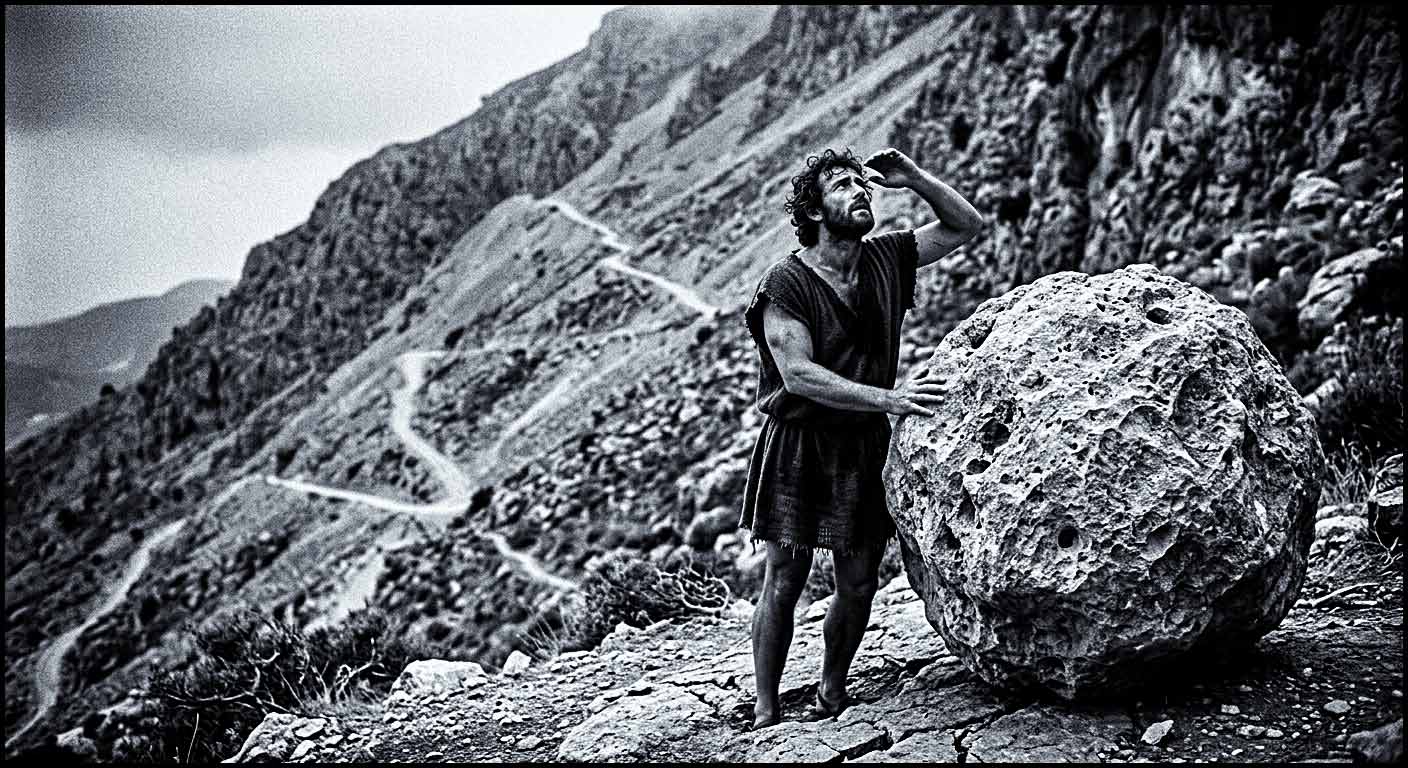
Oh dear. Another futile assault on Shakespeare’s authorship by Dr. Stritmatter, Ph.D. He keeps trying to shift the paradigm–Mount Everest–with spades of wet tissue paper. A self-driven Sisyphus, he’s labored mightily to roll his Big Rock up the hill, to drop it on the Orthodoxy. It’s his dream to squash us flat. He is joined in his futile labours by a crew of fellow cultists—“an hundred Sisiphi at once, rowling so many restlesse stones”—but chiefly here by Gary Goldstein, Robert Prechter, and Bryan Wildenthal. The volume as whole is marked by that peculiar Stritmatterly blend of pomposity, credulity, and arithmetical incompetence.
Dr. Stritmatter has long insisted (against all evidence) that the markings, by a series of unknown hands, in a Geneva Bible once owned by the Earl of Oxford, mirror Shakespeare’s scriptural allusions. Not so. They are almost an anti-match. Whole swathes of Shakespeare’s most alluded-to verses, chapters, even books, go unmarked, while huge tracts of the Apocrypha, which the poet-playwright barely noted, are a thicket of Xs and underlinings.
In this new rock—er, book, Stritmatter’s arithmetic remains shaky, but here at least he’s more or less comparing text to text. He has discovered Early English Books Online, “the definitive online collection of early printed works in English, and works printed in England” from 1473 to 1700. It includes over 132,000 titles, which is virtually everything. What he hasn’t discovered is how to use it. He hasn’t a clue what to look for, or how to structure a search—and that ignorance (as we shall see) proves fatal to his work.
His methods are naive and impressionistic, merely what MacDonald Jackson has called the “uncontrolled accumulation of parallels between a disputed work and an authorial candidate whom the scholar favours.” True stylometric studies go much deeper, into pause patterns and word adjacency networks. By comparison, this stuff is childish dot-to-dottery. For all his pseudo-scholarly posturing, Stritmatter hasn’t a clue how stylometric analysis is done: he appears like a stargazer trying to refute astrophysics, armed only with a cardboard mailing tube for a telescope. It’s no wonder he’s ignored. Nothing daunted, he sets out to show that “there is Salmons in both” Oxford and Shakespeare. And of course, he finds what he’s looking for. He’s assembled a sad little list of banalities that appear both in Shakespeare’s work and in Oxford’s tiny oeuvre (which is plumped out by larceny from other poets), calling these bitlets “unusual common phrases” Unusual and common? “That is, hot ice, and wondrous strange snow.”
And to this reader, very tragicall mirth.
Stritmatter’s conceit of what a ”parallel” might be beggars belief. To take just one: he matches “I have little and seek no more” with Shakespeare’s “Little joy I have / To breathe this news … I speak no more than every one doth know.” That modest ellipsis conceals a cut of eight-and-a-half lines [!] of blank verse. This goes beyond mere wishful thinking into the realm of the delusional.
And as for his statistics—Seriously, what the good doctor needs is a freshman tutorial on using EEBO. He has no idea how it works. I have been through his tables, tested dozens of his figures. All of them are undercounted, some drastically. Some of his results are obvious oversights (or flat-out cheats); others, perplexing.
To begin with, he’s bad at searching. Sometimes he appears to be ignoring variant spellings; nearly always, variant forms. For example, Stritmatter tells us that “EEBO returns only ten hits in ten records (1473-1623) for the search ‘world afford,’” and 34 in 29 records for “world affords.” Hey, what happened to “affordeth”? Did he deliberately ignore it, to suppress the numbers? Or is he absolutely ignorant of Early Modern English verb forms? Counting all variant spellings and grammatical forms of “world afford,” there are 151 instances in 128 books. But wait! What about forms like “will afford”? Or “can scarcely afford”? Since Strimatter counts Shakespeare’s “The spacious world cannot again afford” among his “strongest parallels” with Oxford’s “That world affords,” we must look at “world NEAR afford.” The score leaps to 475/347. I wouldn’t call that rare.
As a rule, his searches are designed to gerrymander, to draw a tight little box around the earl and the playwright, excluding all others. “An EEBO search … (1473-1600) returns only four hits in three sources for the term ‘haggard hawk,’” he crows, proving to himself the rarity and exclusivity of the motif. The actual count is 21 hits in 16 records. He smugly claims that none but Oxford and his alter ego “Shakespeare” ever “associate … the behavior of the ‘haggard hawk’ with human emotions or situations.”
Oh, really? A search for “haggard” on its own, unlimited by “hawk,” from its first appearance in 1566 to 1580, turns up 176 hits in 26 books. Turberville’s 1575 book on falconry accounts for 128 of those. There’s one in a glossary. All the rest— 47 hits in 24 books—refer to human bad behavior. Indeed, the earliest use in English that I found described a human, not a hawk. As noun and adjective, the word caught on at once, and remained a commonplace for “wild, strange; froward, contrarie, crosse” people, especially women: “the haggarde disposition of his mistres”; “the straunge and haggarde nature of loue”; “she is not of haggards kind, Nor hart so hard”; “those which are so coyishe & wilde, or so haggarde like”; “Yee haggards straunge, therefore adiew / Goe seeke some other for thy mate”; “For Haggard like, she will not stoope.” Oxford’s imagery is unexceptional.
But there’s something more than willful blindness going on here. Stritmatter finds only 14/14 hits for “When I am alone.” In fact, there are 24/24 from Chaucer onward, including one each in Oxford and Shakespeare, and one in his precious Geneva Bible. Esther xiv.16, speaking of her crown: “I hate this token of my preeminence, which I beare vpon mine head, … I abhorre it as a menstruous cloth, and that I weare it not when I am alone by my self.” Unmarked, of course: the entire chapter is as virgin snow.
But I digress. Alternate spelling accounts for only one of those ten missing hits. What is happening to his results?
The key to the riddle is found in one ridiculous set of parallels, foregrounded proudly. In a 1602 letter, Oxford uses the Latin proverb “Finis coronat opus” (“The end crowns the work”). I’ll bet his secretary thought of that, and spelled it for him. Stritmatter is thrilled that Shakespeare uses three different versions of that proverb in his work, even though not one of them is Latin. In the Folio version of 2 Henry VI, there’s a typographically mangled version of the French, “La fin Corrone les eumenes [les oeuvres].” The Anglo-French “the fines the Crowne” appears in All’s Well That Ends Well; and “the end crownes all,” in Troilus and Cressida (1609 & 1623). The English and French appear nowhere in Oxford’s poetry or letters; the Latin, nowhere in Shakespeare.
Indeed, until the later 17th century, as far as I can tell, the French proverb appears in print only in Shakespeare (1623) and in G. D. L. M. N.’s The French alphabeth (1592), where it comes with a handy translation: “La fin couronne l’oeuure. The end doth crowne the worke.” That book, whose pseudonymous author is G. Delamothe, was published by Shakespeare’s Stratford contemporary Richard Field, and may have given the playwright that proverb (and perhaps a name in Love’s Labours Lost?).
Shakespeare’s use of “the end crownes all” is the very first recorded in EEBO, though a translator of The Ship of Fooles (1509) simply and succinctly writes “For the ende crowneth.” Shakespeare’s “The fines the Crowne” is unique.
Nonetheless, Strit’s absolutely thrilled by the coincidence.
“By any measure this proverb is rare before 1623. In the Latin version, [only] Henri Estienne (1607), Edmund Bolton (1610), and Gerard Malynes (1622), use ‘finis coronat opus’ before the publication of All’s Well in 1623.” Wait, what? What happened to the anonymous author of A dialogue or speaking together of two personages (1582), William Watson (1602), Otto van Veen (1608), Thomas Milles (1608), Sir Edward Hoby (1615), and Crispijn van de Passe (1615)?
Three out of nine.
You will note that Shakespeare nowhere uses “work.” Nevertheless, it’s “The end crowns the work” that Stritmatter looks for, not the “The end crowns all” “In English,” says Dr. Stritmatter, “only Sébastien Michaelis (1613) and George Hakewell {Hakewill, actually] (1621) are known to do so [include that proverb}.”
What!? I find 27 titles that do so. The first is by Daniel Tossanus (1583): “the end crowneth ye worke.” Among other items, the list includes G. Delamothe’s The French alphabeth (1592), as noted; that terribly obscure play The Spanish tragedie by Thomas Kyd (1592: “The end is crowne of euery worke”); John Bodenham’s, Bel-vedére, or, The Garden of the muses, which is a commonplace book, for heaven’s sake, a list of popular sententiae (1600); George Chapman’s inconspicuous Homer (1611); Constantia Munda, in the gloriously titled The vvorming of a mad dogge: or, A soppe for Cerberus the iaylor of Hell (1617); the great jurist Sir Edward Coke (1618); and Charles Fitz-Geffry (1620): “But the end is the Crowne of the whole work; and the last Act (if any) carrieth away the Applause.”
Oblivious to the end, Stritmatter writes, “Evaluating this evidence honestly requires assessment of prior probabilities.” No. Evaluating this evidence honestly requires the ability to reason and to count.
Three out of nine. Two out of twenty-seven.
What the devil is going on here?
Only part of this grievous deficiency comes down to Stritmatter’s unintelligent search tactics, though a badly stated search will miss variants like “end doth crowne “ and “crowne of euery worke.”
The truly devastating error lies elsewhere, at the very foundations of his research. From the screen shot on p. 11, and by exactly which authors’ names he didn’t find, I could tell that he’s been using an incomplete, perhaps antiquated version of EEBO, EEBO lite. As he should have known—he supposedly studied for his doctorate—EEBO comprises two collections. EEBO-TCP Phase I is freely available to everyone who searches, on any device, from anywhere. It is not tied to any provider. But EEBO-TCP Phase II is “available only to EEBO-TCP partners.” Buried deep in the Help pages is the quiet bombshell: “Your institution may not be subscribed to all EEBO subsets.”
It appears that Coppin State is not.
EEBO-TCP Phase II accounts for three-fifths of all the titles in their database. So Dr. Stritmatter has been merrily searching away, without realizing that his corpus is missing more than half its texts. He’s been calling the winners of an election, in which three-fifths of the ballots have been randomly destroyed. He’s not playing with a full deck.
That noise you hear is the thunk-thunk-thunking of the Big Rock, bounding down and down and down the hill to the very bottom, and into the swamp.
This study is hopelessly, irrevocably, fatally flawed.
The honorable thing would be to withdraw the book, with refunds and apologies.
The rational thing to do would be to stop rolling that stone.
Being Sisyphus, there’s no hope.
Footnotes
Roger Stritmatter, “Poems of Edward de Vere, 17th Earl of Oxford, Volume I: He that Takes the Pain to Pen the Book: Amazon.co.uk: Stritmatter PhD, Roger A., Wildenthal J.D., Bryan H.: 9798392558179: Books,” https://www.amazon.co.uk/Poems-Edward-Vere-17th-Oxford/dp/B0C2SG3ZT2.↩︎
The single instance of this is unattributed by EEBO appearing anonymously in a verse collection. We know that it is the work of Oxford as Sydney satirised it, correcting Oxford’s metre and improving his poetic expression.↩︎