Droeshout
The Coalface of the Authorship Issue
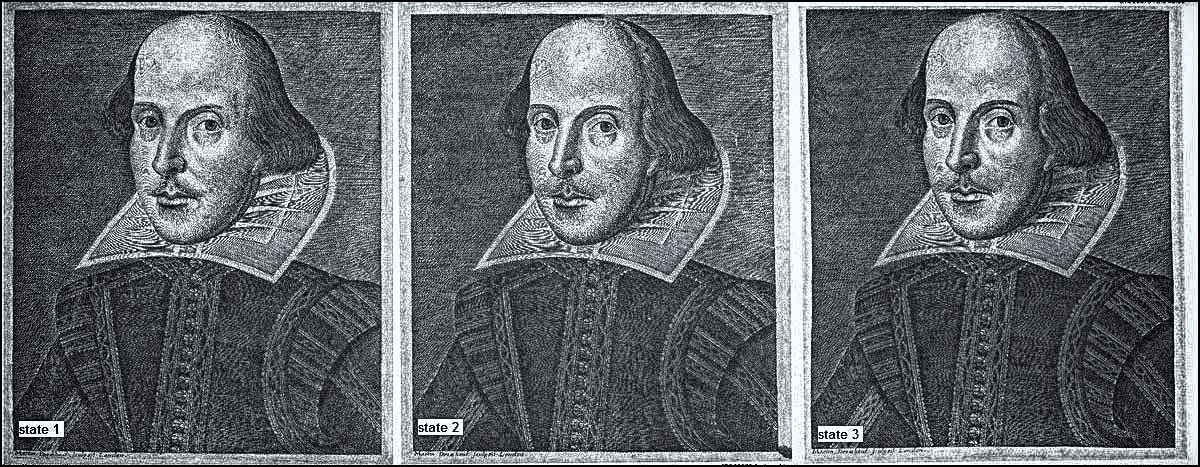
The engraving is the coalface of the authorship issue, the point at which tangible, physical evidence can only be rejected by abstract fantasy. There is nothing suspicious, nothing indicative of alternative authorship or suggestive of misdirection, in truth, not much at all wrong with the engraving of Shakespeare.
Valid hypotheses are based on positive evidence—what is there, what we can see, and what we can measure. Most Doubter hypotheses are openly based on a negative—constructed out of what they imagine should be there but isn’t, missing educational records, the absence of books in a will, lack of correspondence, missing travel receipts, shortages of YouTube1 videos of Shakespeare with a pen looking over his shoulder at Condell asking how many ‘n’s there are in ’incarnadine’.
The Droeshout engraving is positive evidence of a man who existed, worked in Bankside theatre as a playwright. It is authenticates by naming the man depicted as the Folio author, not second hand authority or word of mouth, but by his long term colleagues and fellow sharers in the Company, the men who produced both the compendium of his work, commissioned the engraving, captioned it and described it—three men who worked alongside William Shakespeare for 25 years.
Without tangible counter evidence it stands as insurmountable hurdle to alternative authorship theory. It can’t just be wished away. Counter argument must be counter-factual and while Doubters have sought alternative explanations for this picture’s choice as a frontispiece with almost comic desperation, they have been totally unable to connect any hypothetical explanations with anything resembling tangible evidence. Many of the attempts are not only devoid of tangible support but have no bearing on the issue of authorship.
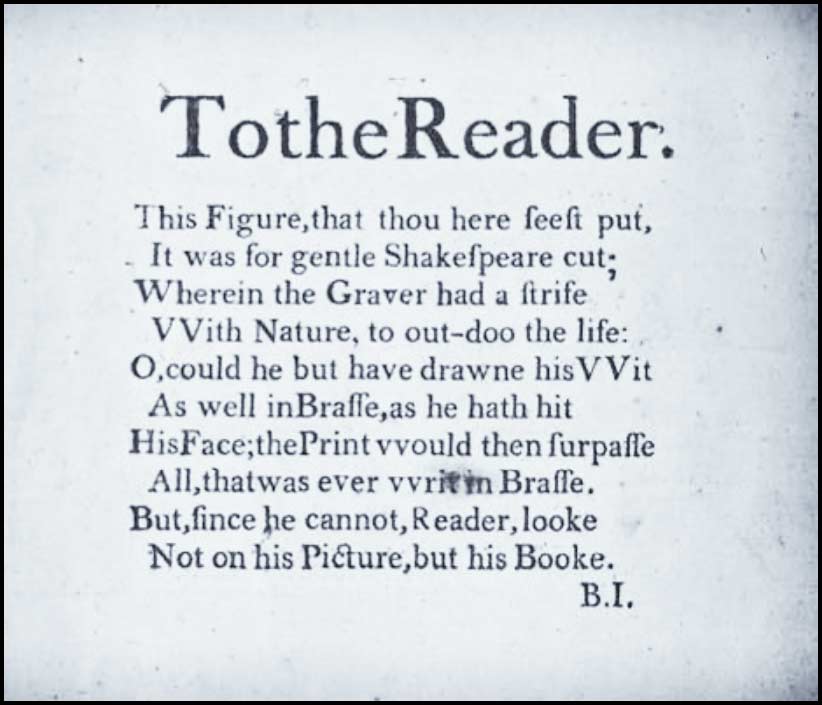
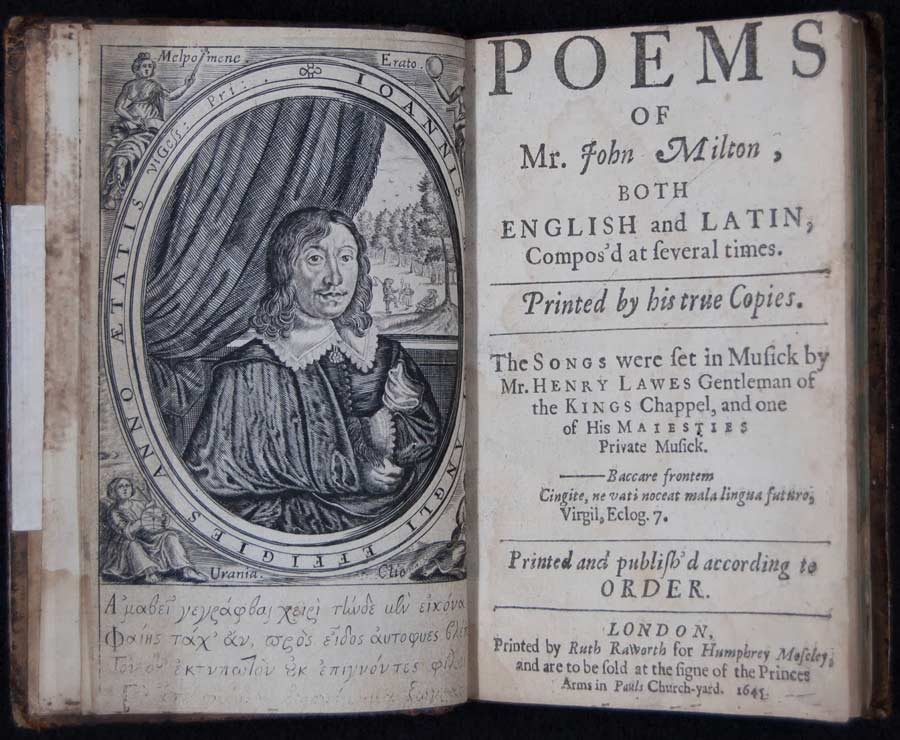
In his extended caption, Jonson is using a clichéd sentiment, common to many eulogies before and since, pointing out that the strength of Shakespeare’s achievement can only be understood by appreciating his work—not from tributes, not from monuments, not from portraits. Advice not heeded by Doubters. Redirect the imagination and Jonson might have been rather pleased with the engraving, produced like that in his own Folio2 on a tight budget. Instead of hidden masks and revealingly irregular seams, look for a young, struggling engraver, doing his best to capture a mirror-image of a famous man in a large portrait, a man who had been dead some seven years. This makes much better sense than the rococo scenarios built by Deniers to infer the uninferrable. Other artists suffered far worse with their frontispieces. Look at Milton below, for example. Many worse examples can be found effortlessly with Google.
Establishing the metrics
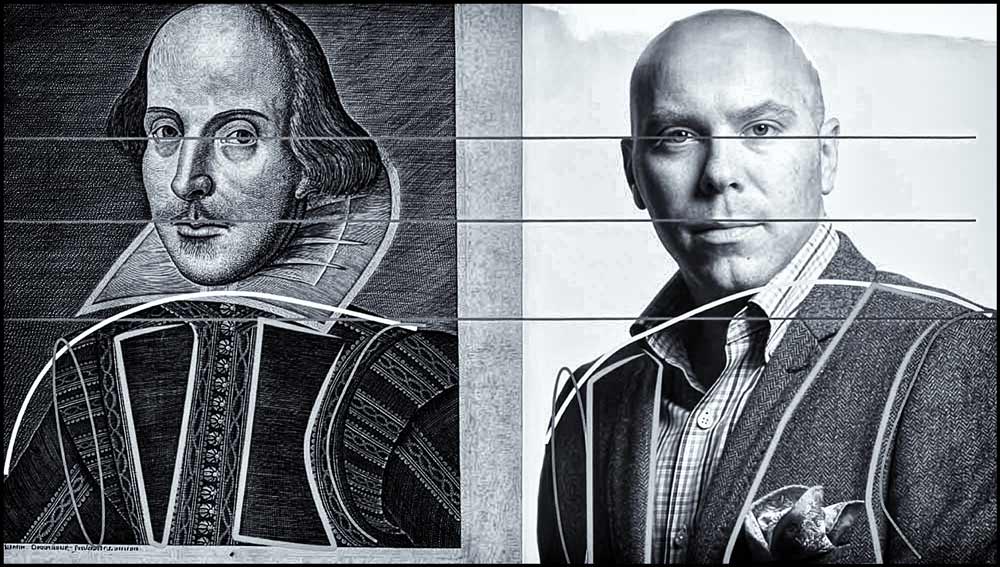
Our first attempt at tackling the Droeshout fantasies was quickly drawn up for the MOOC run by Ros Barber
On our original site we demonstrated the inaccuracy of claims of monstrous proportions with a rather crude comparison which, nevertheless, was good enough to show that Droeshout Junior could draw. Today, however, methods of facial reconstruction once available only to those with vast image processing budgets are now much more modestly priced. Free in some cases.
We decided to use these tools for a deep-dive on Droeshout, measuring and analysing the skull inside the engraved head, modifying the derived dimensions to correct any genuine drawing errors and produce the most accurate AI-generated images of Shakespeare possible using only the refined metrics gathered from the Folio engraving and close up images of the monument. The objective was to produce reconstructed, modern images that Hemmings and Condell might recognise as their friend and colleague.
The AI tools built out a three-dimensional head of Shakespeare then fleshed it out, using forensic-style reconstruction. We tried modernising the appearance and varying his age. With only modest alterations to the skull and by adding the small items of missing facial musculature, there is nothing even slightly unusual, nor much out of proportion nor malformed. They all look like the man in the Droeshout Engraving (or, to a slightly lesser extent, the Monument).
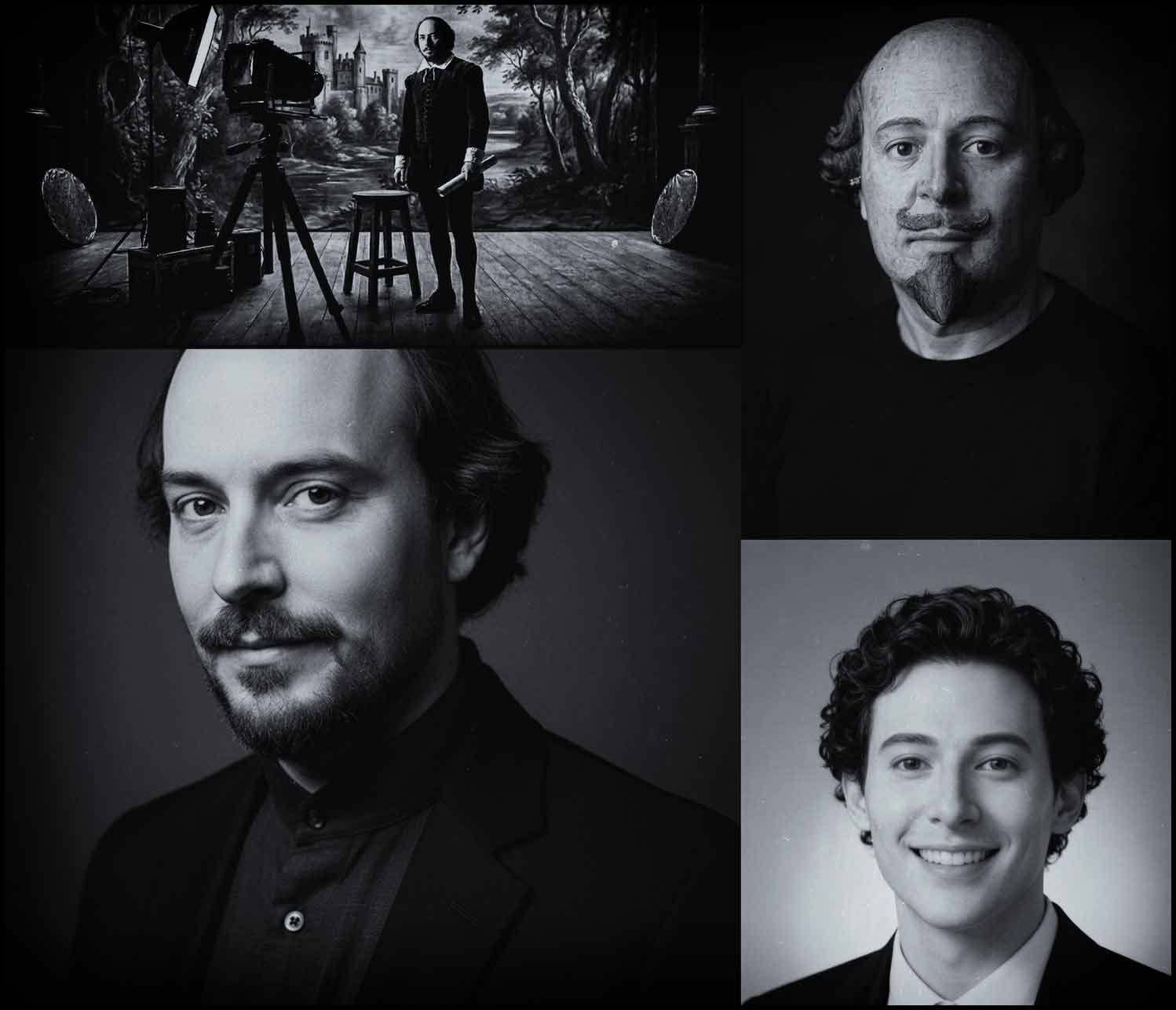
Armed with a formula for a Shakespeare photo session, we decided to shoot our Shakespeare emulating a specific photographer’s style, using specific photographic equipment and a specific film stock3. We dressed our playwright in period costume at different locations in his period travels.
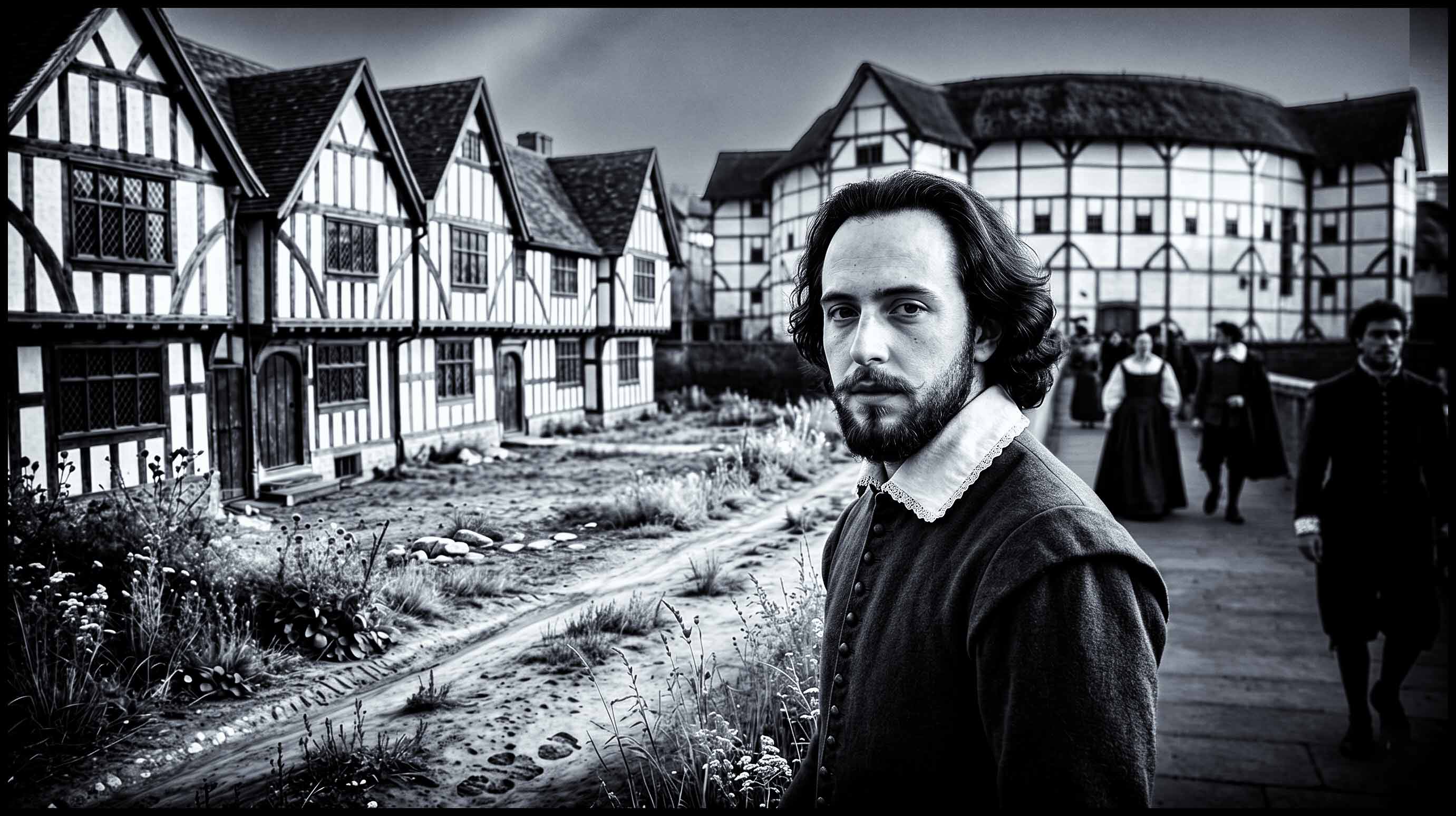
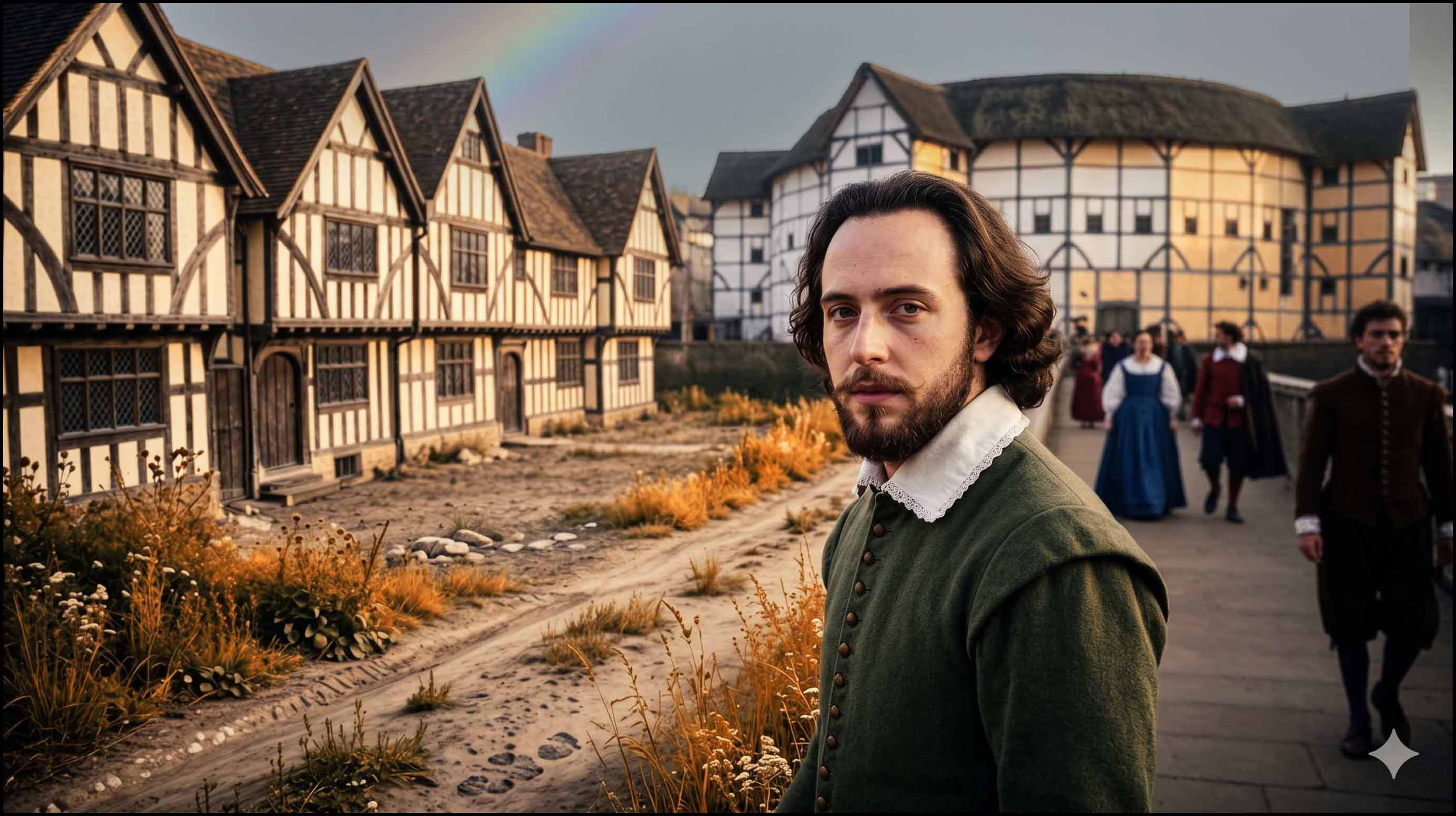
Shakespeare on his way to work. I have left the credit to Google Gemini in just this one. Like real photographer’s work, they have all spent most of their early lives in Photoshop.Their intent is to provide assistance to the imagination in an issue where imagination is so often lacking, with images that have as close a connection with evidence as we can manage. ⌕
The detailed metrical analysis
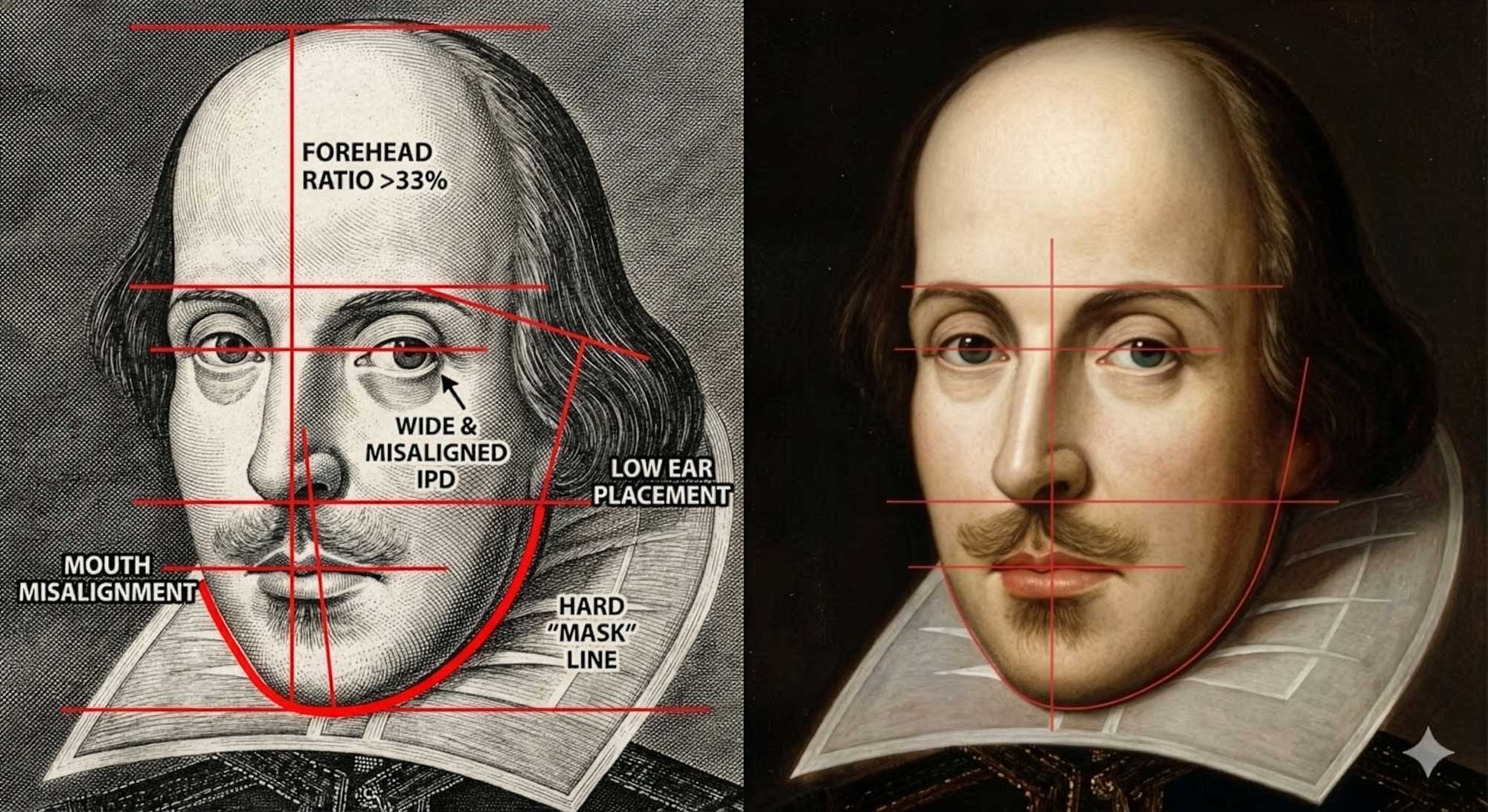
The following detailed observations were taken into account in the recreations. No artist should have to suffer this level of scrutiny but we are dealing with particular need for anthropometric accuracy here.
1. The Vertical “Rule of Thirds” Violation
In a standard human face, the vertical height is divided into three roughly equal sections:
- Trichion to Glabella: Hairline to between the eyebrows.
- Glabella to Subnasale: Eyebrows to the bottom of the nose.
- Subnasale to Menton: Bottom of nose to the bottom of the chin.
The Droeshout Deviation:
Measurement: The forehead section (Trichion to Glabella) is disproportionately large, occupying over 40% of the upper face rather than the standard 33%.
Forensic Note: This is often cited as “hydrocephalic” in earlier criticism. The hairline recedes so far back that it defies the natural curve of the cranium, creating a frontal bone that resembles a plate rather than a curved skull.
2. The Inter-Pupillary Distance (IPD) vs. Head Width
Biometric scanners often use the distance between the pupils (IPD) as a fixed anchor scale to measure other features.
The Droeshout Deviation:
Measurement: If you scale a human face so the head widths match, the Droeshout’s eyes are set abnormally wide apart.
The “Wandering” Eye: The right eye (viewer’s left) is physically larger and set on a slightly different horizontal plane than the left eye. A horizontal line drawn through the center of the left pupil will often bisect the upper eyelid of the right eye, rather than the pupil.
3. The Ear-to-Eyebrow Alignment
In standard anthropometry, the top of the ear (the superior helix) typically aligns with the height of the eyebrow or the upper eyelid.
The Droeshout Deviation:
Measurement: The visible ear is significantly lower than the brow line.
Similarity Anomaly: This “low ear” placement is sometimes used in arguments to match the engraving to specific candidates (like the Earl of Oxford), but biologically, it implies a distortion of the jawline or neck insertion point.
4. The “Mask” Line (The Mandibular Curve)
This is the most critical metrical area for the “Mask” theory.
The Droeshout Deviation:
Landmark: Trace the jawline from the ear down to the chin.
Measurement: On a human face, the jawline (mandible) connects to the neck muscle (sternocleidomastoid) behind the ear.
The Hard Line: On the Droeshout, there is a distinct, hard line that runs from the ear lobe down to the chin without connecting to the neck muscles naturally.
Metric Comparison: If you measure the distance from the corner of the mouth (Cheilion) to the edge of the jaw, the Droeshout’s distance is wider and flatter than average, lacking the curvature of the buccinator muscle (cheek) that wraps around real teeth.
What we had to fix
Forensic Calibration: From Mask to Man
Mandibular Alignment: In the original engraving, the jaw hinge is structurally detached. In our photographer’s reconstruction, we have restored the Temporomandibular joint to its biological position, aligning the jawline with actual skeletal structure.
Ocular Depth: The Droeshout eyes are “pasted” onto a plane that is too flat. Our polish restores the Supraorbital ridge, giving the gaze the three-dimensional weight seen in the Holy Trinity monument.
Cranial Normalization: We have reduced the “High-Brow” vault—a clear artifact of the engraver’s plate-stitching—to a standard human cranial ratio. This removes the “alien” quality that deniers use as a clue and replaces it with the likeness of a 40-year-old man.
Lighting Coherence: We have unified the shadow vectors. Instead of the mismatched light sources found in the First Folio, the photographs uses a single, flooded, high-contrast source, proving that the features belong to a single face, not a composite mask.
Conclusion
“O, could he but have drawn his wit
As well in brass, as he has hit
His face…”** — Ben Jonson, 1623
If Jonson intended to signal a “fake,” or steer attention away from Shakespeare, he chose a disastrous way to do it. He explicitly praises the likeness (“hit his face”). To argue this is irony, sarcasm or deliberate misdirection requires ignoring the plain meaning of the text in favour of a conspiracy that no one noticed for 250 years. We could have taken 20 random engravings from books of the period (we didn’t) and found similar “errors” in all of them. A waste. The Droeshout is not an outlier, it is a typical engraving of the period, with typical errors—better than Milton’s, not so good as Jonson’s. It is not a puzzle, it is not a caricature, it is not a mask. It is a portrait of Shakespeare, the canon author known to the colleagues who commissioned it, the actors who performed his plays and the audience who paid to see them.
The Art of Deception using answers to Unasked Questions
In her MOOC, purporting to promote critical thinking on Authorship issues, Ros Barber had her learners looking for hidden clues in the stitching on the 400-year-old engraving and wondering (aloud of course) if the doublet was drawn with two left sleeves to indicate a double meaning. Barber fills three videos with attempts to prove the engraving is covertly revealing a complex, visually encoded message to those who will have the power to understand in future generations. “So why didn’t the publishers of this expensive 900-page Folio volume—a book it would cost two-thirds of a school-teacher’s monthly salary to buy—reject this crude and bizarre portrait as a suitable adornment for their publication?” demands Barber,4 leading the inquest.
The answer–100% unhelpful to her own Marlovian cause–is 100% obvious.
The answer is because it is neither crude nor bizarre. Appearing to be curious in this disingenuous way is a key technique in circumnavigating conclusive counter evidence.
Footnotes
Deniers standards of evidence are entirely their own. This is the unspoken standard of acceptability as each new demonstration is rejected, however much certainty contemporary evidence provides. Casting doubt on documentary evidence purely based on its inconvenience to one’s own arguments is “as destructive as forgery” Alan H Nelson (Alan H. Nelson, Monstrous adversary: The life of Edward de Vere, 17th Earl of Oxford, (Liverpool University Press: Liverpool, 2003)).↩︎
1573?-1637. Jonson Ben, The workes of Beniamin Ionson, (London :: Printed by W: Stansby, and are to be sould by Rich: Meighen, 1616).↩︎
60s and 70s portrait photographers using, an 35mm Olympus OM1, Ilford F-Pan with a 90mm portrait lens.↩︎
The MOOC remains online, a monument to narrative synthesis in conspiracy theory, though Barber is no longer at Goldsmiths College London. If you visit, be prepared to dig deep in the forums for any relevant discussion which has all been moderated out of sight. https://www.coursera.org/learn/shakespeare/home/module/1↩︎