Oxford’s Sonnets
An invitation to read the lines themselves, rather than the space between them
Can De Vere, for whom we have a small body of undisputed work, write like Shakespeare? It should be palpable in his poetic work, even early work. In Shakespeare Identified1 Looney’s discovery of The Earl as a candidate relied on what he claimed was the hitherto unconsidered similarity between Oxford’s work and Shakespeare’s. The Oxford Fellowship, as of 2018, regards their similarities as “powerful evidence”. Here are six sonnets, one from Shakespeare, Oxford’s only sonnet and four others from The Oxford Book of Sixteenth Century Verse.
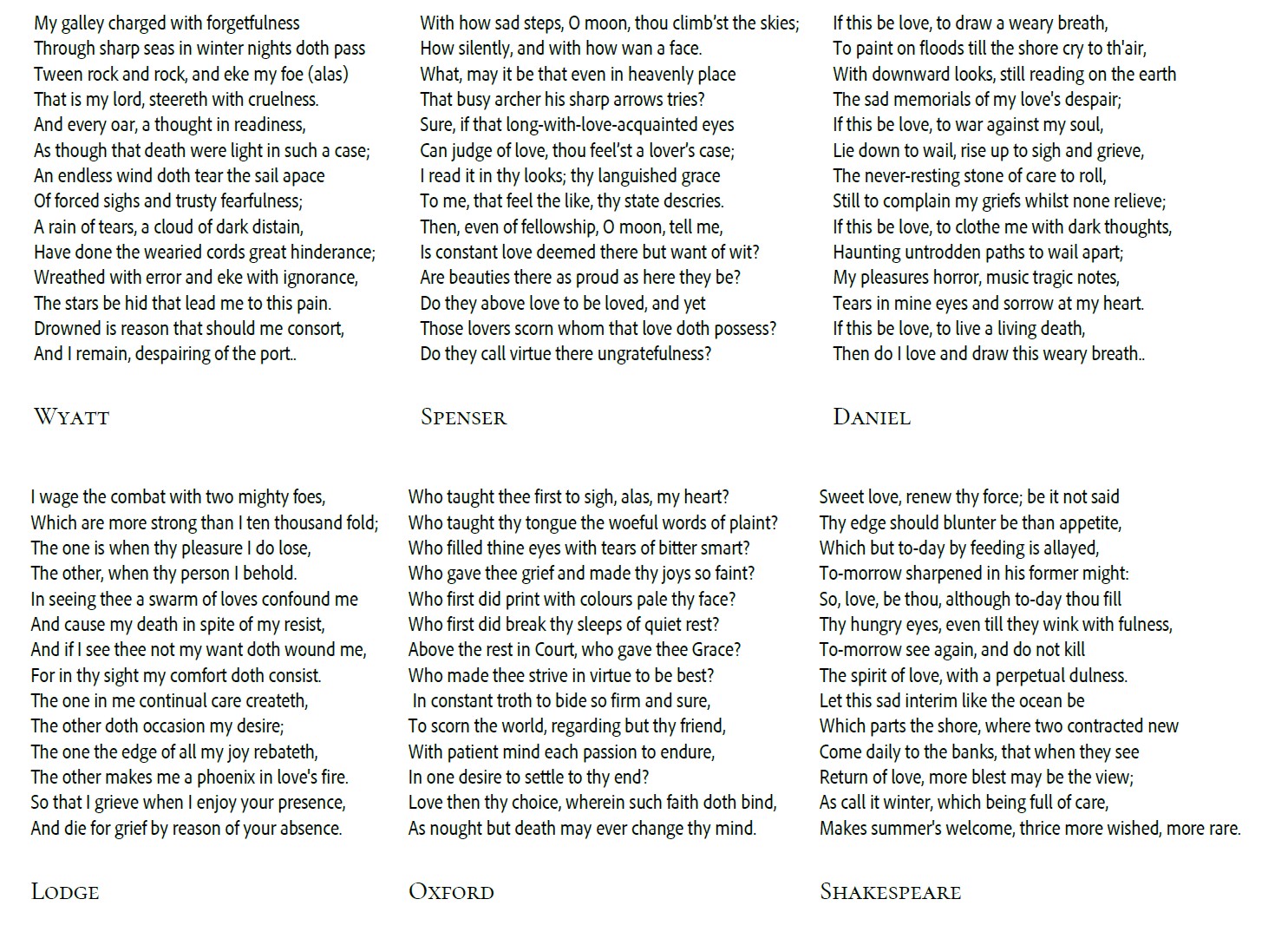
Can Oxford write like Shakespeare? Does his sonnet take an obvious second place? Sonnet 56 isn’t one of the most popular from Shakespeare’s collection, choose another if you prefer, nor would many claim that any of the others qualify as their author’s best work. So this is a relatively simple question. Which, if any or even all, of these six works sound like Shakespeare? If two of them, rather than one, are written by Shakespeare, we are surely entitled to hear the compelling connections that suggest shared authorship, not hear the lack of them artificially dismissed by claims of age difference. We do not know the relative ages of the authors. Can Oxford write like Shakespeare? Is his sonnet obviously the closest in thought, progression, quality, verbal dexterity, metrical variety and precision, figurative language?
Are alliteration and assonance used subtly or obviously? The sonnet is a tight verse form. Do the lines scan easily through polysyllables or march in monosyllabic step? Is there enjambment? Basic practical criticism should make at least some connections. Five of the sonnets, for example, feature enjambment and one does not. One of them features a lot of alliteration and assonance, one features none. One of them features a lot of polysyllables, one features none. One of them features a lot of figurative language, one features none. Oxford could write a sonnet but since you can count his entire output on the fingers of one hand (that doesn’t have all its fingers), he can hardly be called a sonneteer. He has no performed plays to his name so it hardly makes sense to advance his cause as the greatest playwright of all time. If he can write like Shakespeare, why, in his published work, did he not?
Since none of the other writers have ever been suspected as potential authors of anything Shakespearean, the differences should be clear. So should the similarities. This is a test an aspirant candidate should pass without difficulty. Oxfordians offer this sonnet and some 20 other short poems as the germ of Shakespearean genius. Can the claim be dismissed on the evidence of six randomly chosen sonnets from different authors?
Practical criticism
Practical criticism is criticism that is practical. The objective is to “encourage students to concentrate on ‘the words on the page’, rather than relying on preconceived or received beliefs about a text”. The antithesis of trying to extract authorship information by reading between the lines. Late 18c and early 19c students of Shakespeare like Johnson, Pope and later Keats and Shelley believed that the mechanics of the English language could be studied, like the mechanics of a clock. The mainspring of the English language, what drove it, were verbs foremost followed by their descriptive sidekicks, adverbs.
The hare limped trembling through the frozen grass 2
The line between Marlowe and Shakespeare may be wavy, Shakespeare uses many more adjectives, but they are on the same side with very similar usage patterns when it comes to verbs and adverbs. In the engine room of the English language, De Vere uses 80% fewer verbs than Shakespeare and his work is 43% heavier with nouns. These are not small differences. EEBO can show far greater disparities between the two authors with a little more work but looking at the wood, rather than twiglets on one of the trees, there are differences that have ot be explained.
Students trained in practical criticism have been known to become impatient with Oxfordians. When using the comparative methods of practical criticism, a discipline that most able readers can acquire online, they are quick to perceive the gulf between Oxford’s poetry and the verse of Bankside professionals. It cannot be explained in any way at all. De Vere’s work is not juvenilia. Great poets do not publish childish work in their 20s. They do not repeat mediocre or commonplace expressions.
And yet I languish in great thirst
while others drink the wine.
Thus like a woeful wight wove my web of woe;
The more I would weed out my cares,
the more they seem to grow.
Care and Disappointment E. Ox.
Drown me you trickling tears,
you wailful wights of woe;
Come help these hands to rent my hairs,
my rueful haps to show;
The Forsaken Man, Edward De Vere
There’s not really a great deal to be gained discussing Oxford’s poetry. But what else are we here for? The first sample reads like a challenge for starting words with the letter ‘w’, nine examples in three lines. Any schoolchild would be expected to be able to spot this isn’t Shakespeare. It isn’t Oxford’s best work, he’s capable of better but he can’t aspire to being Shakespeare or even Wyatt. Most, if not all the people he hired into his service, Munday, Lyly, Churchyard, can write better than this.
Fram’d in the front of forlorn hope past all recovery,
I stayless stand, to abide the shock of shame and infamy.
My life, through ling’ring long, is lodg’d in lair of loathsome ways;
My death delay’d to keep from life the harm of hapless days.
My sprites, my heart, my wit and force, in deep distress are drown’d;
The only loss of my good name is of these griefs the ground.
And since my mind, my wit, my head, my voice and tongue are weak,
To utter, move, devise, conceive, sound forth, declare and speak,
Such piercing plaints as answer might, or would my woeful case,
Help crave I must, and crave I will, with tears upon my face,
Of all that may in heaven or hell, in earth or air be found,
To wail with me this loss of mine, as of these griefs the ground.
Help ye that are aye wont to wail, ye howling hounds of hell;
Help man, help beasts, help birds and worms, that on the earth do toil;
Help fish, help fowl, that flock and feed upon the salt sea soil,
Help echo that in air doth flee, shrill voices to resound,
To wail with me this loss of mine, as of these griefs the ground.
E. Ox 1550 - 1604
They flee from me that sometime did me seek
With naked foot, stalking in my chamber.
I have seen them gentle, tame, and meek,
That now are wild and do not remember
That sometime they put themself in danger
To take bread at my hand; and now they range,
Busily seeking with a continual change.
Thanked be fortune it hath been otherwise
Twenty times better; but once in special,
In thin array after a pleasant guise,
When her loose gown from her shoulders did fall,
And she me caught in her arms long and small;
Therewithall sweetly did me kiss
And softly said, “Dear heart, how like you this?”
It was no dream: I lay broad waking.
But all is turned thorough my gentleness
Into a strange fashion of forsaking;
And I have leave to go of her goodness,
And she also, to use newfangleness.
But since that I so kindly am served
I would fain know what she hath deserved.
Sir Thomas Wyatt 1503 - 1542
If you didn’t follow the link to Richards, this is the first poem on the course. Wyatt isn’t a contemporary of De Vere but despite dying two years before De Vere was born his work sounds later, more agile in its verse, more varied in its metre, his grief more personal, more individually expressed.
It should by now seem obvious that De Vere is not capable of filling Shakespeare’s shoes. In addition ot the sycophantic admirers of whom Oxfordians make so much, he had critics among his peers at the time he was writing. Here once again we have two poets side by side.
Oxford and Sir Philip did not get on. They were on opposite sides of the marriage dispute in the 1570s, Oxford favouring a French marriage, Sydney against.
In August 1579, when Oxford was 29, they famously quarrelled in a tennis court and Sydney tried to finesse Oxford into challenging him to a duel that the Queen subsequently prevented by direct intervention.
Sydney seems to have responded in kind by taking a headmasterly eye to Oxford’s poetry and writing a very cynical response to Oxford’s poem, ‘Were I a king’. It is not a lampoon or the satire of a rival. He corrects Oxford’s metre, readjusts both the selfish sentiments and reforms the wayward logic of the original:
Were I a king I might command content;
Were I obscure unknown would be my cares,
And were I dead no thoughts should me torment,
Nor words, nor wrongs, nor love, nor hate, nor fears;
A doubtful choice of these things which to crave,
A kingdom or a cottage or a grave.
Wert thou a King yet not command content,
Since empire none thy mind could yet suffice,
Wert thou obscure still cares would thee torment;
But wert thou dead, all care and sorrow dies;
An easy choice of these things which to crave,
No kingdom nor a cottage but a grave.
Sydney’s answer, dating from 1579 even have had something to do with the duel. The better poet applies a little more thought to the issue.
The repetition at the beginning of Oxford’s first two lines is done for effect this time, rather than the sort of careless repetition we see elsewhere in his verse. The effect is rather unappealing, however, so Sydney does not echo it.
The second line of Sidney’s reply uses a grammatical compression that is nowhere evident in Oxford’s work. ‘Since empire none’ contains no verb. It is a compression of ‘Since I would have no empire’ and sits in apposition to the remaining half of the line despite preceding it. Using the same technique, Sydney could have eliminated the words ‘Were’t thou’ and ‘But were’t thou’ in the third and fourth lines but there is so little matter in Oxford’s six lines that any more compression would defeat the object of the exercise by making the riposte unrecognisable.
Sydney’s tone is that of a disappointed teacher correcting an unpromising pupil’s homework and the change in sentiment is a direct rebuke of the arrogant, self-obsession shown in the original.
‘Were I a King’ can hardly be ascribed to Oxford’s juvenilia. Sydney would not have picked on Oxford’s schoolwork to ridicule him. This is Oxford, after his fall from grace, bemoaning his lack of respect and the unwelcome publicity his misdeeds attract. Lack of respect is one of the Earl’s regular themes but is found nowhere in Will’s work.
Though the second poem here is significantly better than the first, neither work is of sufficient quality to appear on even the outer fringes of the Shakespearean radar screen. Sydney is the more accomplished writer, but neither of these men are in Shakespeare’s League.