What is a Prima Facie Case?
Detailed account of how the case works
Attributing Authorship
According to Harold Love in his book Attributing Authorship,1
The most common reason for believing that a particular author wrote a particular work is that someone presumed to have first-hand knowledge tells us so. This telling usually takes the form of an ascription on a title-page or in an incipit, explicit or colophon, or in the item, title or contents-list of an anthologised piece. It may be supported by legal and book-trade records. There may be direct corroborating evidence in correspondence and personal recollections of the period of composition, such as Coleridge’s famous story of the composition of ‘Kubla Khan’ being interrupted by a person from Porlock (the point is not whether the incident ever happened but that it constitutes a claim by Coleridge to the authorship of the poem). If we can confirm a title-page ascription from other evidence, we have satisfied the first requirement of attribution studies; however, we must be careful that the name is attached to the right bearer of it.
A case for William Shakespeare of Stratford’s authorship does not rely on a series of ambiguous interpretations. It relies instead on solid documentary evidence.
There’s really no question about whether the author was known as “William Shakespeare.” Everyone acknowledges that that was the name on the title pages and other documents, though the spelling of the name varied widely. The question raised by doubters is whether that name refers to the true author, given that his personal background is largely undocumented. Many of them make the logical error of confusing the lack of documentation– for instance, of his education at the Stratford grammar school – for positive evidence that he did not attend the school.
So how do we know that the William Shakespeare identified on title pages is the same as the William Shakespeare who was named as a player in the King’s Men, and the buyer of the Blackfriars Gatehouse property? It’s established by a prima facie case, based on other evidence that “someone presumed to have first-hand knowledge,” in this case, John Heminges and Henry Condell, tells us so, and having additional evidence that unambiguously demonstrates that Heminges and Condell could only have been referring to William Shakespeare of Stratford.
Prima Facie
This is precisely the type of evidence Harold Love identifies as foundational in attribution studies: contemporary ascriptions, supported by records and personal testimony. The Shakespeare case fits this model unusually well.
This is called a prima facie case (PFC). An AI-derived definition of that term is as follows:
A prima facie case in history is an initial, evidence-based argument that makes a hypothesis plausible pending critical scrutiny and rebuttal.
A prima facie case is not absolute proof. Like other logical propositions, absolute proof is a standard that really can’t be achieved outside of mathematics, and certainly not in matters of human history. But a historical event can be established to a standard where it is considered a fact for purposes of further research. By providing a logically consistent prima facie case based on primary source evidence, we meet the burden of proof for an historical fact. The case can be defeated, but only by similar primary source evidence. It is sufficient documentary evidence that historians treat the identification as established unless compelling counter-evidence appears. Merely throwing out a far-fetched scenario without any evidence doesn’t refute the PFC.
Going back to Harold Love, we have to take heed of his final sentence: we must be careful that the name is attached to the right bearer of it. How do we establish not only that Heminges and Condell identified the author as “Shakespeare,” which authorship doubters would claim could be a pen-name or allonym, but Shakespeare of Stratford? That’s what completes the PFC. Primary sources demonstrate that the description of Shakespeare as their “friend and fellow” uniquely identifies Shakespeare of Stratford as the author.
Sharer in the Lord Chamberlain’s Men/King’s Men. Numerous primary sources identify Shakespeare as a sharer in the playing company established in 1594 as the Lord Chamberlain’s Men, e.g.:
the account of March 15, 1595, paying Burbage, Shakespeare and Kemp for two plays performed at court during the previous Yuletide.
Listed as one of the King’s Men company in letters patent issued under privy seal. Shakespeare is listed as one of nine named members of the company (followed by a catch-all for “the rest of their associates”)
Shakespeare identified as a “fellow.”
The first definition of the term “Fellow” in the Oxford English Dictionary is “One who shares with another in a possession, official dignity, or in the performance of any work; a partner, colleague, co-worker.” The term was used with this meaning in Shakespeare’s time.
Named as a “fellow” of King’s Men sharer Augustine Phillips in his will. This is direct evidence that the members of the company referred to each other as “fellows.”
Shakespeare leaves a similar bequest to his “fellows” John Heminge, Richard Burbage, and Henry Condell. This further strengthens the evidence that “fellow” was a term used by the men named in the letters patent as members of the company for each other. It identified these men as the particular Heminge, Burbage and Condell who the will intends to receive the bequest.
Heminges named as a trustee in Shakespeare’s purchase of the Blackfriars Gatehouse. John Heminges’ role in the purchase of the Gatehouse property, and its subsequent transfer back to the benefit of William Shakespeare’s daughter and son-in-law, Susanna and John Hall, clearly shows that their bond of trust and friendship extended beyond being business partners and players in an acting company for almost two decades. They were friends and fellows.
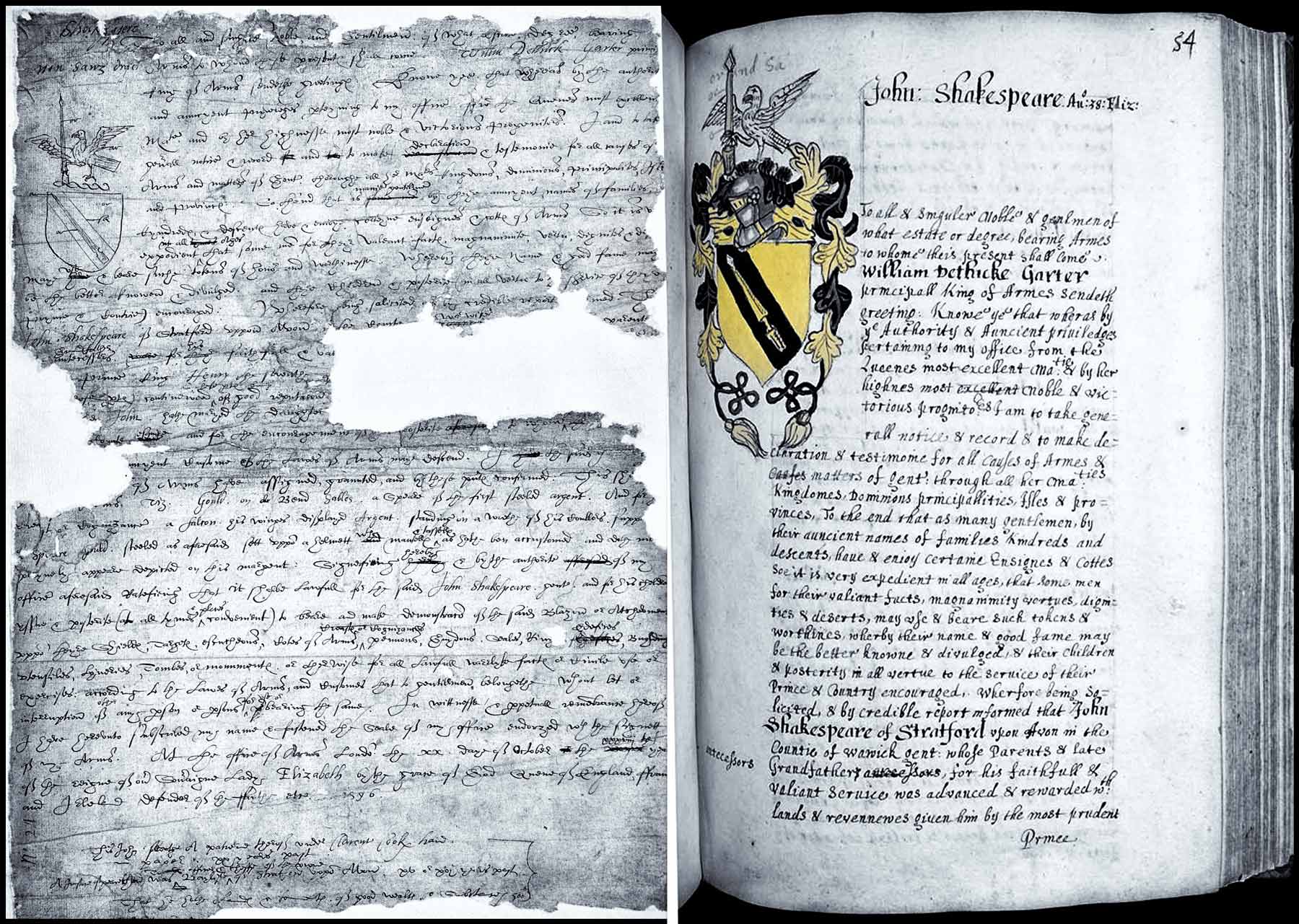
The author begins to be identified as a gentleman after William Shakespeare obtains a family coat of arms.
Shakespeare the author was identified as “M” or “master” in a number of title pages, including the 1608 title page of the first edition of King Lear. At the time there was no other person named Shakespeare entitled to be identified as a gentleman. The title page of the First Folio also names the author as a gentleman.
Shakespeare’s coat of arms was contested (unsuccessfully) by the York Herald. In a note of the controversy, the bearer is identified as “Shakespeare the player.”
This chain of evidence, taken together shows:
The author called “Shakespeare”
is the man called a “fellow” by Heminges and Condell
who is the same “fellow” named in company wills
who is the same man listed in company legal records
who is the same man in private legal dealings with Heminges
who is the same man identified as a player and gentleman in heraldic documents.2