Shakespeare’s Handwriting
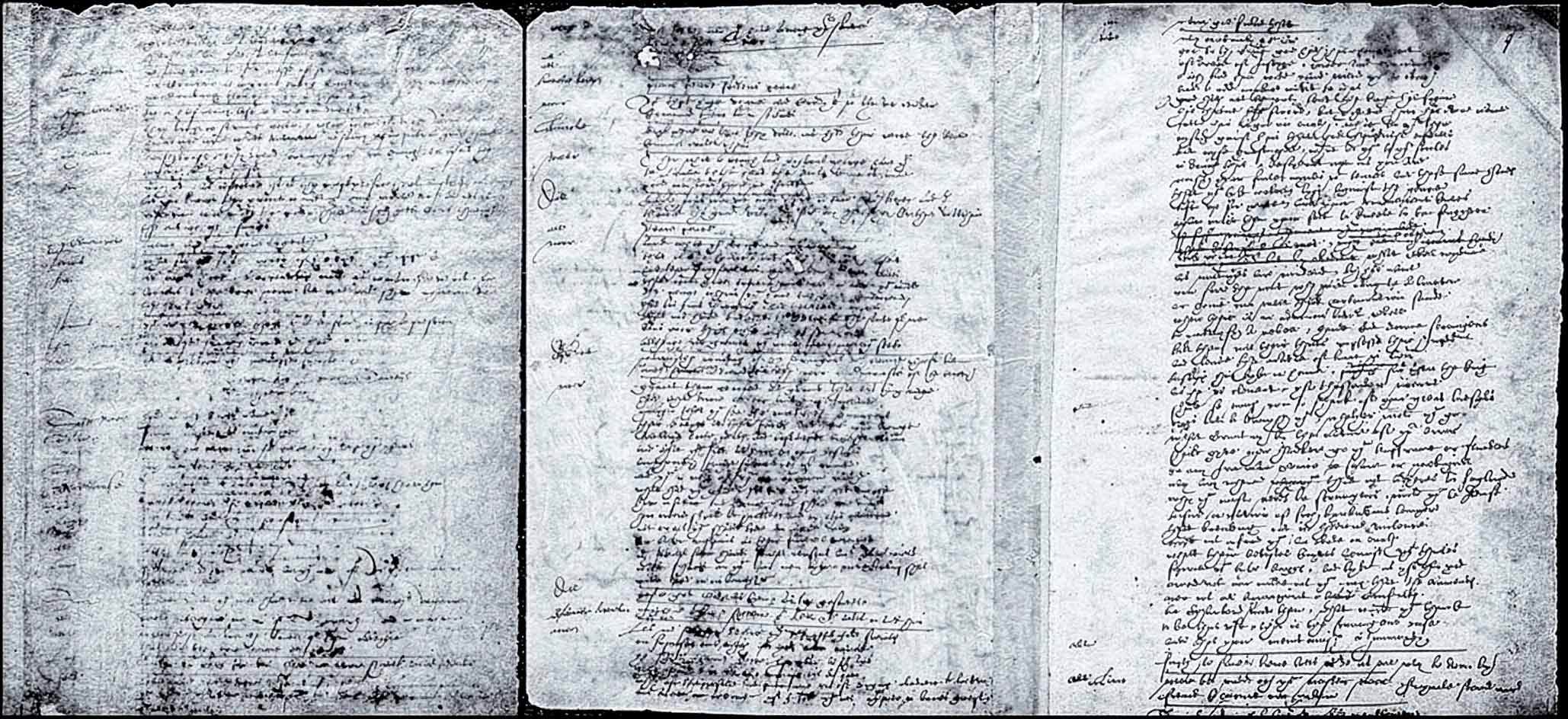
The Hand D additions to Sir Thomas More
The reputation of the unperformed Elizabethan play Sir Thomas More has undergone a complete transformation during the life of the Oxfraud website. The play was rejected on first composition in the 1590s and Shakespeare made an attempt to revise it, stylometrists say, around the time he wrote Othello. Once, those involved in the arguments over authorship either ignored it altogether or worried that citing Shakespeare’s contribution was “going nuclear”—likely to blow up both sides. Students and academics ignored it. It cropped up in Shakespeare Quarterly and other academic publications every 20 years and its curator, The British Library, was academically cautious in their description of it.
A few things happened in relative proximity that changed everything. Not quite overnight but there’s no going back now. The “Stranger’s Case” has gone from relative obscurity to one the most quoted parts of the canon and features regularly in the media, turning up in Newsnight, The Oxford Union, the BBC, The Globe, the RSC, even in The Economist.1 It has been widely translated and used in dozens of other articles about the plight of the displaced.
In short succession:-
A 577-page Arden edition2 of the complete play was released with a full scholarly treatment of attribution. It pulled no punches. Shakespeare is Shakespeare and students need to know it.
A performance of the play by the RSC took place in London and extracts began appearing on YouTube, notably from Sir Ian McKellen who describes it as some of Shakespeare’s best work. There are now dozens of YouTube performances to choose from.
The first big-data stylometry book3 appeared using algorithmic analysis on large data volumes and attributed the Hand D additions firmly to Shakespeare.
Anonymous 2011, the $30 million film of the authorship debate, directed by Roland Emmerich appeared. And authorship arguments were, briefly, in the headlines.
Immigration forced its way onto the daily front pages as the issue of the age thanks to millions displaced by war and famine almost everywhere.
Anonymous flopped, losing director Roland Emmerich half of what he paid to make it. Twisting the case for the Earl of Oxford as playwright into a coherent narrative proved too much for scriptwriter John Orloff and the hopes of an Oxfordian revival died with it. Steady decline has followed. But while the five other sections of Sir Thomas More turned out to be a bit humdrum, its Hand D additions were different. Shakespeare-style different. Shakespeare at his best different. The Arden edition was very specific about just how good Shakespeare’s contribution was. While respecting academic caution with a few “probably”s in its ascription, editor John Jowett quotes extensively from R W Chambers,4 an academic with no doubts whatsoever.
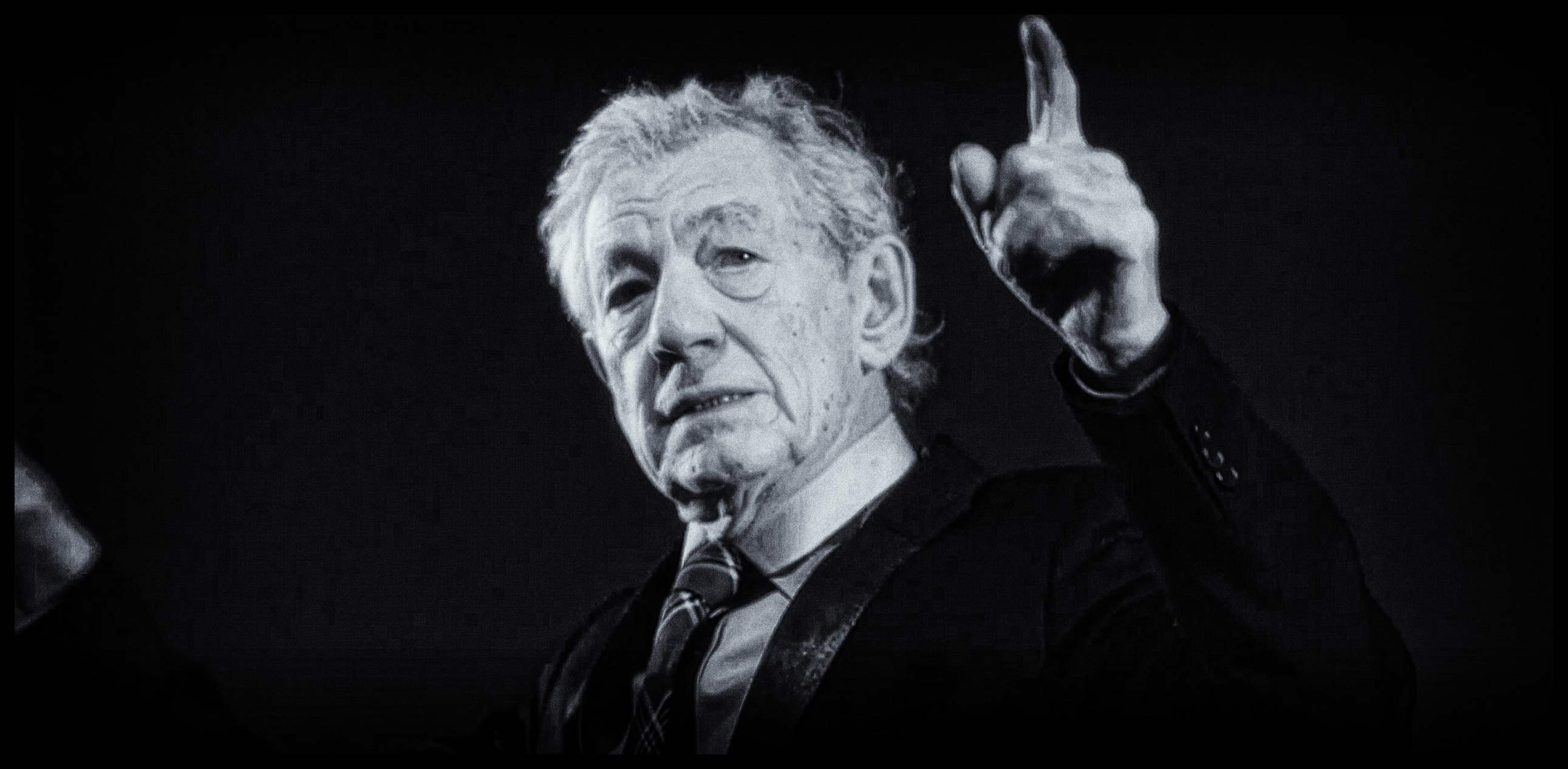
What really moved the needle though, were performances. Ian McKellen, first on the radio, then in Nottingham, then on YouTube, became the undisputed master of More’s speech to the crowd. The Hand D Additions were transformed from a forgotten contribution in an unperformed rarity, to one of Shakespeare’s greatest public orations.
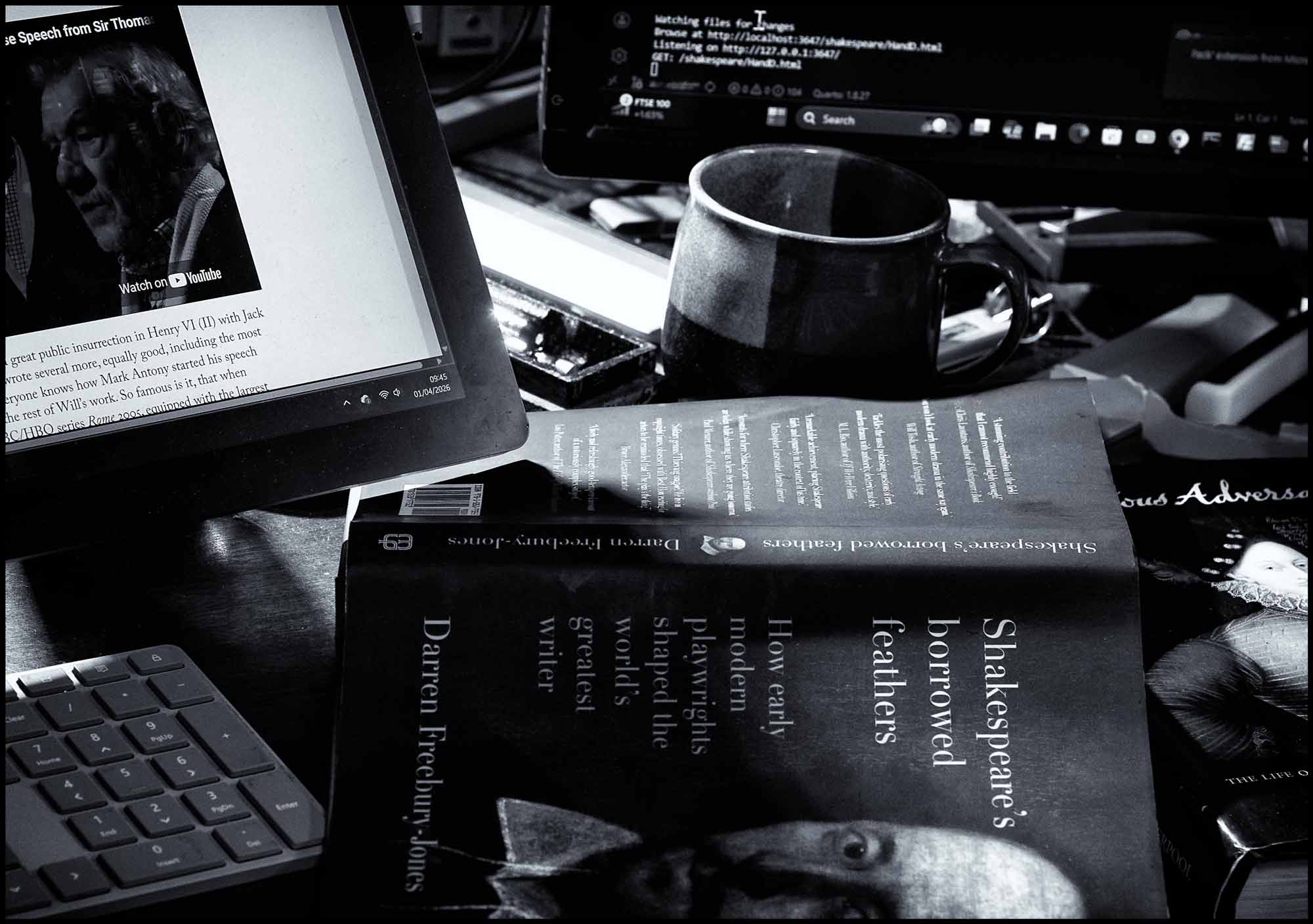
Sir Thomas More, with its revisions, reassemblies, internal editing and differing authors gives us a close-up, first-hand view of how Bankside theatre worked. In his recent book, Shakespeare’s Borrowed Feathers5 Darren Freebury-Jones looks at the tapestry of Bankside theatre through the lens of collocations, using a database extracted with the help of Google N-grams. What makes the book unique is it reviews the 527 plays in the database as a single corpus. All of the Bankside authors we know, and some we don’t, appear as authors and influencers on all of the plays. Those expecting a new review of the candidates for the Hand D Additions, hoping for a loosening of Shakespeare’s claims must have been appalled at the absence of the slightest doubt that it is canonical work.
The Stranger’s Case
Since it was the only part of the play in which there was topical interest, More’s speech (there are other additions by Shakespeare in other parts of the play) quickly acquired a name of its own—‘The Stranger’s Case’. Appropriately, it’s the name Shakespeare gave it in the text. Its defence of homeless immigrants, directly addresses human rights and who has them from the liberal side of the argument, examined in detail by Margaret Tudeau-Clayton in 2012.6 What she describes as ‘utopic dissonance’ can hardly be attributed to a self-obsessed Earl. For a 400-year old text, it is now bizarrely relevant to current political strife. When Sir Ian performed it on Stephen Colbert’s Late Show, he spoke straight down the lens to the Oval Office.
Sound familiar? Will had already written a great public insurrection in Henry VI (II) with Jack Cade as a rather seductive anti-hero. He wrote several more, equally good, including the most famous mob scene in theatre. Almost everyone knows how Mark Antony started his panegyric, however little they know of the rest of Will’s work. So famous is it, that when covering the identical situation, the BBC/HBO series Rome 2005, equipped with the largest budget ever spent on a drama series, made no attempt to quote from it or recreate it.
The writers cut straight to listeners in the audience describing its effect. A single line from Anthony as he stepped into the green room did the whole job. “Great speech, Brutus. Bit technical for that crowd, though”. That’s the power of Shakespeare.
Great mob scenes are not at all common in the work of Will’s rivals. Apart from getting the mood right, they need a key and a hook. A key to fix the audience’s attention long enough to hook them out of their preconceptions. Unfortunately getting any kind of political activism past the Master of the Revels required specialist skills. Hand D and the five others failed. Left to his own devices, Shakespeare always managed when left to his own devices. Coriolanus, in 1608, covered much of what Shakespeare wrote for Sir Thomas.His politicians today are quoted on every part of the political spectrum.
The play
The apprentices are revolting. More arrives at a riot and addresses a classic mob of angry apprentices and workers who feel that immigrants are causing inflation, eating their food, drinking their beer and taking their jobs. More is brilliant. He lectures them on their constitutional responsibility, the need for order then puts the moral case with such force that it cannot fail to strike home accusing them (us by extension—always) in his finale of ‘Mountainish inhumanity”. Shakespeare knows that ’mountainish’ is not a word but he has trebled it’s emotive power by neologising a variant. A signature trick. Don’t just make the seas wine-dark with Homeric blood, incarnadine them.
More, like Anthony, uses images of Divine Power. The objective is to implore citizens not to use their angry hands or their powerful arms but their supplicant knees, remembering their duty to the state is part of their duty to God. The juxtaposition of the plural meanings of ‘arms’ as limbs and weapons and ‘knees’, as joints and instruments of prayer, is distinctively Shakespearean.
MORE Nay, certainly you are;
For to the king God hath his office lent
Of dread, of justice, power and command,
Hath bid him rule, and willed you to obey;
And, to add ampler majesty to this,
He hath not only lent the king his figure,
His throne and sword, but given him his own name,
Calls him a god on earth. What do you, then,
Rising gainst him that God himself installs,
But rise against God? what do you to your souls
In doing this? O, desperate as you are,
Wash your foul minds with tears, and those same hands,
That you like rebels lift against the peace,
Lift up for peace, and your unreverent knees,
Make them your feet to kneel to be forgiven!
Now for Menenius, one of the most politically astute characters in literature (and a much better match for a Cecil than Polonius, should you need one) with the same thought in Coriolanus. Here we see Will attributing an equivalent Divine Nature to the republican state of Rome. Once again, we find the opposition of knees and arms.
…you may as well Strike at the heaven with your staves as lift them
Against the Roman state, whose course will on
The way it takes, cracking ten thousand curbs
Of more strong link asunder than can ever
Appear in your impediment. For the dearth,
The gods, not the patricians, make it, and
Your knees to them, not arms, must help.
The playwright tells us we are all human and we demean ourselves by denying human rights to others. Marx, Engels and Brecht may never have heard The Stranger’s Case but they were all fans of Coriolanus.
Was this written yesterday? This is how Will Shakespeare, an unprecedented genius when it comes to narrowly observing humankind, is able to excite the Elizabethan groundling, the Jacobean monarch and the authors of The Communist Manifesto with the same work.
Could the Earl of Oxford possibly write like this? Only on another planet. ‘Myne is made to serve me’, is Oxford’s creed, ‘the rich man in his castle, the poor man at his gate’. On which side of the argument about penniless refugees would De Vere come down? There is certainly no evidence of any liberality in The Earl’s actions. Collectors of biographical similarity are going to be stumped to find anything similar in any aristocratic life.
And there, black, wet and glistening in the penultimate line, is another of Will’s signature moves, taking the strong noun “shark” and turning it into a transitive verb. A linguistic magic trick. There’s another in the clever apposition of ‘ruff’ and ‘ruffian’. Like the loose punning on arms and knees, these virtuoso tricks of language are stronger connections than the occurrence of repeated lines or similar phrases.
Let’s be absolutely clear now.
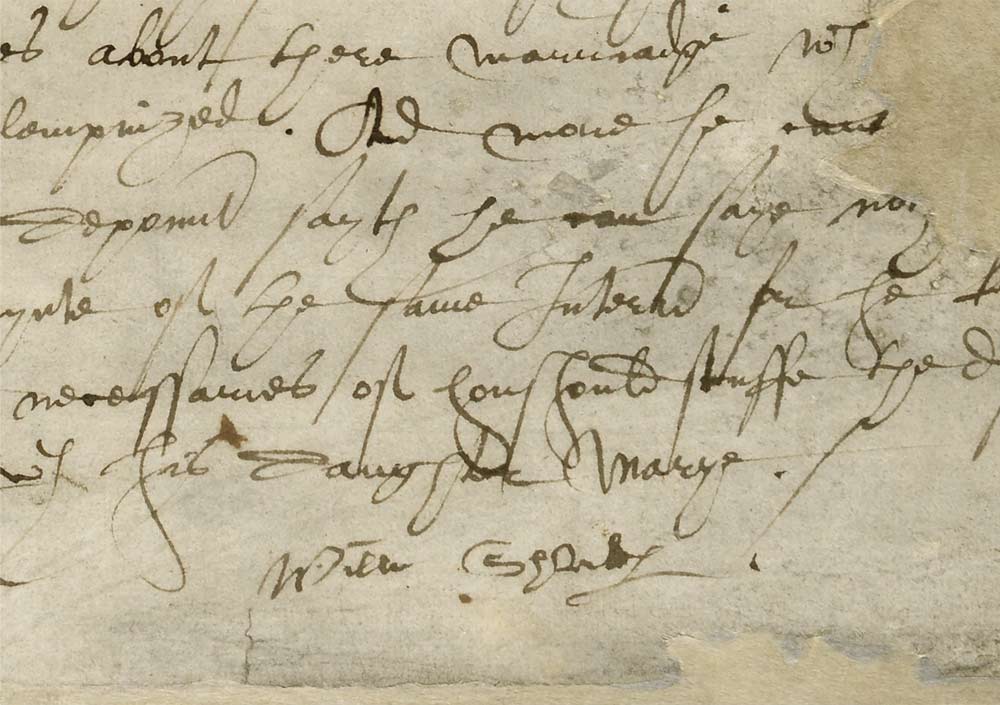
Hand D is Shakespeare’s handwriting, Shakespeare at work, amending as he writes, making three and even four attempts to get the mot juste. The British Library has dropped its reservations and now describe it as Shakespeare’s only surviving manuscript. Algorithmic stylometrists are completely convinced.7
You may fairly argue about Marlowe’s contributions to H6 (ii). It’s another crowd scene, another upending ot the natural order. In the collaborative attribution studio, Freebury-Jones completely rejects Shakespeare’s contributions to Arden of Faversham but defends his scenes with Jack Cade. Stylometrically, however, Sir Thomas More’s Hand D additions sit firmly inside all the Shakespearean boundaries. It’s in the RSC’s repertoire, the Arden Shakespeare Collection and it’s our greatest Shakespearean actor’s favourite cameo. And we haven’t finished with it. In the next section we’ll do a detailed comparison of Will’s manuscript and Oxford’s letters. Two idiolects, side by side.
Unperformed
Highly political, much too topical for Elizabethans and therefore never performed on Bankside, the manuscript of Sir Thomas More is one of a very small number to have come down to us from Shakespeare’s day. Its survival helps answer the question “why?”. In the theatre, manuscripts were working documents, broken up into roles, turned into playscripts, lost to the scribes and the publishers. The play Sir Thomas More lived in a drawer in the hope its day would come and survived because it never did.
Discovered in 1723, it was not considered as Shakespeare’s work for another 150 years. It was thought by some to be too good to be true or dismissed as one of many forgeries which appeared in the 18C. In 1871, Richard Simpson proposed that some additions to the play had been written by Shakespeare, and a year later James Spedding, editor of the works of Sir Francis Bacon, while rejecting some of Simpson’s suggestions, supported the attribution to Shakespeare of the passage credited to Hand D.
The first serious handwriting analysis was carried out by Sir Edward Maunde Thompson in preparation for the tercentenary and appeared on 1916. The work was extended and published with a collection of literary essays by A W Pollard 1923,8 It met with initial scepticism from some document examiners and all Doubters like S A Tannenbaum 9 with a dog in the fight. More recent scholarship is almost universally on the side of authentication. That is where the pendulum has now come to rest. It would be academically incautious not to leave a small door open to the possibility another author, one who could write as well as Shakespeare, but it is vanishingly unlikely. Whoever that might turn out ot be, it certainly won’t be the Earl of Oxford or any of the other contenders.
It is obvious at a glance that the manuscript is a theatre script, written for the professional stage and for trained actors. But the manuscript is more than just an unperformed play. It is written in the hands of five playwrights who make deletions and emendations plus one scribal hand attempting a fair copy. Finally, it includes a seventh hand, the annotations of The Master of the Revels, Sir Edmund Tilney. It illustrates how plays were worked and reworked for the stage in Shakespeare’s time. Rather than a secret author in an ivory tower, it suggests a creative process closer to the modern process of TV or movie scriptwriting, with groups of writers improving, patching, and rewriting a script too. Oxfordians agree. They imagine Oxford leading a writer’s room with half the Bankside authors working under his direction in it. How would that remain secret over the 25 years of Shakespeare’s career.?
The work of a Master
Liverpool playwright Willy Russell says “a script is just an ambition, theatre is made in theatres”, a process that involves presence in a physical location, requiring all the modern panoply of producers, investors and directors to organise and fund rehearsal, working with the actors, prop men and stage managers. Crucially, through this manuscript, the writing shows itself to be an iterative process involving other writers—and re-writers. This is fatal to Oxfordian argument, since the there is no chance an Earl, hidden to the historical record, could work remotely or hide pseudonymously behind a complex cover story and function in such a working environment.
‘A theory of imitation would compel us to suppose …that ’D’ imitated Shakespeare and that Shakespeare imitated D. It is simpler to suppose D and Shakespeare the same person.’
R W Chambers
The other Hands
There are five other hands. Five more playwrights who all wrote their parts earlier than Shakespeare. However Sir Thomas More manuscript contains the work of one, and only one, master playwright: Hand D writes quickly and smoothly in a beautifully integrated series of complex images, bending the language to its full expressive potential. It deals with issues painfully relevant today and asks a question which is a regular concern of Shakespeare. Do all humans have rights? Who grants them? Who protects them? It’s not a regular Bankside agenda but it crops up in Shakespeare again and again. From the common soldiers in Henry V to the plebeians in Coriolanus. Even Caliban.
It’s Will Shakespeare. What else would you expect?
Factors isolating Hand D as Will’s work
| Trademark Stagecraft and Imagery | Trademark Orthography | Trademark Handwriting Features |
|
|
|
Goose Quills
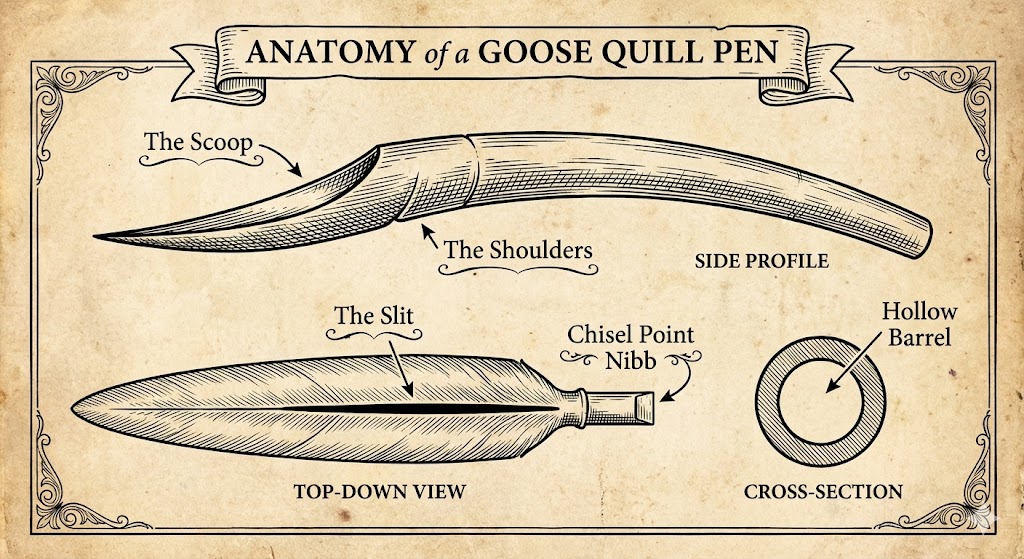
If you have ever tried to write with a goose quill you know that the technique of ‘stroking and scratching’ the paper surface, rather than pressing down hard, transmits copious information about stroke and pressure, more than almost any other writing implement. Quill tips also react depending on the surface being written on–the cheaper and rougher the paper, the more spray, blotting and inked-in loops. Still in use today for high quality calligraphy, quills transmit more personality than pencils or steel-nibbed pens. None of that, however, is discernible on digital high contrast scans or photocopies. You are not looking at Will’s marks unless you are fortunate enough to be looking at the originals.
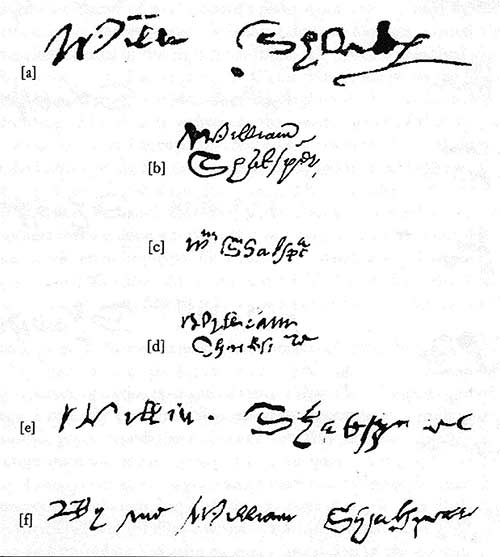
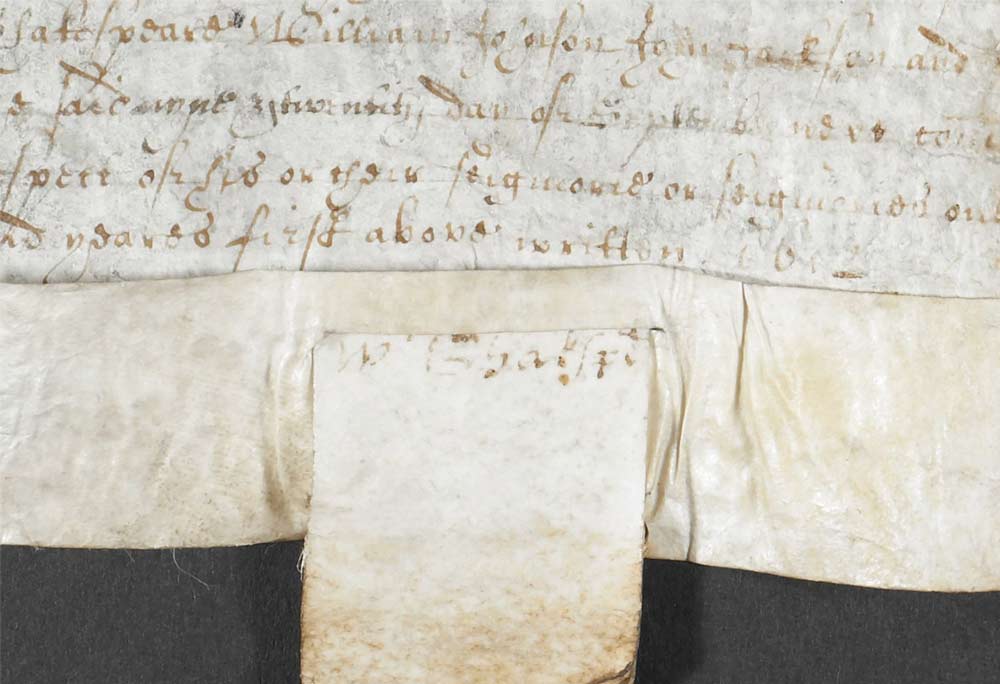
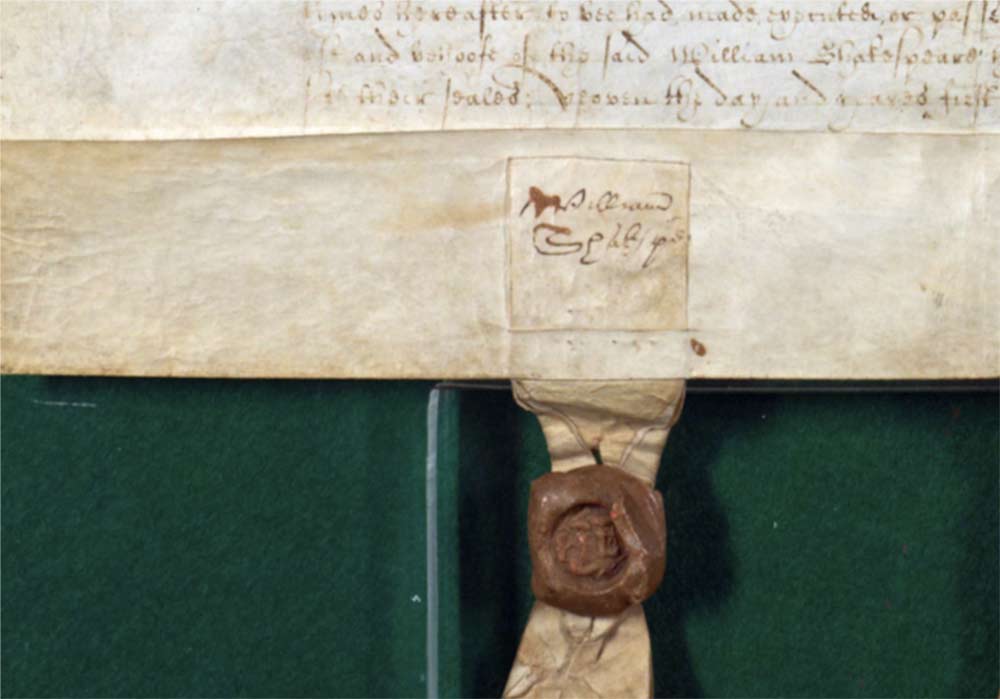
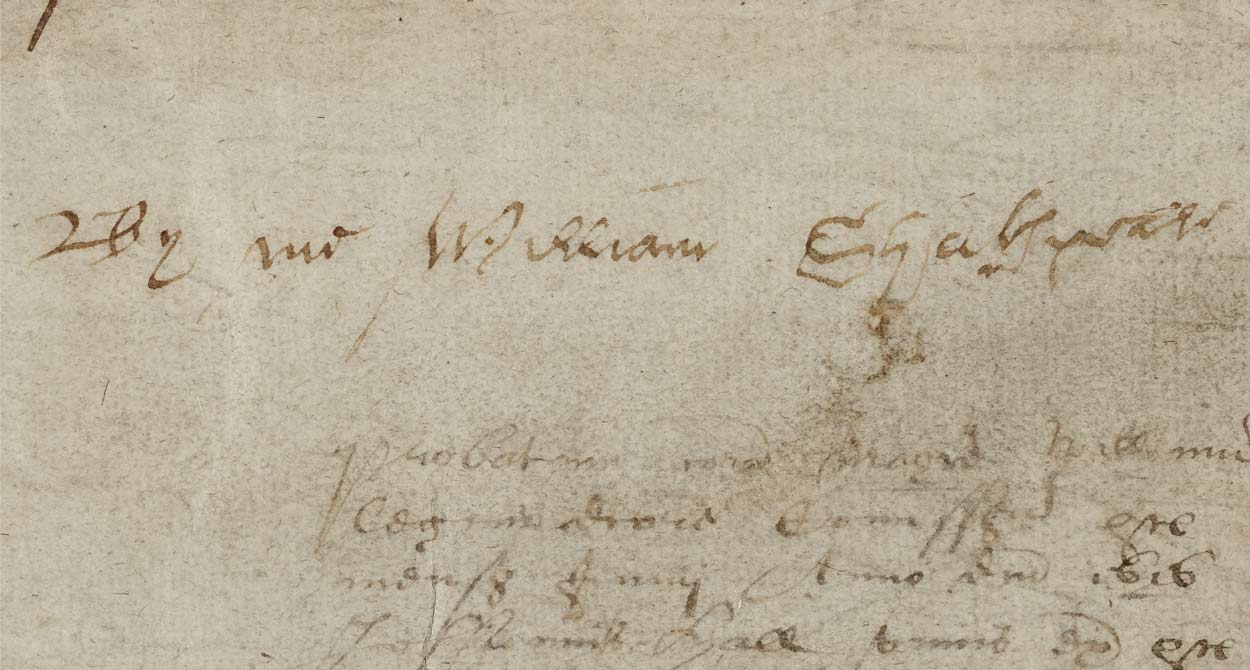
What is, however, clearly discernible is that the Oxfordian argument that each signature is so different from the others that they could all be written by different people is specious. Despite the deterioration evident in the last three signatures made when a terminally ill Shakespeare was signing the pages of his will, even the untrained eye can see similarities and discern that they are sufficiently alike to be from the same hand.
- In every case except 3, the ‘W’ begins below the baseline of the rest of the signature.
- The ‘W’ in 1, 2 and 5 have a scrivener’s dot in the curve of the final arm, which curves back down to the base line.
- The ‘W’ in 2 and 4 have an extra small ornamental curve attaching the final leg and the arm.
- The ’i’s in William are made with an up-stroke and a down-stroke and left undotted.
- In all but signature 5, the double ‘ll’ in William has a distinctive change of stroke at the bottom of the first ‘l’ and another before the second ‘l’ loops into the ‘i’.
- The ‘illiam’ in 2 and 5 are extremely similar in both slant and letter formation.
- The medial ‘a’ in 1 and 2 are formed similarly: both are open, and both begin well above the letter. No. 1 is linked with the previous ‘h’ and No. 2 appears as that it was at one time or that both letters were made cursively, the pen leaving the paper as the upstroke of the upward bow of the ‘h’ was formed.
- The medial ‘a’ in the given name of 2 and 5, and in the surname of 3, 4, and 5 are all formed the same.
- The initial ‘S’ in all the surnames are formed alike, save for the reversed loop in 5, which doesn’t make it all the way over the letter.
- The slant of the ‘h’ stem in 3, 4, and 5 are the same.
- All of the signatures except for 4 use the italic long ‘s’.
- The ‘k’ is made like a ‘b’.
In addition to the paper, the space allowed for the signature plays a role. At least two of the signatures have been cramped into a restricted space. Just as silly as the idea that these are the signatures of different people, is the Oxfordian idea that a scribe signed on an illiterate Will’s behalf. The stylish, professional scribal hand above the signature is not the same hand or even on the same calligraphic planet.
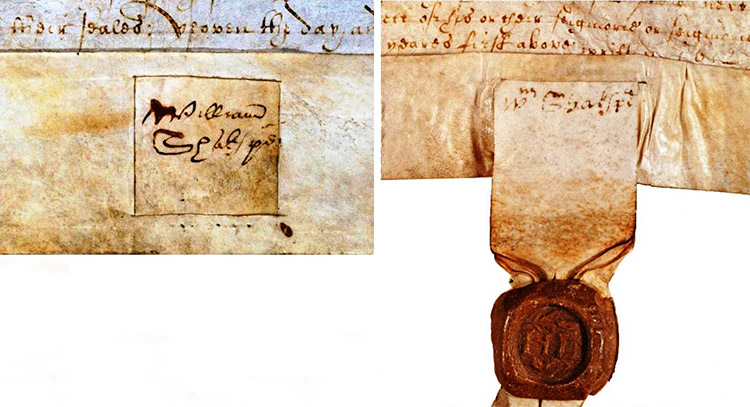
To make their judgements, real palaeographers work with originals, microscopes and all manner of kit they don’t like sharing. Soon, maybe, we’ll have 3D EMR scans enabling us to examine handwriting on our 3D tablets using free palaeography apps but for now, we must content ourselves with the work of Sir Edward Maunde Thompson, a top palaeographer from the early 20c who had microscopes and expertise galore and unfettered access to the originals..10 Three later palaeographic examinations have been carried out and all agree. The first of Thompson’s important observations takes us to a scene near the end of Shakespeare’s life.
We may suppose that when Shakespeare prepared to subscribe his signature to the third page of his will he was conscious of the solemnity of the occasion. Five of his neighbours stood by to witness this important signature. He started with the words ‘By me’, and in forming the m in ‘me’ he began with a little flourish, a preliminary up-stroke of the pen. This he repeated on the W of ‘William’. These strokes were not a form of embellishment that he thought up on the spur of the moment. He had been making them for years, and with a few others, he had been making them for a long time. The earliest I have seen were produced in 1572.
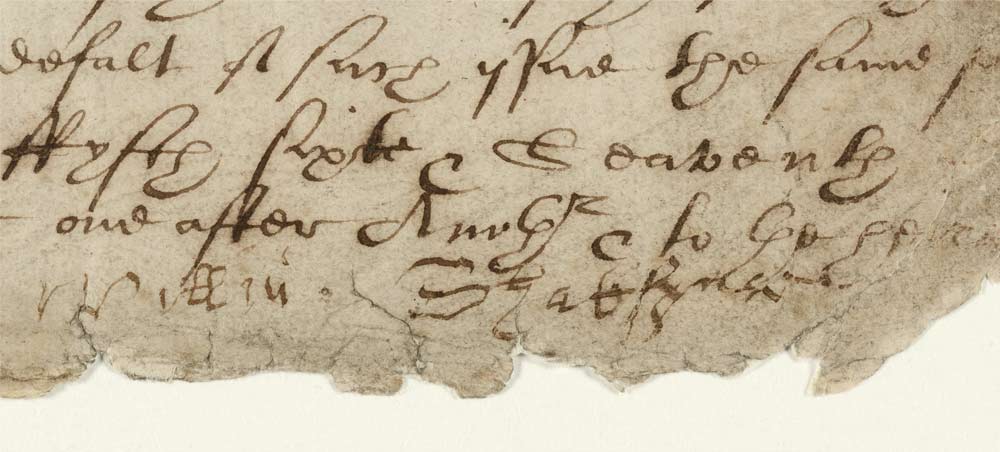
Thompson saw these embellishments, and he made a further important observation - that in making the up-stroke on the W Shakespeare began with a down-stroke. This is not readily seen because the up-stroke retraces, or nearly retraces, the down-stroke, and this can be seen only where the retracing is imperfect and leaves what Thompson calls a ‘needle-eye’.
The writer of the 147 lines of Hand D made use of these up-strokes. He attached them to initial i,m,n,r,v,and w, but those on m and w far exceed the others in number. In the 147 lines 65 words begin with m, and on 44 of these the up-stroke may be seen. Of 79 initial ’W’s, 34 bear the up-stroke.
This is analysis we cannot recreate. However hard we stare at photographs, without the originals, we can only see the up and downstrokes when they are an obvious artefact of letter formation, like the two strokes in the i.
More than a few academics are looking for 100% certainty from Thompson’s handwriting comparison. Oxfordians, even if offered 1000% certainty will argue more is possible and continue refusing to accept it when more turns up.
Why?
The witnessed signatures are unquestionably those of Will Shakespeare and the owner of Hand D is unquestionably that of an Elizabethan playwright who is really good at his job. There simply is no space for the Oxfordian horse and cart to be driven through the proof offered by the physical evidence, even before it is augmented with context.
When we eliminate playwrights whose handwriting is known to be different, the number of candidates for Hand D sinks to a single handful.
Is it 100%?
So why, when the range of possible alternatives is so small, hasn’t Thompson’s virtual certainty been accepted as definitive proof?
Dawson11 addresses the this question and concludes that while his analysis is sound and his conclusion secure, Thompson makes a weak case overall. Thompson dismisses the pressure-based ‘needle-eye’ feature of Will’s hand as generic. Dawson spent a lot of time looking at 250 different Elizabethan hands and found it to be much less common than Thompson implied. In fact, he found only one other instance of the characteristic down-stroke preliminary to an upstroke in the letter v in all 250 writers.
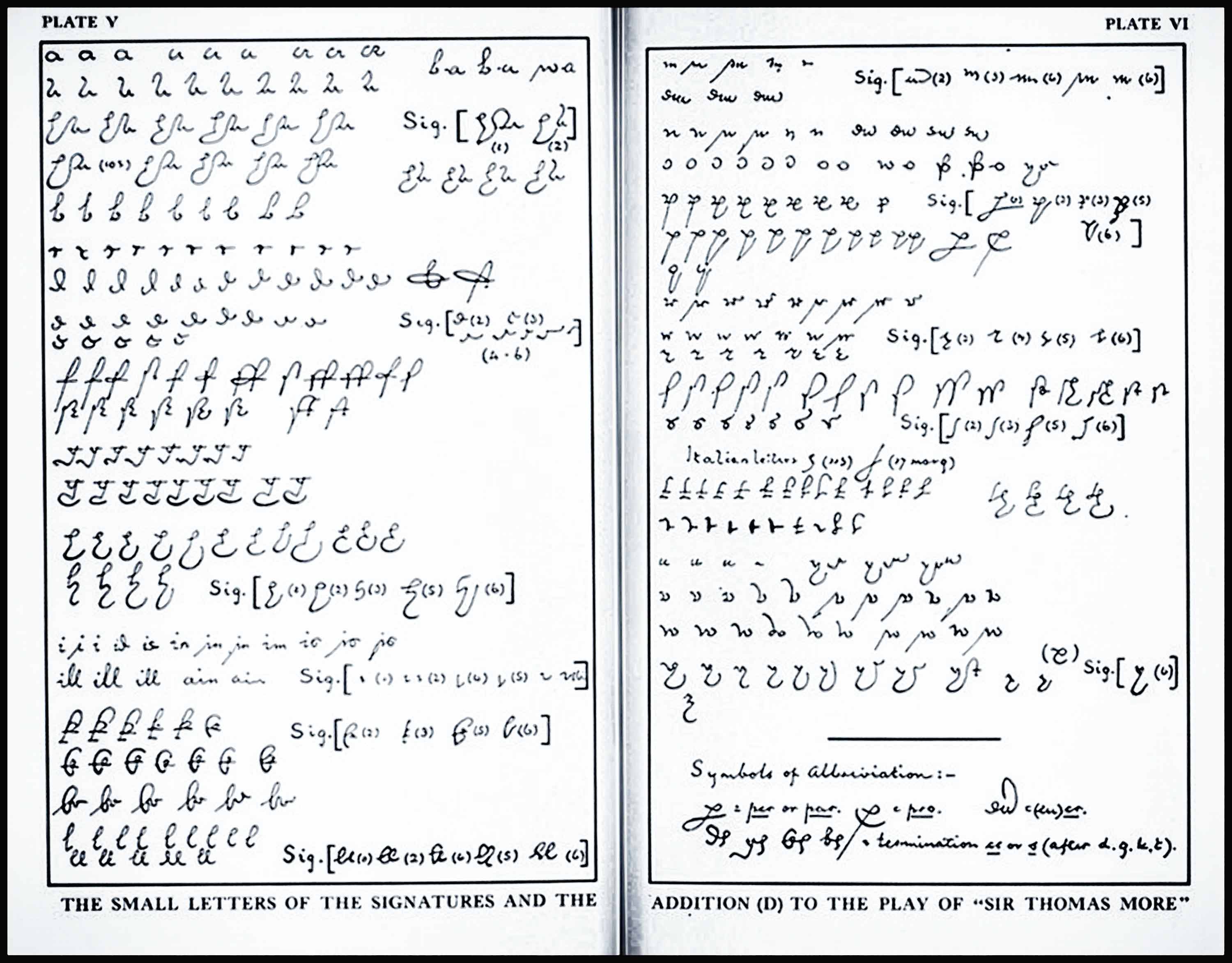
There are other unusual features of Hand D which appear in the signatures which do not depend on pressure, one of which is the ‘spurred a’.
In line 105 of Hand D, if we look closely at the word ‘that’ in the middle of the line, we can see that the h-a link is exactly like the one we have been examining in the signature in having the sharp point precisely touching the up- stroke, and also the same straight line forming the bottom of the misshapen a. Again, the word ‘harber’ near the middle of line 127 exhibits the same sharp point (which here fails by a hair’s breadth to close the circle) and the same flat-bottomed a. And compare the pointed ‘a’ (third word in line 119) and the a in ‘against’ (line109).
In my examination of the hands of many writers I found twelve who linked h and a with those faddish bulbous spurs, but I found no writer who even once produced that link with the sharp point closing the circle and forming an a with a long, flat bottom.
Some Oxfordians, like Nina Green in another of her ‘Oxmyths’ essays, cleave for support to Samuel Tannenbaum who rejected Maunde Thompson’s analysis and conclusions. Tannenbaum was a self-taught palaeographer, a psychiatrist by profession. Arthur Freeman & Janet Ing Freeman produced an authoritative work on forgery in the 19c¹, described his investigative monographs as ‘fringe at best’. Amplifying, they point out that ‘Tannenbaum’s eccentric palaeographical12 claims were not always sceptical, nor restricted to Collier: in 1927 he made the only extendeded modern attempt to rehabilitate Madden’s unlucky purchase of the ’Shakespeare’ Montaigne, with its signature ridiculed by Collier himself, discredited by Maunde Thompson, and disowned by the British Museum. Tannenbaum found its genuineness ’unquestionable.” Robert Elrodt when writing in Shakespeare Survey², went further, quoting an Assistant Keeper of The British Museum, W H Kelliher, who said,“Tannenbaum’s arguments offer no serious challenge to Maunde Thompson”.
So. Green’s claim that Tannenbaum has yet to be refuted turns out be as specious as her claim in the same document that you can’t analyse handwriting by analysing handwriting. Large samples are nice to work with but small ones, especially from witnessed documents, can be used to produce results where large samples are not available. And in this case, the signatures ARE being compared to a satisfactorily large sample.
There are others who make objections to parts of the handwriting anaalysis, e.g Huber, a document examiner, and Werstine, a palaeogtapher, some of which may be fairly made but they are not objections to the overall conclusion. The handwriting is Shakespeare’s handwriting.
Dawson’s article is written in clear English, with no jargon and is conclusive. Of course he leaves a smidgen of doubt–a door open–by presenting his final conclusion in the form of rhetorical questions rather than outright statements. But then he is not expecting a horde of Doubters to try to force their ideas through a minuscule crack with amateur analysis of rough photocopies.
If we return to the very small number of possible candidates, we can eliminate everyone except a few very talented Elizabethan playwrights, solely on the evidence of the manuscript itself. There are fewer than five possibilities. From those we can eliminate the remaining playwrights on the internal, stylistic evidence. What possible doubt is left?
Dawson puts the question in his conclusion:
What then is the mathematical probability that two skilled dramatists, writing simultaneously about the year 1600, would be engaging in all of those unusual practices, some highly unusual?
Nil. That’s the answer.
Stylometry
The last domino falls. New techniques of stylometric analysis are making large improvements to attribution science and bringing it almost to the forefront of academic research into Bankside theatre. Hand D is canonical work which means, of course, it’s connected to Will Shakespeare without the need for handwriting analysis. It’s authorial and canonical so it’s attached to Shakespeare by all the other evidence for the man on the title pages of the plays. It is therefore a mistake, made by both sides, to assume that attribution depends on handwriting analysis.
Comparing Shakespeare’s work systematically to those of half a dozen contemporaries is very useful. Being able to access it against nearly all surviving literary texts from the period, allows a truer estimate of its distinctive style.
**** Stylometry, AI and Big Data13
Unlike early stylometric tests, the norms in this type of analysis are derived algorithmically, not from banks of subjectively designed tests but by addressing all the data that exists and using Principle Component Analysis to make it manageable. This type of question the technique can only address questions that have simple “yes” or “no” answers, but because the whole process is a computerised, it is easy to vary and repeat the questions and home in on solutions. Secondly they run not on test banks, but on all the available digitised data from the Early Professional Theatre compreising 3,250,000 words of dialogue from 165 plays.
Lots of new horizons open up once we can test reliably using an algorithmic process. For example, it can reduce the many assumptions which have to be made before tests are designed using other methods. Algorithmic methods are not bound, in the way others were, to test like with like. They can judge the importance and weight of different ‘likes’. They can measure the difference between the vocabularies of Shakespeare’s prose and verse in a meaningful way, (Oxford’s too, if they wished), testing whether the difference requires separate analysis for successful discrimination. Maybe, maybe not, is the answer. With Shakespeare, anyway. There’s so much in each category that properly implemented mathematical tests can overcome.
Timon of Athens
Before we look at Sir Thomas More, let’s have a look at Timon. This is a bald summary of the process.
First C&K take Timon out of the test data. They now have a databank which contains the 27 plays of Shakespeare without collaboration and, since Middleton is the favoured collaborator, all of his undisputed work is also present.
The process builds two signature sets of favourite/least favourite words, calculating which words each dramatist is likely and least likely to use - a bespoke Shakespeare/Middleton profile. Then they carry out a function word test on each dramatist. Using some more fancy math and lots of CPU time, they tie the two test sets together. In this test, they compare every 2,000 word segment (with random boundaries) after testing whether running the tests following scene boundaries would improve accuracy. There’s not a great deal of difference in the results, suggesting the undisputed nature of the attributions is correct. The chart shows the result of scene boundary and 2,000 word segments.
Now they use the same analysis technique on same-size segments, scenes in this case, of the play(s) under examination. Having subjected them to the same analysis which created the author profiles, they then overlay the sections of the play on to the segment profiles.
Here’s the result:
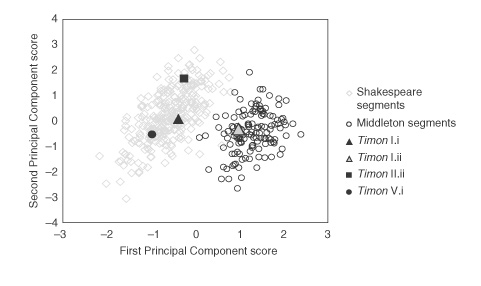
Shakespeare’s diamond-shaped segments represent the analysis of all his undisputed work thus excluding Timon. Middleton’s black circles represent all his work except his supposed contributions to Timon. There is almost no overlap between the work of the two dramatists. A line can be drawn which almost completely isolates one from the other since only two of Shakespeare’s segments sit on the Middleton side of the chart. This is not an inaccuracy or a weakness in the system. It merely says that very occasionally, in less than 2% of cases, Shakespeare can sound a bit like Middleton. It’s impressive consistency, not weakness. In 98% of the segments, he’s speaking in his own clear voice.
Analysis of the play segments drops each of the four segments of Timon on to the chart. Three fall into Shakespeare’s segment area, one very close to what C&K call a Shakespeare centroid and the Middleton segment drops smack bang on one of the Middleton centroids itself.
A firm attribution
Timothy Irish Watt’s contribution to Craig and Kinney’s book applying algorithmic analysis to whole oeuvres is unequivocal.14 All other authorship sites ignore it.
This approach can separate Shakespeare from the rest by calculating values for words most likely to be used by Shakespeare and words most likely to be used by all other dramatists, defining ‘Shakespeareness’ and ‘Not Shakespeareness’ quotients. It’s 98% accurate. 98% of Shakespeare’s segment appears below a dividing mean and only 2% stray into the territory of “all the rest”. And vice versa. The 2% error doesn’t mean that those segments were written bey other dramatists, it just means that this test suggests they might repay further investigation. This type of mathematical stylometry can get much more complicated than this (and achieve higher rates of accuracy) but all its results on Hand D are consistent.
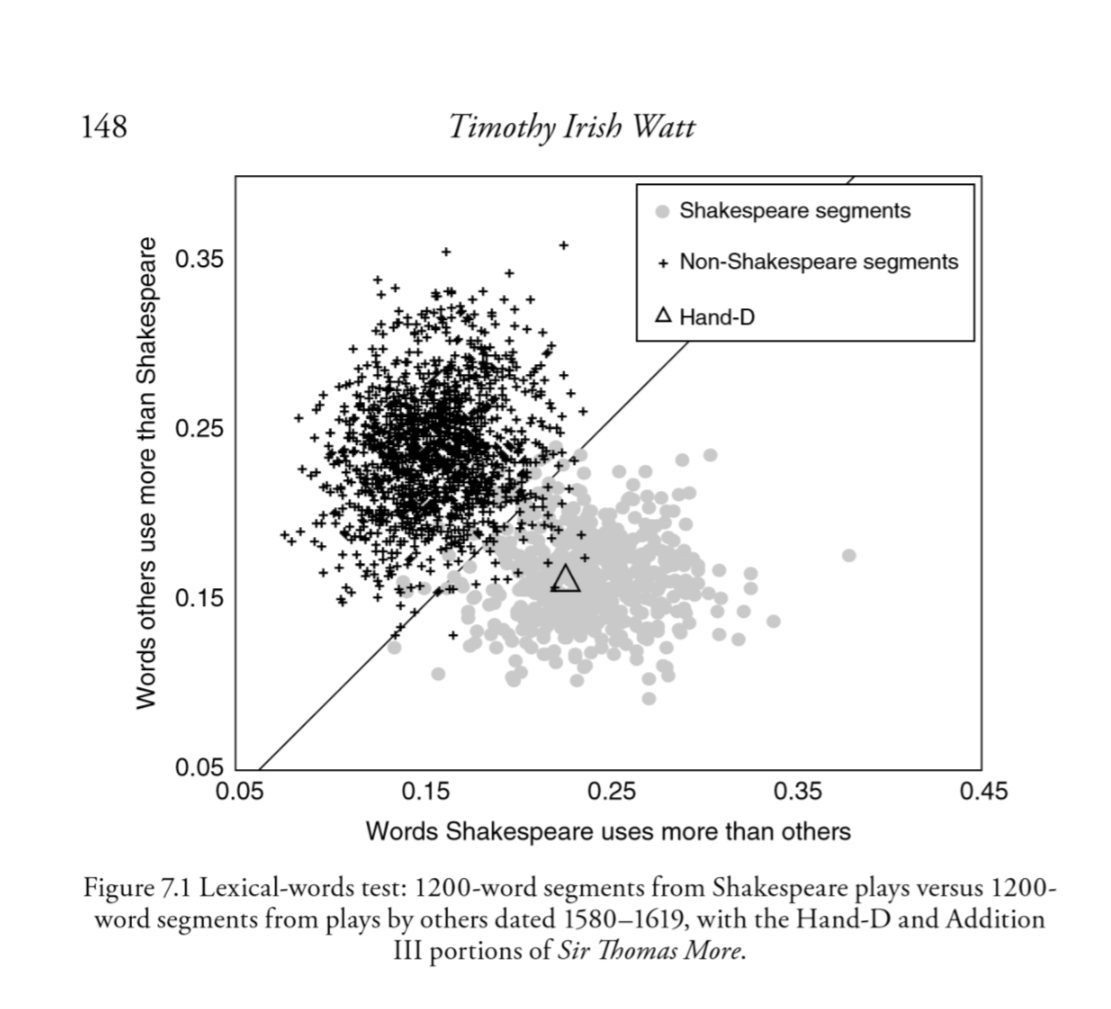
“Not only does he use the rare words appearing in Hand-D more than his peers, but he also generally eschews the common words neglected by the writer of Hand-D. The evidence presented here is unusually consistent. The Hand-D and Addition III portions of Sir Thomas More are very like Shakespeare in their use of Shakespeare lexical words, non-Shakespeare lexical words, and function words. The Hand-D and Addition III portions share many rare words with Shakespeare and avoid many of the same common words. On these measures the More passages are not on a Shakespeare borderline but in a Shakespeare heartland. These results can be added to the many indications already in existence, from parallel passages, image clusters, rare words, idiosyncratic spellings, and indeed from handwriting…”
T Irish Watt. Shakespeare, Computers, and the Mystery of Authorship
The Sir Thomas More segments represented by a triangle, are nowhere near the boundary, however. The are close to the centre. They don’t just sound like Shakespeare, they come from Shakespeare’s heartland. It’s Shakespeare on a good day.
There are further tests and analysis in the chapter I have cited which make even stronger claims for Shakespeare’s authorship. The chapter on Hand D in this seminal work on big data stylometry has this to say in conclusion about Hand D.
“The identification of Hand-D with Shakespeare now seems one of the better established facts about his canon, and among the surest facts of his biography.”
Bluster cannot rebut evidence like this.
The Hand D Gallery
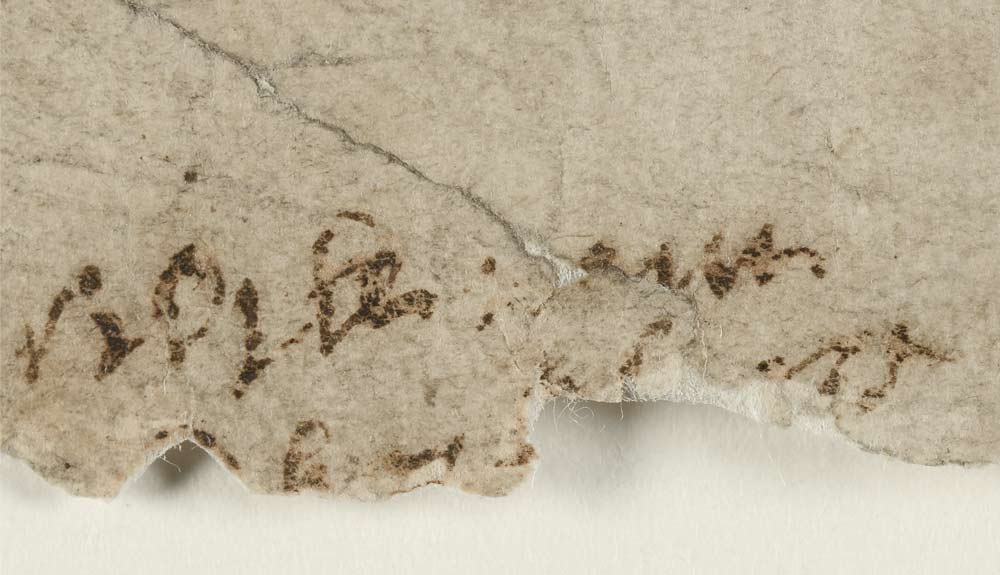
Below are detailed sections of the manuscript and known signatures for comparison. Click any image to enter the Lightbox gallery view.
For those requiring maximum detail, you can also view the full high-resolution assembly of all three pages of the manuscript:
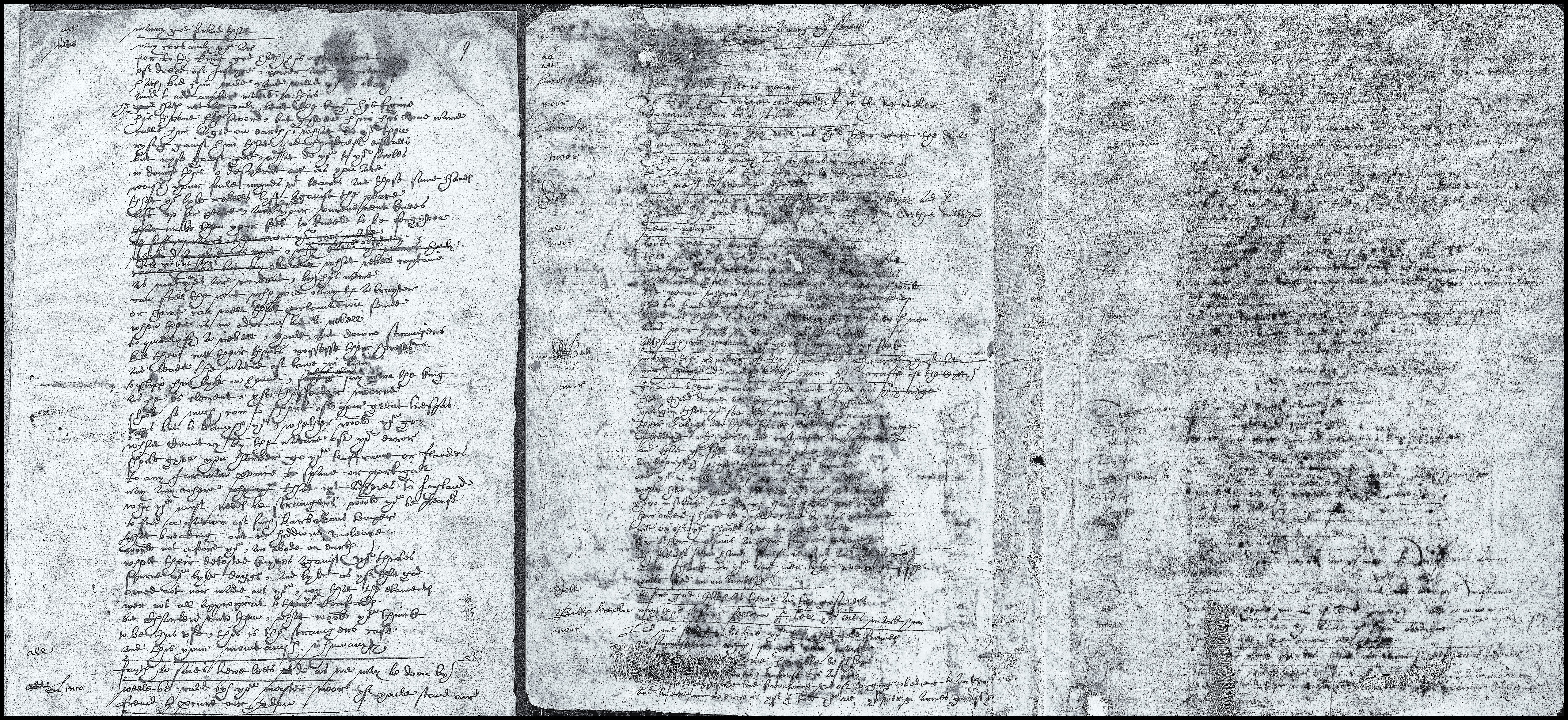
Fig. 8: The More Manuscript (Hand D) — Selenium Toned / Contrast Correction, Fine Grain.
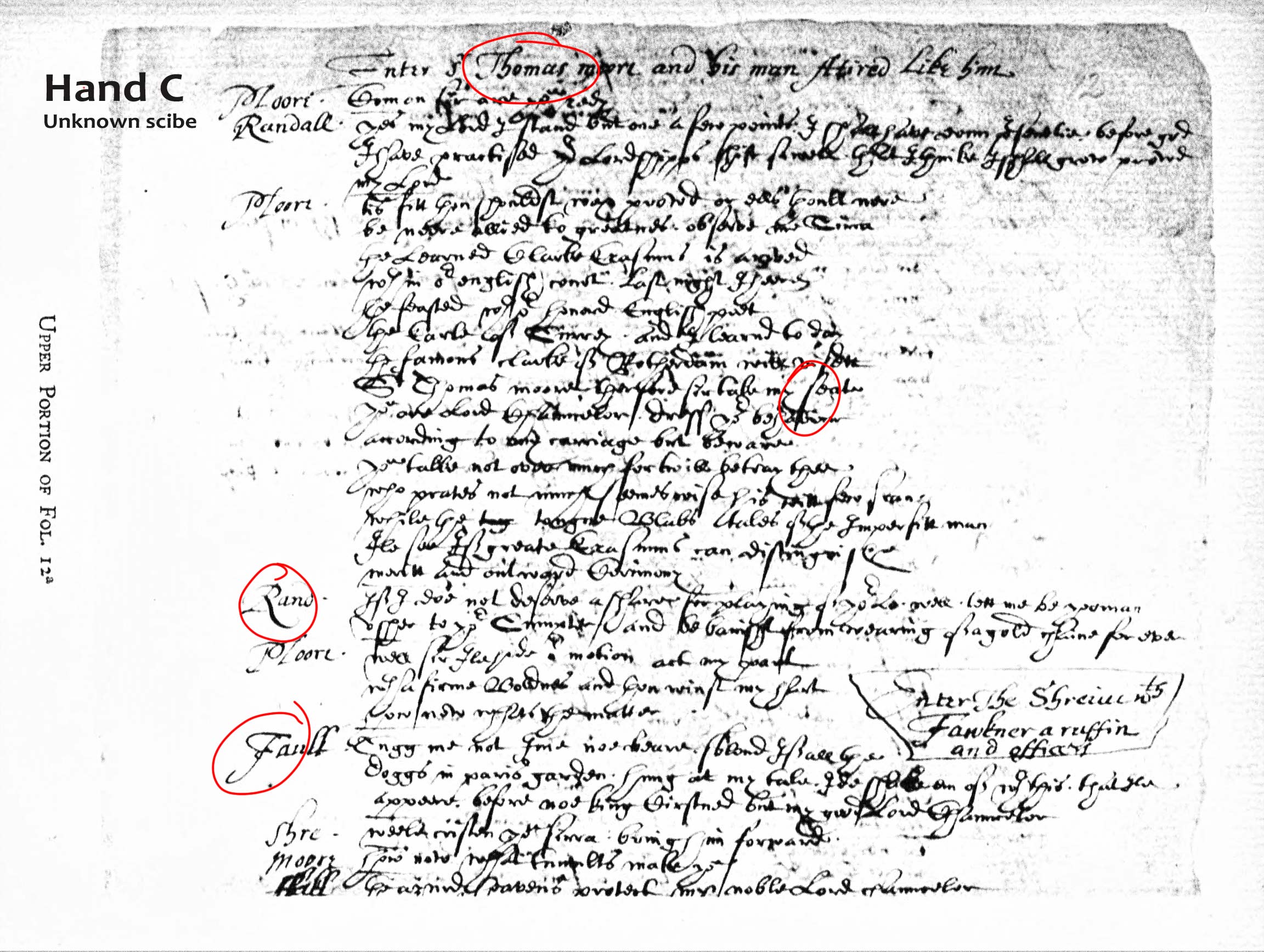
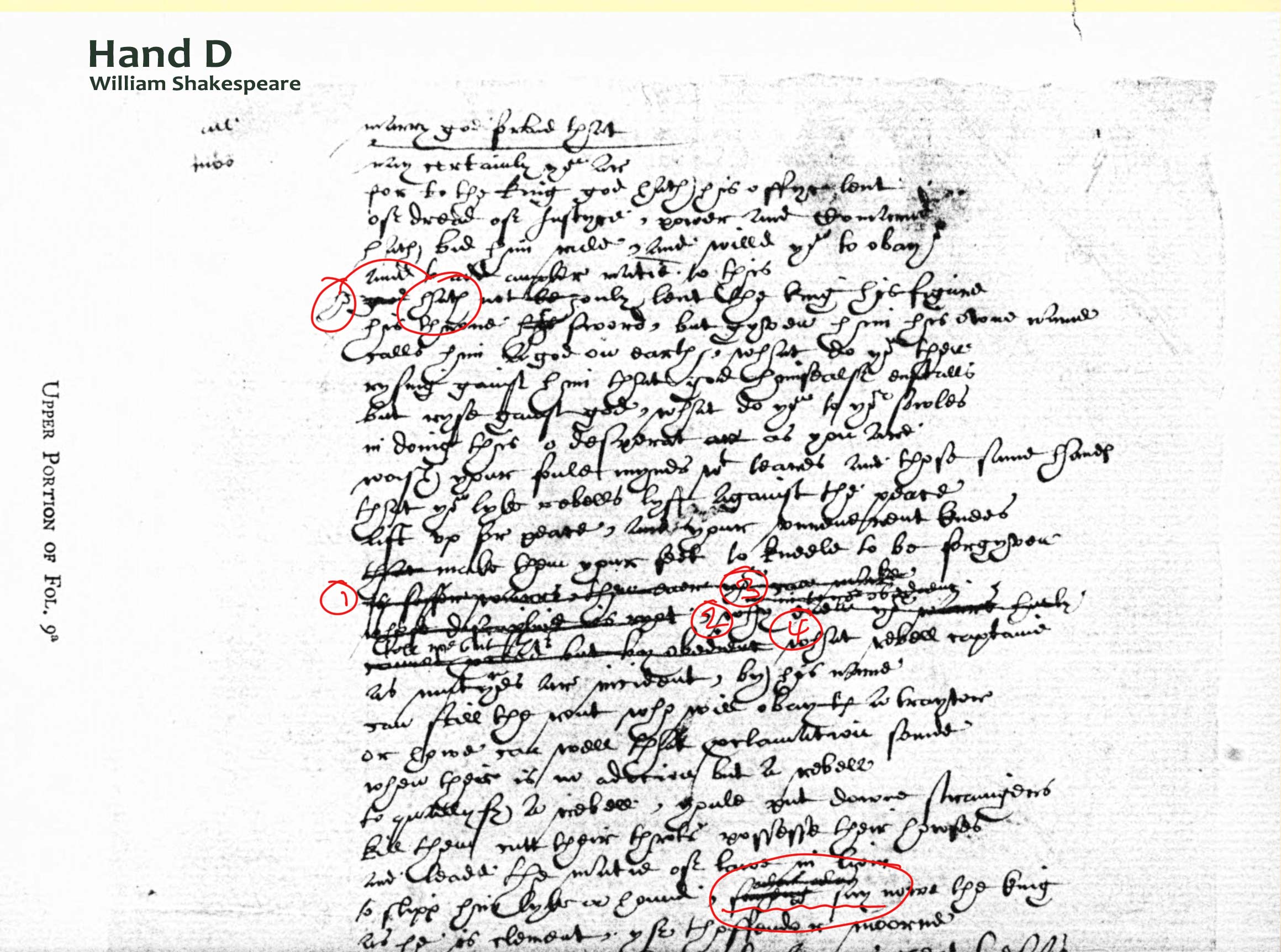
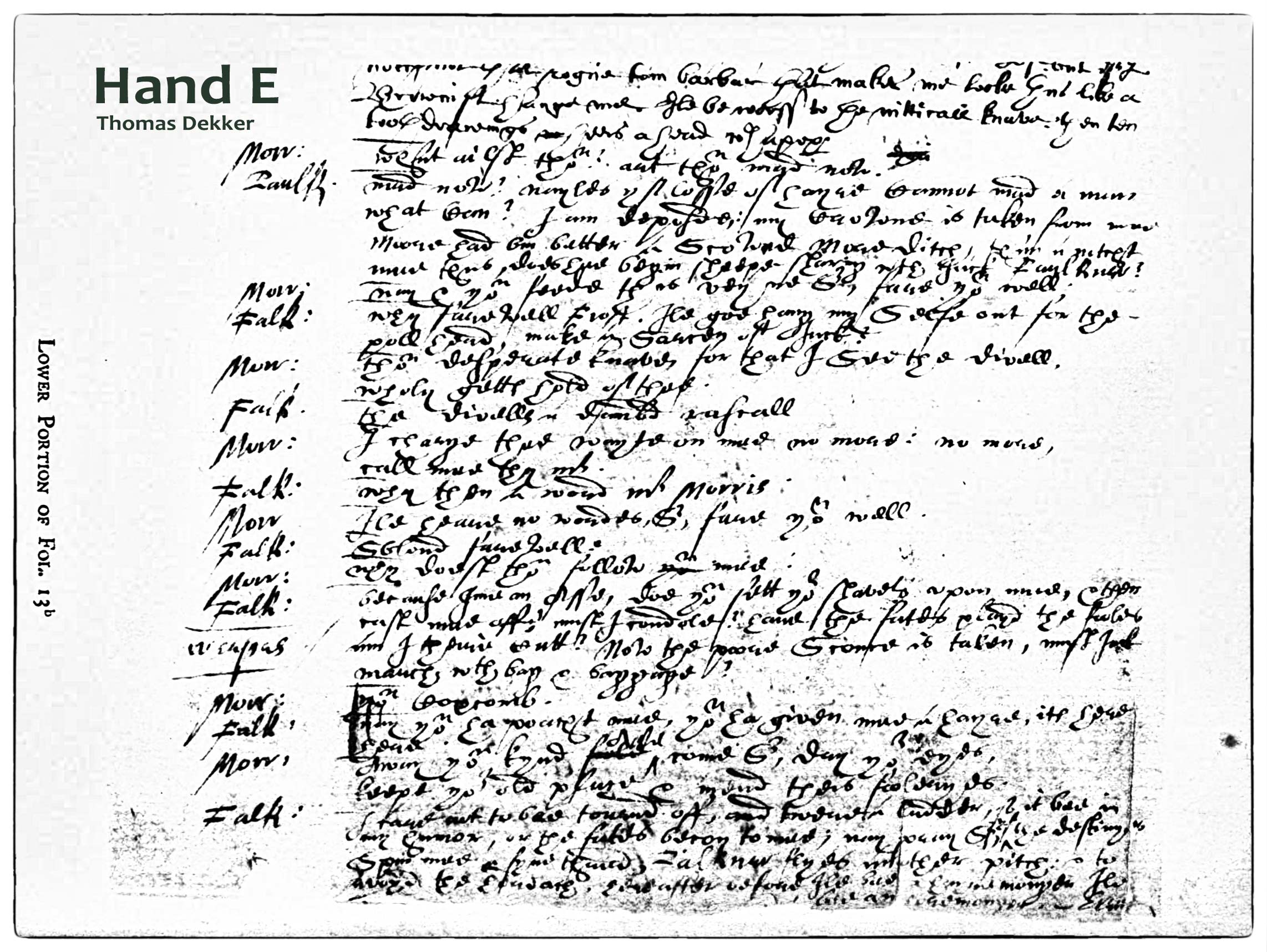
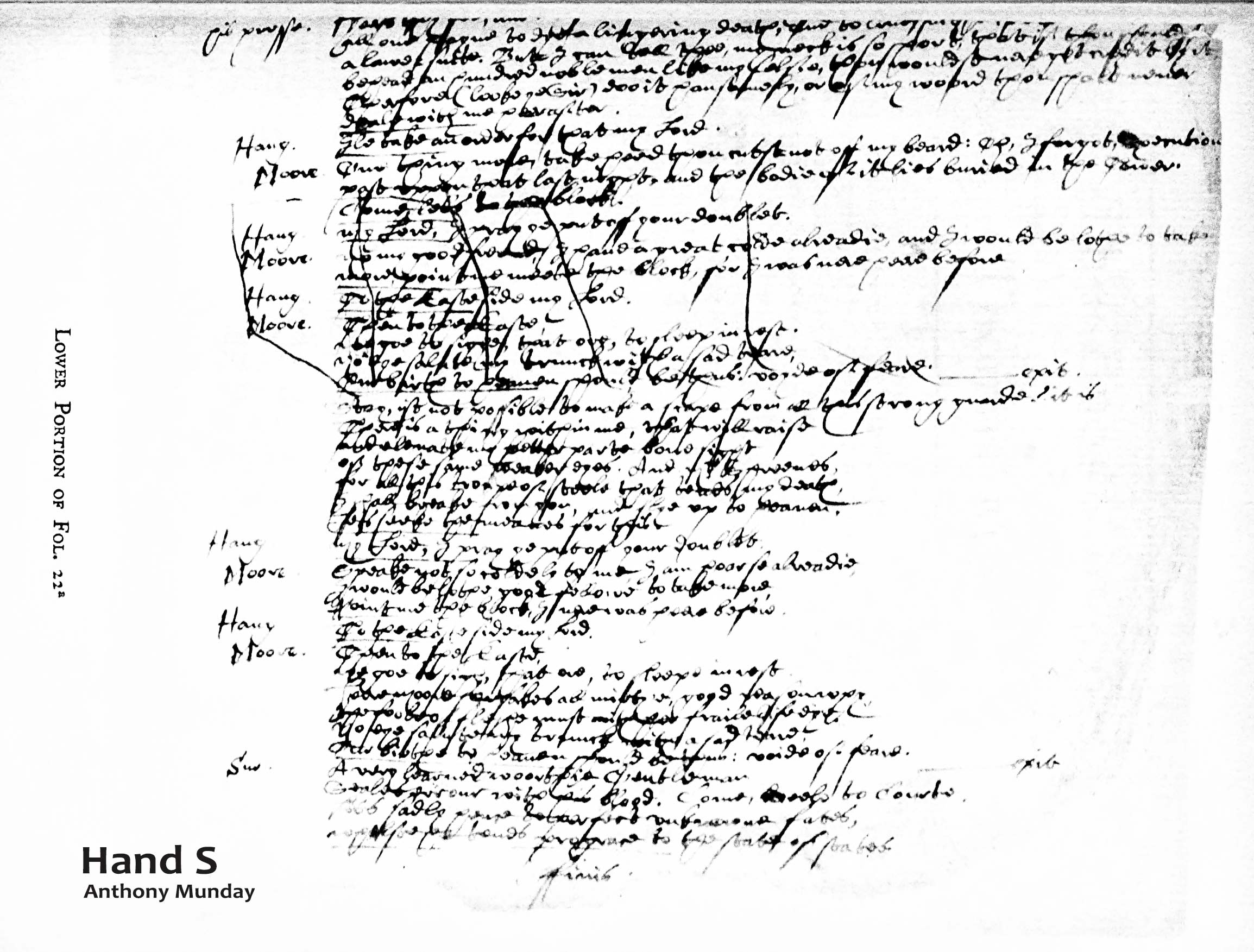
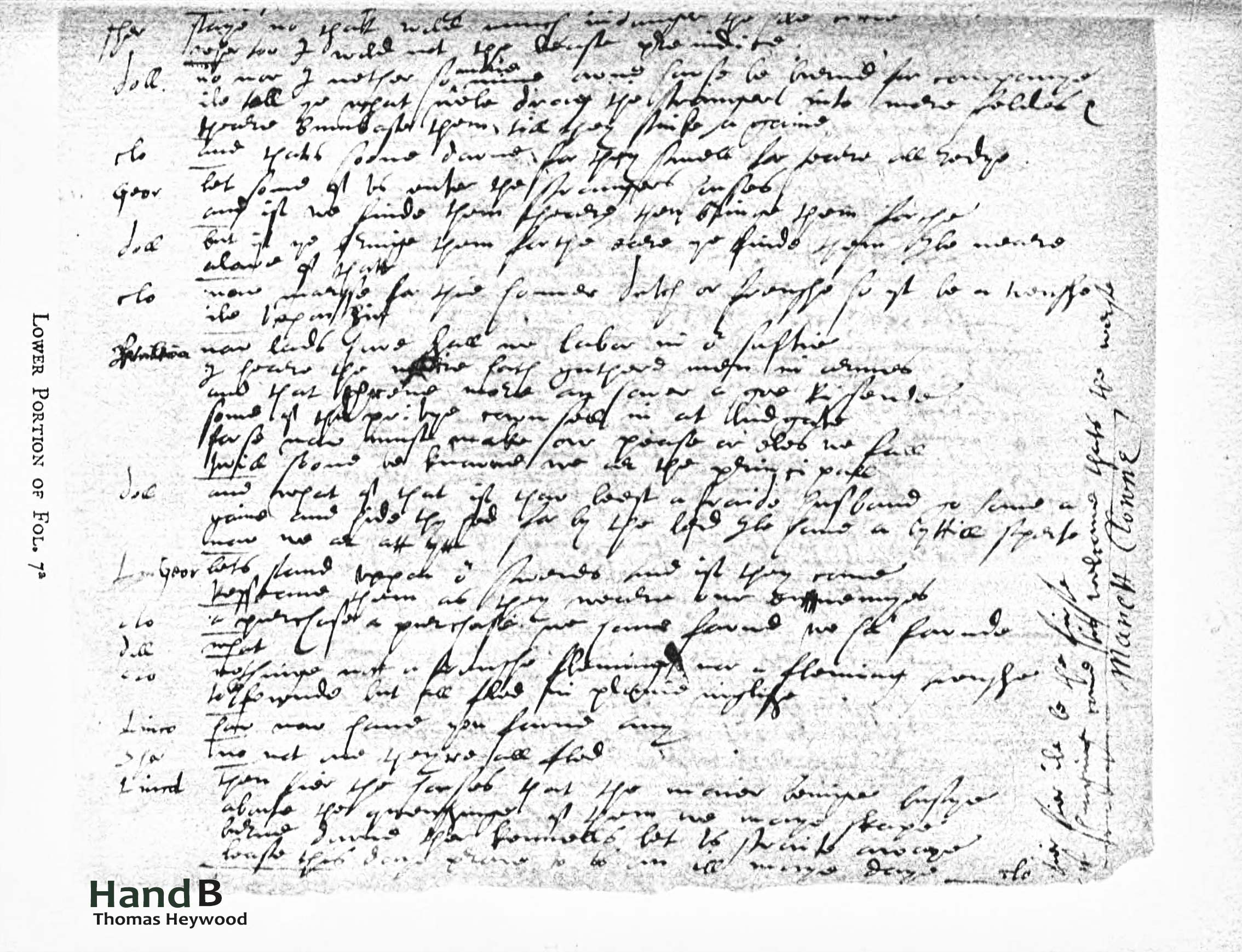
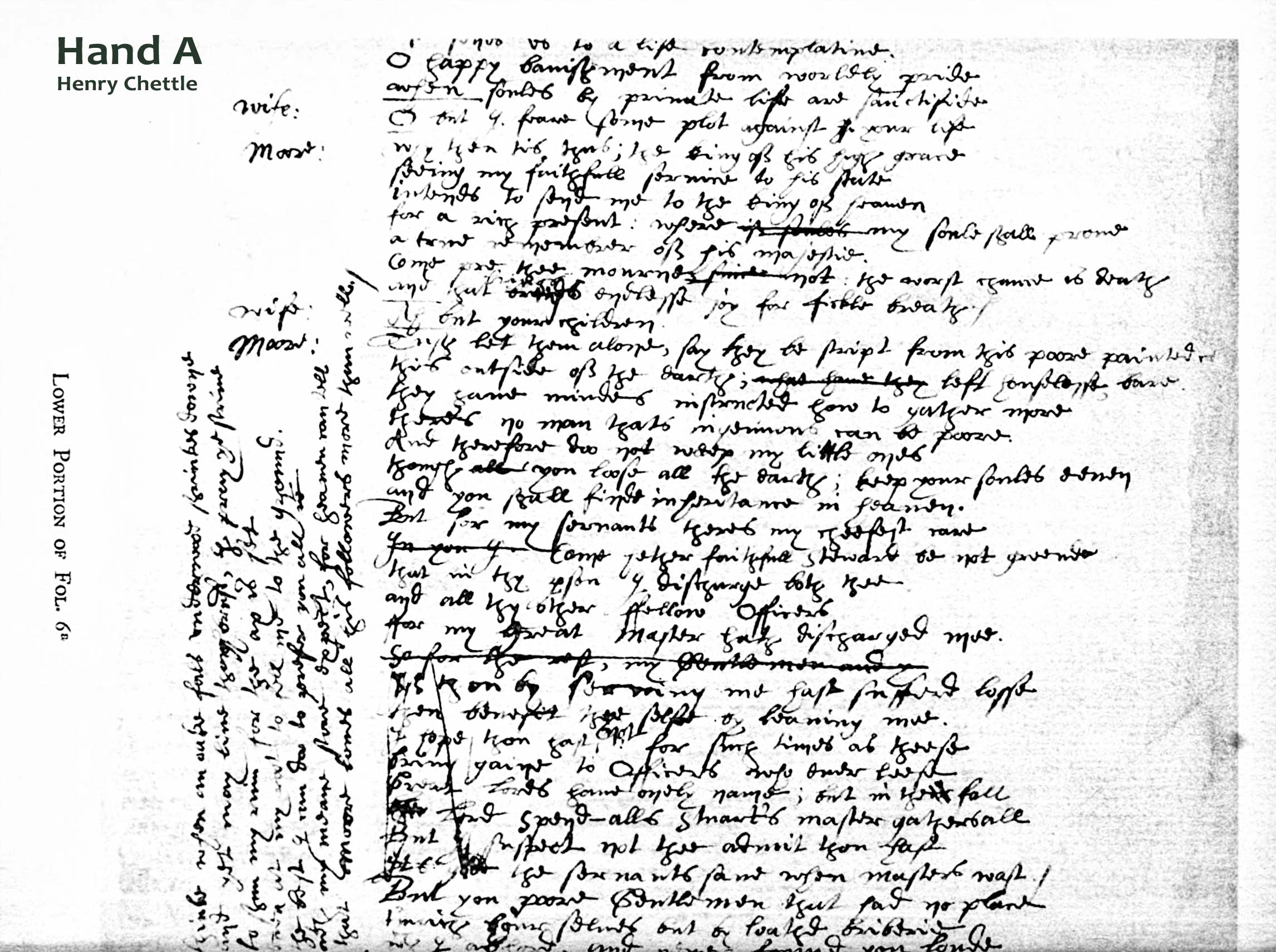
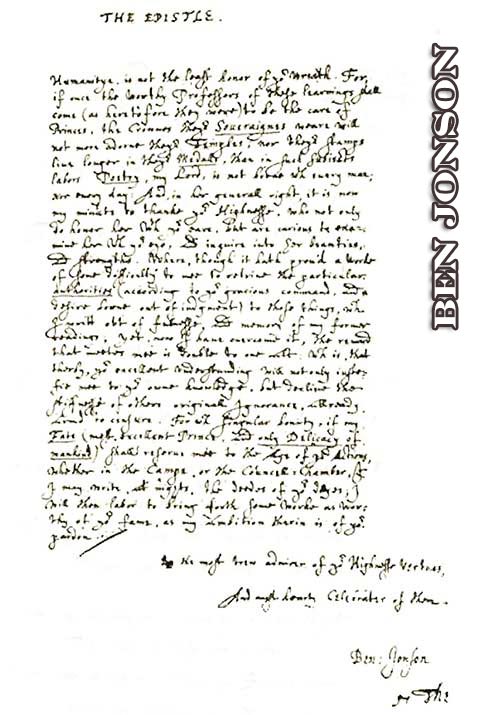
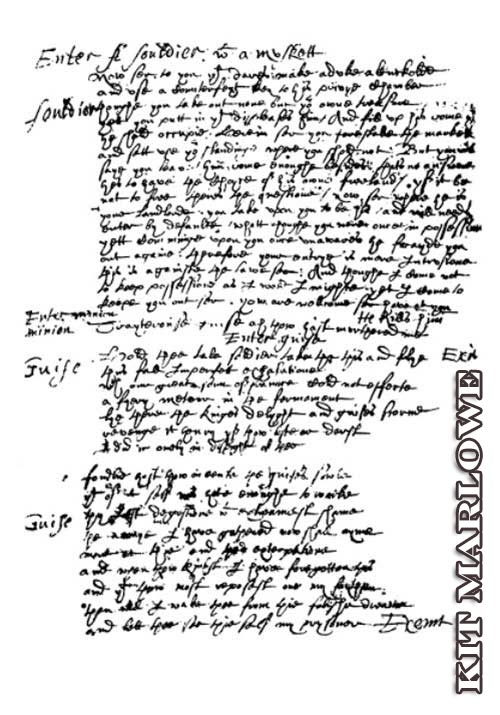
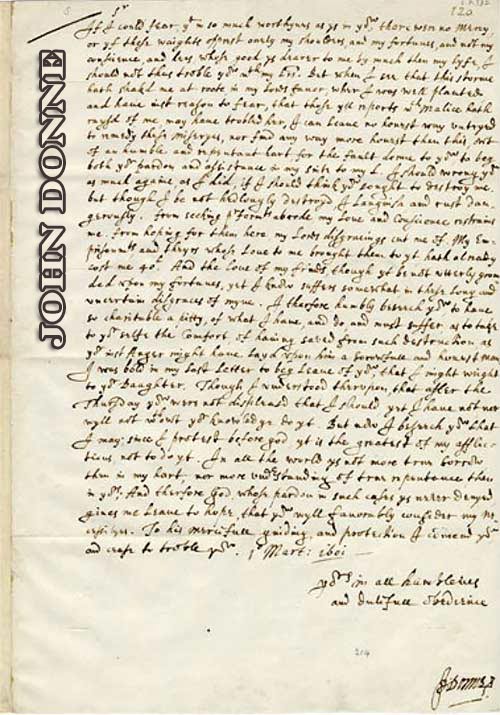
Hand D
Grant them removed, and grant that this your noise
Hath chid down all the majesty of England;
Imagine that you see the wretched strangers,
Their babies at their backs and their poor luggage,
Plodding to th’ ports and costs for transportation,
And that you sit as kings in your desires,
Authority quite silent by your brawl,
And you in ruff of your opinions clothed;
What had you got? I’ll tell you: you had taught
How insolence and strong hand should prevail,
How order should be quelled; and by this pattern
Not one of you should live an aged man,
For other ruffians, as their fancies wrought,
With self same hand, self reasons, and self right,
Would shark on you, and men like ravenous fishes
Would feed on one another…
His Calls him a god on earth. What do you, then,
But rise against God? what do you to your souls
In doing this? O, desperate as you are,
Wash your foul minds with tears, and those same hands,
That you like rebels lift against the peace,
Lift up for peace, and your unreverent knees,
Make them your feet to kneel to be forgiven!…
…You’ll put down strangers,
Kill them, cut their throats, possess their houses,
To slip him like a hound. Say now the king
(As he is clement, if th’ offender mourn)
Should so much come to short of your great trespass
As but to banish you, whether would you go?
What country, by the nature of your error,
To any German province, to Spain or Portugal,
Nay, any where that not adheres to England,—
Why, you must needs be strangers: would you be pleased
To find a nation of such barbarous temper,
That, breaking out in hideous violence,
Would not afford you an abode on earth,
Whet their detested knives against your throats,
Spurn you like dogs, and like as if that God
Owed not nor made not you, nor that the elements
Were not all appropriate to your comforts,
But chartered unto them, what would you think
To be thus used? this is the strangers case;
And this your mountanish inhumanity.
Coriolanus
Men: Your suffering in this dearth, you may as well
Strike at the Heauen with your staues, as lift them
Against the Roman State, whose course will on
The way it takes: cracking ten thousand Curbes
Of more strong linke assunder, then can euer
Appeare in your impediment. For the Dearth,
The Gods, not the Patricians make it, and
Your knees to them (not armes) must helpe…
Mar: Thanks. What’s the matter you dissentious rogues
That rubbing the poore Itch of your Opinion,
Make your selues Scabs…
…He that will giue good words to thee, wil flatter
Beneath abhorring. What would you haue, you Curres,
That like nor Peace, nor Warre? The one affrights you,
The other makes you proud. He that trusts to you,
Where he should finde you Lyons, findes you Hares:
Where Foxes, Geese you are: No surer, no,
Then is the coale of fire vpon the Ice,
Or Hailstone in the Sun. Your Vertue is,
To make him worthy, whose offence subdues him,
And curse that Iustice did it. Who deserues Greatnes,
Deserues your Hate: and your Affections are
A sickmans Appetite; who desires most that
Which would encrease his euill. He that depends
Vpon your fauours, swimmes with finnes of Leade,
And hewes downe Oakes, with rushes. Hang ye: trust ye?
With euery Minute you do change a Minde,
And call him Noble, that was now your Hate:
Him vilde, that was your Garland. What’s the matter,
That in these seuerall places of the Citie,
You cry against the Noble Senate, who
(Vnder the Gods) keepe you in awe, which else
Would feede on one another? What’s their seeking?
They said they were an hungry, sigh’d forth Prouerbes
That Hunger-broke stone wals: that dogges must eate
That meate was made for mouths. That the gods sent not
They vented their Complainings, which being answer’d
And a petition granted them, a strange one,
To breake the heart of generosity,
And make bold power looke pale, they threw their caps
As they would hang them on the hornes a’th Moone,
Shooting their Emulation.
…
There are only three other instances of men feeding on one another in the whole of EEBO, two of which may be references to Coriolanus.
Footnotes
“What would Shakespeare do about Europe’s migrants?” The Economist.↩︎
Anthony Munday, Shakespeare: William, (Bloomsbury Arden Shakespeare: London, 2011).↩︎
Hugh Craig and Arthur F. Kinney (eds.), Shakespeare, Computers, and the Mystery of Authorship, (Cambridge University Press: Cambridge (GB), 2009).↩︎
R. W. Chambers, Man’s Unconquerable Mind, (Haskell House Pub Ltd, 1939).↩︎
Darren Freebury-Jones, Shakespeare’s borrowed feathers: How Early Modern Playwrights Shaped the World’s Greatest Writer, (Manchester University Press: Manchester, 2024).↩︎
Margaret Tudeau-Clayton, “‘This is the strangers’ case’: The utopic dissonance of Shakespeare’s contribution to sir thomas more,” in Peter Holland (ed.), Shakespeare Survey: A Midsummer Night’s Dream: Volume 65: A Midsummer Night’s Dream, Vol. 65, (Cambridge University Press: Cambridge, 2012), pp. 239–254.↩︎
Craig and Kinney (eds.), Shakespeare, Computers, and the Mystery of Authorship.↩︎
Alfred W. (Alfred William) Pollard, Shakespeare’s hand in the play of Sir Thomas More;, (Cambridge, University P., 1923).↩︎
Some Oxfordians, like Nina Green in another of her ‘Oxmyths’ essays, cleave for support to Tannenbaum who rejected Maunde Thompson’s analysis and conclusions. Tannenbaum was a self-taught palaeographer, a psychiatrist by profession. Arthur Freeman & Janet Ing Freeman produced an authoritative work on forgery in the 19c¹, described his investigative monographs as ‘fringe at best’. Amplifying, they point out that ’Tannenbaum’s eccentric palaeographical claims were not always sceptical, nor restricted to Collier: in 1927 he made the only extendeded modern attempt to rehabilitate Madden’s unlucky purchase of the ‘Shakespeare’ Montaigne, with its signature ridiculed by Collier himself, discredited by Maunde Thompson, and disowned by the British Museum. Tannenbaum found its genuineness ‘unquestionable.” Robert Elrodt when writing in Shakespeare Survey², went further, quoting an Assistant Keeper of The British Museum, W H Kelliher, who said,“Tannenbaum’s arguments offer no serious challenge to Maunde Thompson”.↩︎
Pollard, Shakespeare’s hand in the play of Sir Thomas More;↩︎
Giles E. Dawson, “Shakespeare’s Handwriting,” in “Shakespeare’s Handwriting,” Shakespeare Survey, (Cambridge University Press, January 1990), pp. 119–128.↩︎
Samuel Aaron Tannenbaum and Modern Language Association of America., Problems in Shakespeare’s penmanship, including a study of the poets will, (The Century co. for the Modern language association of America: New York, 1927).↩︎
Craig and Kinney (eds.), Shakespeare, Computers, and the Mystery of Authorship.↩︎
Craig and Kinney (eds.), Shakespeare, Computers, and the Mystery of Authorship.↩︎