Shakespeare’s Biography
Professor Nelson’s a Plea for Documentary Discipline
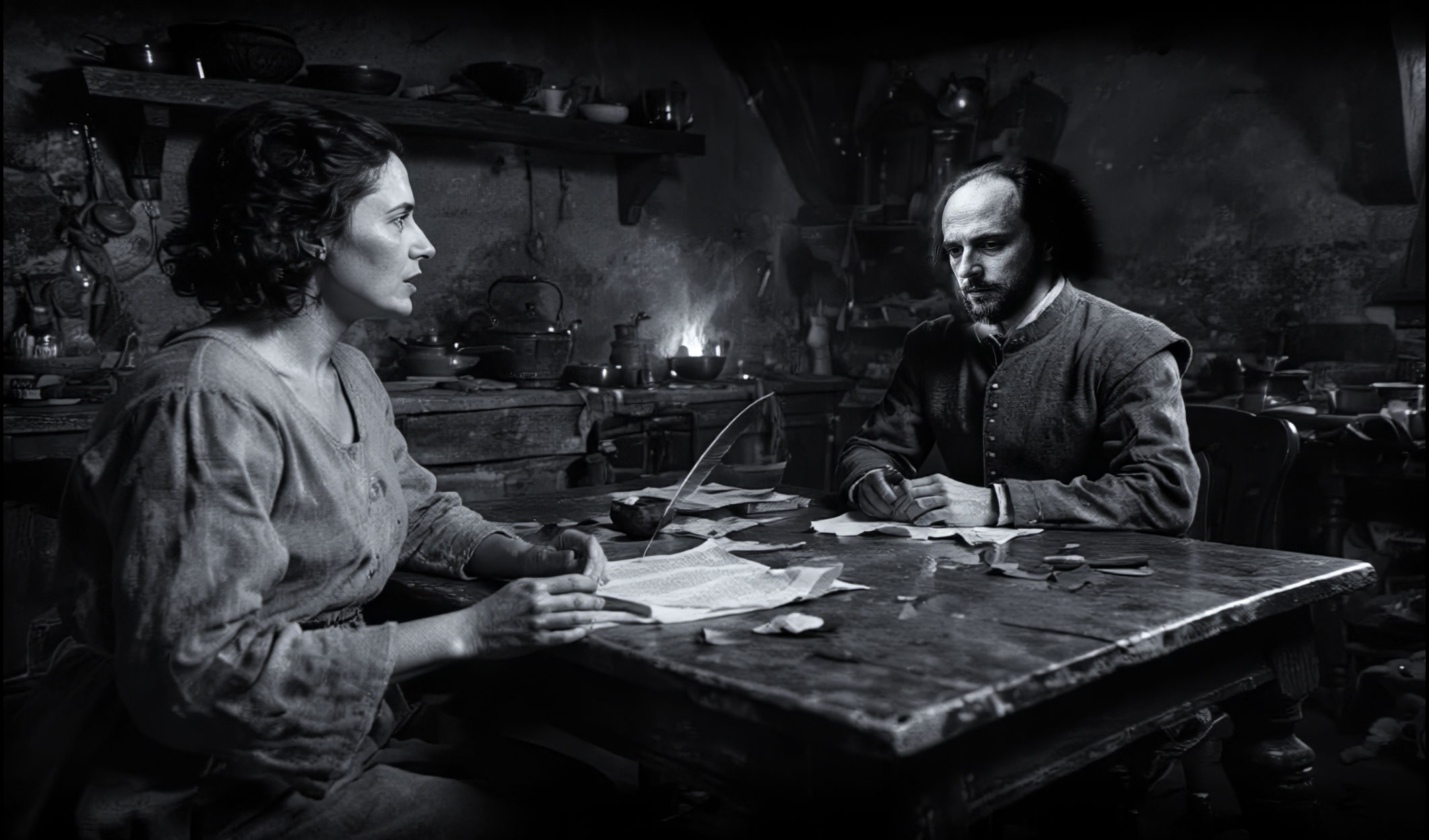
The history of Shakespeare biography has provided a playground for Doubters. When compared to highly fictionalised lives that Doubters create to accommodate their candidates, it can seem like Shakespeareans are also terraforming Stratford to accommodate their author. Where can you find more speculation than in a 500-page biography of a life that left so little behind? Dozens of biographies reflect a conflict between archival evidence and the desire for a coherent narrative. Shakespeare in Love, the Oscar-laden film of Shakespeare on the threshold of his fame, is sometimes described as “just as accurate and informative as any biography despite being entirely fictional”. It’s a texture issue, claim its fans. The history may be imaginary but the film delivers an accurate version of the historical and artistic texture of early English theatre, capturing Shakespeare’s Bankside world perfectly.
In 2003, Alan H. Nelson,1 the 17th Earl of Oxford’s only peer-reviewed biographer, addressed the issue of biography in relation to Shakespeare Scholarship, observing a number of basic principles.
Nelson’s Four Principles of Restraint
- Documentary Primacy: Treat claims of inauthenticity with care. Casting doubt on authentic documents—as, for example, Samuel A. Tannenbaum2 often did—is as destructive as forgery.
- Restraint in Speculation: One must draw meaning from a document, but practice restraint.
- Mythos vs. Fact: Treat the “Shakespeare mythos” as evidence of popular interest at the time, not as biographical data.
- New Discovery: Follow the example of those like Park Honan, who approached the Stratford archives with a finer-toothed comb than any predecessor.3
Lena Orlin’s4 Private Life of William Shakespeare brings the whole business back down to earth. By drowning her readers in solid detail, she rebuilds the whole Stratfordian landscape from the archival record. Instead of focussing only on William Shakespseare and fitting the environment to the man, she concentrates on the environment and lets Shakespeare find his place in it. As a consequence, Stratford upon Avon emerges as as an English market town riding the crest of sixteenth century wave of prosperity. She showes it to be a well-managed community with a modern charter, stable institutions and an eye to the future. The Shakespeare’s place within it is mapped in all the detail that records afford. The lives of their neighbours and relations receive similarly close examination and while the book is not entirely free of speculation, the fuller picture has a sense of modernity in the early progressive culture of the West Midlands that dispenses with Doubter accounts of the bookless cultural wasteland in which they try to maroon the young artist.
The Quiney Letter - an evidence cluster
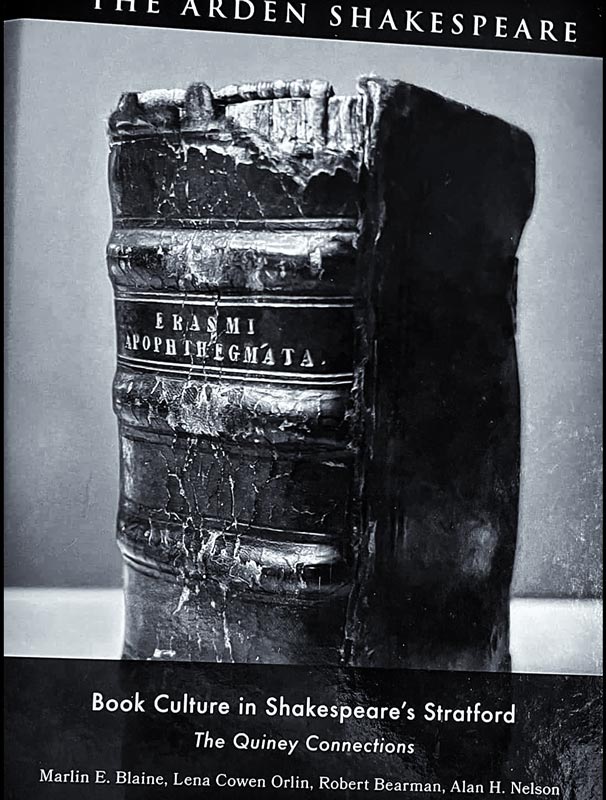
A hugely important new book5 on Shakespeare’s Stratford. Three other authors join Orlin in building out an accurate picture of culture in Elizabethan Stratford upon Avon
The Quiney letter, often built out by Doubters as evidence of a money lending career activity, shows how a single document can be misinterpreted when deliberately taken out of context. The letter, written by Shakespeare’s friend and fellow Stratford resident Thomas Quiney, referred to a petition to the local authorities regarding a property dispute. Doubters have seized upon the letter’s tone and content to paint Shakespeare as a man of questionable character, but this is a gross misreading.
Orlin accepts that there is little actual documentary evidence for Shakespeare’s side of the correspondence but she plumbs the reasoning behind the letter’s tone and context to its absolute depth, extracting every connecting circumstance on Quiney’s side and building an detailed account of what the money was for, why Shakespeare was asked for it, showing its relevance to Quiney’s family, his neighbours and to Will and Ann’s financial dexterity. Orlin provides a long and detailed portrait of money and investment at work in Stratford and London, revealing just how modern the practices of family investment were. The letter is not a “smoking gun” of Shakespeare’s bad character but a window into the financial and social networks of Stratford, demonstrating the interconnectedness of its residents and the practical realities of life in a provincial town. The necessity of outward looking activity and investment. The letter’s significance lies not in what it reveals about Shakespeare’s character but in what it tells us about the social and economic context in which he lived. Instead of imaginatively filling the gaps. Orlin concentrates her efforts where there is real data and solid evidence, understanding historical documents within their broader context, rather than using them as isolated pieces of evidence to support preconceived narratives.
By delivering all the reliable tangential data that exists, it becomes connective and capable of profound new insights into the people most closely connected to Shakespeare.
This entirely removes the oxygen from the Doubters’ favourite tactic of filling in the gaps in Shakespeare’s CV with their own demeaning fantasies— the polar the opposite of Orlin’s approach. Without evidential support make Shakespeare’s life as inimical as possible to life of a great poet, disconnecting him from his own world and building him another in which the rich and entitled are the masters, the artists and the inheritors of everything.
The Doubter portrait of Shakespeare in Stratford has always been an absurd caricature, intended to diminish Shakespeare’s capabilities and render him incapable of great work. Many will describe him as an ‘illiterate bumpkin’, a ‘wool brogger’, a ‘tight fisted money-lender’ or a ‘malt hoarder’. Instead of imaginatively supplying detail we don’t have Orlin uses a method of clustering evidence, comparing Shakespeare’s records with those of his ‘coetaneans’ (contemporaries).to show that many parts of his life previously thought to be ‘mysterious’, ‘underhand’, ‘illegal’ or ‘insulting’ were actually standard early modern practices.
Like the PFC, there has been little or no response to Orlin’s book, from Doubters..
The ‘Second-Best Bed’ Reinterpreted
Orlin examined thousands of contemporary wills and found that ‘second-best’ was an identifying term, not a qualitative one. She found instances of people leaving their ‘worst’ beds, but never as an insult. Anne was already legally protected by ‘dower rights,’ which guaranteed her a third of his estate and the right to live in the family home. Bequeathing the bed was a way to ensure she kept a specific, sentimental piece of furniture that might otherwise have been claimed by his heirs as an ‘heirloom’ of the house.
The Funerary Monument: A Life Portrait
Orlin’s most radical discovery concerns the monument in Holy Trinity Church. Traditionally thought to have been erected by his family years after his death, Orlin argues it was commissioned by Shakespeare himself while he was still alive. She identified Nicholas Johnson (not his brother Gerard) as the sculptor. Nicholas was a tomb-maker based in Southwark, just steps from the Globe Theatre. Orlin pointed out that the inscription on the memorial plaque was painted in two stages; a space was left for the specific date and age of death to be added later. The fact that this information is ‘squeezed in’ awkwardly suggests the rest of the monument was already finished before he died.
Marriage as ‘Self-Determination’
Orlin challenges the ‘shotgun wedding’ narrative, viewing the marriage as a strategic move by a young William. In the early modern period, an unmarried man was usually bound to a seven-year apprenticeship. By marrying at 18, Shakespeare effectively ‘emancipated’ himself from the local craft system in Stratford. This allowed him to pursue a literary career and property investments much earlier than his peers. Orlin suggests that Anne’s own work and management of the household in Stratford provided the financial stability that allowed William to establish himself in London.
John Shakespeare’s Financial ‘Failure’
Biographers often claim Shakespeare’s father, John, fell into a ‘shameful’ poverty that William had to ‘rescue’ the family from. Orlin’s research into Stratford’s civic records suggests that John’s ‘withdrawal’ from public life was a common strategy to avoid the heavy financial burdens placed on civic leaders during times of economic hardship. She identifies similar patterns among John’s neighbours.
The Fallacy of the “Lost” Years
While the lack of a continuous, day-by-day diary is lamented by biographers, this is a standard condition for any non-noble individual in the sixteenth century. The expectation of a modern “interior” biography is a projection that disregards the nature of early modern record-keeping. This is where the work of E.K. Chambers and later S. Schoenbaum6 remains essential. They recognized that the “missing” narrative is a product of our own generic expectations, not a failure of the archives.
Footnotes
Alan H. Nelson, Monstrous adversary: The life of Edward de Vere, 17th Earl of Oxford, (Liverpool University Press: Liverpool, 2003).↩︎
Samuel Aaron Tannenbaum and Modern Language Association of America., Problems in Shakespeare’s penmanship, including a study of the poets will, (The Century co. for the Modern language association of America: New York, 1927).↩︎
Honan’s Shakespeare: A Life (Oxford, 1998) remains a benchmark for this archival rigor, though it predates Orlin’s work on the Shakepeare’s in Stratford. Orlin’s The Private Lives of the Shakespeares (Yale, 2024) builds on this foundation with even more exhaustive research into the social and economic context of the Shakespeare family.↩︎
Lena Cowen Orlin, The Private Life of William Shakespeare, (OUP Oxford: Oxford, 2021).↩︎
bloomsbury.com, “Book Culture in Shakespeare’s Stratford,” Bloomsbury.↩︎
S. Schoenbaum, William Shakespeare: A Compact Documentary Life, (Oxford University Press: Oxford, 1978).↩︎