Emilia Bassano Lanier
The currently popular leading female
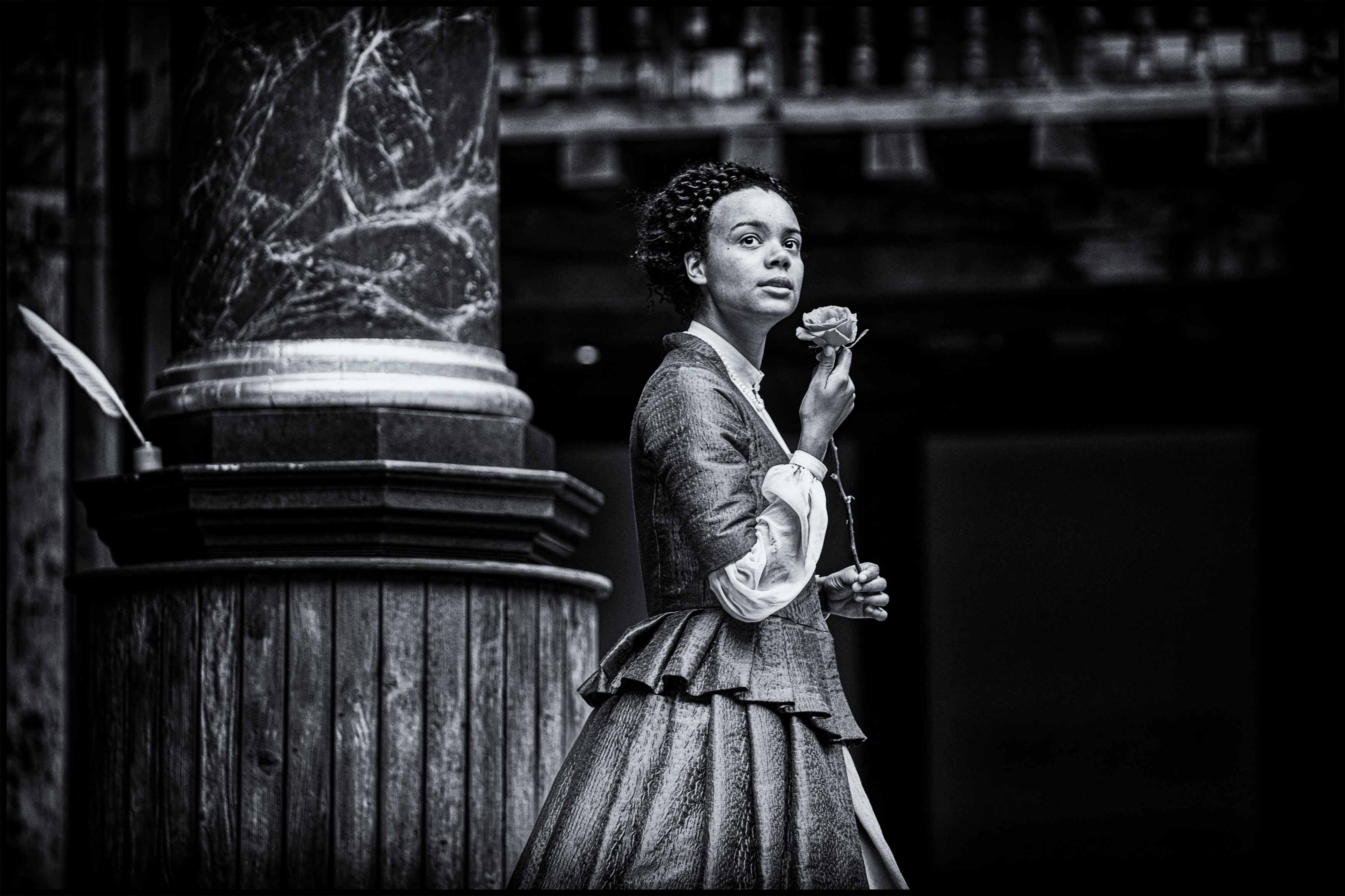
There are three Emilias in Malcolm Lloyd Malcolm’s 2018 play about Emilia Bassano, none of whom, sadly, wrote any of Shakespeare’s work. The play received some stellar reviews yet Winkler, in her quest to remove Lanier’s light from the bushel, includes no reference to it.
In an Atlantic article in 2019, Elizabeth Winkler proposed Elizabethan poet—indeed, as far as we know the first professionally published female poet in England – Emilia Bassano Lanier as the true author of the works of William Shakespeare. By itself, this raised little notice other than possibly evincing the sad decline of a once great publication; after all Winkler is not the first person to opt for EBL (as she is known in the SAQ community 1), nor was she the last. Modern day Fanny Hurst2and highly successful author of books for which I am not of the target audience, Jodi has, in her own words, followed Winkler down the “rabbit hole” of Denialist conspiracy theories and also landed on EBL. It is a little odd that Picoult, who makes her living with words, does not fully appreciate the implications of the rabbit hole trope, but there it is.
The methodology and arguments Winkler and Picoult rely upon are not unique takes on the issue. What has raised notice is that after numerous experts bluntly told Winkler that she was wrong (and why!), instead of questioning her research, her assumptions and the validity of her conclusions, she wrote a book3 Winkler was unwilling to accept the possibility that she is being told she is wrong simply because she is wrong and found in her universal rejection by experts a plot to silence those who think like her. As a result, she has made of herself a poster child for the poor, suppressed Shakespeare Denialists. Bravely confronting the biggest taboo in literature! Ignored or denigrated by an academia that is moribund and afraid to seek out the truth, confront preconceived ideas or question existing assumptions! We will get to Winkler’s self-professed “heresies”, but let’s look at the candidate first.
EBL is an interesting Elizabethan figure who deserves and gets study in her own right, and Winkler insults her legacy and diminishes her importance by forcing her to don the borrowed cloak of another writer. EBL was born in 1569, and died in 1645, which as a candidate presents an interesting chronology question, since it assumes she started writing for the public stage a tad too early at roughly 20 and stopped writing a lot too early at about three decades before her death. On the bright side, having a life span that includes all of the corpus during, more or less, adulthood alone makes her a better candidate than Oxenford since you do not have to rearrange the entire history of Elizabethan and Jacobian drama to fit her lifetime. The faked death fantasies of Marlovians are likewise unnecessary.
EBL was born into a definitely musical, partly Venetian and arguably Jewish family. After her father’s death when she was 8, she was educated in the household of the Countess of Kent and lived for a while with the family of the Countess of Cumberland. Some time after her mother’s death, the 18-year-old EBL became the mistress of Henry Carey, the First Lord Hunsdon who was ER I’s cousin (according to some, half-brother) and Lord Chamberlain, where she was “maintained with great pomp” and enjoyed, in every sense of the word, a lavish lifestyle. Unhappily married in 1592 to a family connection in order to, allegedly, hide a Hunsdon induced pregnancy, she wrote and published a volume of poetry in 1611 entitled Salve Deus Rex Judaeorum, this time using her own name4 instead of what Winkler claims was her established and successful pen name—reasons not included. The title cut is not Shakespearean in its voice, or its language - except in the vague sort of way all Elizabethan poetry sounds similar to modern ears. It is also, for that matter, not particularly good. Nor does there appear to be any thematic consistency with Shakespeare’s works either.
EBL’s husband died in 1613, at which point Winkler and Picoult seem to think EBL stopped writing under Shakespeare’s, or any, name, also for reasons. EBL ran a school until 1619-ish, sued her brother-in-law, and at some point was described as a “pensioner” before her death at age 76, after 30 years of artistic silence.5
It never seems to occur to Denialists that what Shakespeare created were interesting, three-dimensional characters who resonate as believable people wherever Shakespeare places them.
Winkler’s Atlantic article leans heavily into common Shakespearean wish fulfillment fantasies. Winkler sees a feminist attitude in the likes of Lady Macbeth, Rosalind, Isabella, Portia, Kate of Kate Hall6and that greatest and most modern of all Shakespearian heroines, Beatrice7She projects on the plays a buried theme of strong women fighting male hegemony. From this she posits a female Shakespeare. Notably, this thematic concern does not appear in EBL’s actual published work. Shakespeare’s work is so wide-ranging that it is particularly easy to read into it what you want to see. While I suppose there may be some basis for arguing that Shakespeare was, for the Elizabethan Era, feminist adjacent – I would argue those strong women seem strong because Shakespeare wrote them as real and vibrant humans—what Winkler sees as a feminist perspective in Shakespeare is mostly Shakespeare as a mirror, in which Winkler then sees herself.
Winkler’s EBL theory is of the same species as Safa Khulusi’s belief that Shakespeare was an Arab. It is guided not by external evidence but internal desire. Inventive, sure, but inventive does not mean it should be taken seriously as an option. Her theory is maybe a little more solid than Khulusi’s, if only because unlike Sheik Zubayr bin William, EBL actually existed.8It is a cousin to the Oxenfraudian belief that Shakespeare just had to be an aristocrat. It never seems to occur to Denialists that what Shakespeare created were interesting, three-dimensional characters who resonate as believable people wherever Shakespeare places them. Looking into my own mirror, I think the most fully realized and recognizable of Shakespeare’s characters is Bottom9but that does not provide evidence Shakespeare was a weaver.10
Having decided on a female Shakespeare based on her personal reading, Winkler posits EBL as that woman because, well, I think because EBL was a woman in Elizabethan England who, according to the evidence Winkler chooses to believe, wrote. She cites no stylistic similarities, no commonality of theme and certainly no actual real-world evidence, linking her to Shakespeare’s works.11For Winkler who in her Atlantic article rejects Shakespeare as Shakespeare for lack of unequivocal statements he was an author [sic]12and any sign he wrote [even siccer]13 glomming onto EBL without even an equivocal representation she was Shakespeare or any sign she wrote his works is at best odd and more accurately blindingly hypocritical.14
Picoult echoes Winkler from the depth of the rabbit hole, though in her case she adds the idea that what the strong women in Shakespeare show is women searching for their own voice. In part, this is due to Picoult’s looming novel about EBL and her fictional current day descendent which promises to tackle issues regarding women finding their voice in a world dominated by men. Even though as history the idea is twaddle, the book could be worth a look – Ros Barber’s book is apparently an interesting fictional tale15– although given Picoult’s oeuvre I will wait for her new book to become a Lifetime Network Original Movie. I have no problem with alternate history, even absurd alternate history, if it is well done and thoughtful. I do have a problem with the authors trying to pass their fiction off as true. Say what you want about the jarring tonal shifts of Inglourious Basterds – and mind you, I can say a lot – at least Quintin Tarantino has never tried to convince people Hitler actually died in a Paris theater fire.
Interestingly, Picoult also uses EBL as a mirror, and the reflection she sees is of a woman denied her own voice because of gender and forced to subsume her identity. To no one’s surprise this reflects the themes Picoult wanted to explore in her own novel. That her wish was the father to her thought does not seem to occur to her. On the other hand, this does cure one problem Winkler ignores. It gives EBL a reason to suddenly start writing in her own name: reclaiming her voice. Picoult does not explain why EBL changed not only her name in 1611 but her style and thematic concerns as well, and also sort of started to suck, but at least it is something. Again, I can see that as a powerful fictional moment in the hands of a skilled novelist. Whether Picoult meets that description is not for me to say16 but regardless wishing something to be true and finding in your wish grist for the mill of one’s imagination provides precisely zero evidence that it actually is true.
Picoult says she has “done research”. Which I am sure she has, although the real question is what sources she researched, other than talking to Mark Rylance. She invents rather freely things for which there is no evidence at all, for instance a relationship with Southampton – there is no evidence they ever met - and a “mentor” who might be Kit Marlowe, for whom there is also no evidence they ever met. But her biggest evidence free inventions are first, the factually unsupported theory that EBL had a hidden literary career before 1611, and second, attaching that imagined career to the works of a specific extant person.
Whether you choose to believe the evidence and facts or not, they point to no one else; it is Shakespeare or the void.
Picoult bases her idea of a hidden literary career, in part on the not entirely accurate claim that people do not become authors at 43 like EBL did.17Even if it were true, Authors usually don’t stop writing at 43 either, not if they have another 30 years to live. She offers no reason for the silence. Picoult erroneously claims that we do not know Shakespeare “actually put quill to paper” (She does not provide an alternate method for how the extant signatures came to exist.18) but there is no evidence that, before 1613, EBL did either. Picoult ignores this. There is no evidence that the publication of Salve Deus Rex Judaeorum was anything other than a one off. There is no evidence of anything like that secret career Picoult imagines.19
Even if you want to imagine a secret literary career for EBL, and there is flatly no evidence of one, there is no reason why that secret career would involve the works attributed to Shakespeare – or any other actual then existing identified author for that matter - instead of, oh, the hundreds of Elizabethan poems and plays printed anonymously, merely referenced without attribution in the records, privately circulated or lost to time entirely. There are uncountable things known and unknown for Picoult to put EBL’s name to if she wanted to theorize about EBL writing. There is not, outside of novelistic ones, any reason to imagine that those hidden works were Shakespeare’s works. Even if you accept the evidence-free idea that Shakespeare was not Shakespeare and you also accept the equally evidence-free idea that EBL has a secret literary career, there is no evidence at all for connecting those two dots amidst a sea of other dots. It is almost as if Picoult’s knowledge of Elizabethan literature has in it but one only man.
Beyond these inventions, Picoult connects two specific plays, Romeo and Juliet and Othello, to EBL based upon her reading of EBL’s life. First, she ties Romeo and Juliet to EBL by noting Shakespeare made a point of repeatedly mentioning that Juliet was 13, “the age that Emilia was when she was given against her will to become someone’s mistress”. “Against her will” is a not necessarily true extrapolation on Picoult’s part that seems based on Picoult’s viewing the past as being like modern day, but more egregiously Picoult’s statement is off by five years. EBL was 18, not 13, when she became Hunsdon’s mistress after her mother’s documented death, or at least burial, in July of 1587. EBL’s being 18 at the onset of her affair with Hunsdon slightly undercuts the idea that it has anything to do with Juliet’s being 13. Anyway, she did research.
entity-type=“file” entity-uuid=“2608f072-2b96-4c97-9106-200b1bf55aa7” style=“float: left; margin-left: 0px; margin-right: 8px;” width=“450”}Picoult’s argument tying EBL to Othello runs afoul of a Denialist error even more common than shoddy research: hypocrisy. She sees references in Othello that she believes describe a mural in EBL’s “ancestral home” of Bassano del Grappa, Italy, and finds, apparently, the whole plot in the names of two apothecaries there, Cinthio be damned. Here is the problem: in arguing against Shakespeare as author, Picoult claims he could not be the author because he never visited the places he described in his plays. She “knows” this because there is no record of his travelling. It is a stupid point fashioned solely for and applied solely to Shakespeare – no one claims Marlowe could not have written Tamburlaine because there is no evidence he ever visited the Middle East – but Picoult ignores the fact that based upon the same evidence, EBL never travelled either and never set foot in Italy, let alone Bassano del Grappa. If Shakespeare needed to travel to see a mural to write Othello so would EBL. If he needed to visit Denmark to write Hamlet, so would EBL. But Picoult does not hold EBL’s lack of documented travel against her – does not mention it at all in fact, because like most Denialists Picoult ignores inconvenient facts. If Picoult applied the standard of scrutiny and level of certainty she reserves for Shakespeare, rather than find evidence EBL wrote Othello Picoult would have to categorically hold that EBL never went to Bassano del Grappa, never saw the famed fresco did not know of the town’s apothecaries, and therefore could not have written Othello. She unsurprisingly does not.
If Picoult treated her “evidence” for EBL the way she treats evidence for Shakespeare, she could not claim EBL wrote anything before 1611. She could not claim EBL wrote about a fresco she had never seen. She could not claim EBL wrote about cities she never visited. She could not claim EBL knew Southampton. She could not claim EBL was mentored by Marlowe – admittedly that one is conditional, the one time she admitted that she imagined facts because she wanted them to be true. She could not claim any connection with the plays, sonnets and poems of Shakespeare. She could not claim a sonnet was about the death of EBL’s infant child. Picoult makes all these claims, though, because she is a hypocrite about the evidence. All Denialists are. No candidate for authorship would survive the level of skepticism and scrutiny Denialists must subject Shakespeare to for Denialism to even exist.
Some Denialist, I think it was one of the Ogburns, once wrote that you cannot get anywhere with Oxenford until you are rid of William Shakespeare. This is the ultimate weakness and hypocrisy in every alternate Shakespeare. To get to the point where you are looking at alternate authors at all, you have to jettison every bit of actual fact that surrounds the authorship of the plays because the only person the actual facts point to is William Shakespeare. Whether you choose to believe the evidence and facts or not, they point to no one else; it is Shakespeare or the void. And for Denialists, since you have opted for the void rather than the evidence and facts to get to the point of an alternate author, you need not rely on any facts or evidence to support your candidate. You can fill the void with whoever you want. This leaves Denialists like Winkler and Picoult free to engage in arrant, unsupported and evidence free speculation. That is not how academia works. That is not how evidence works. Winkler and Picoult do not get a hearing because they do not deserve one. Which leads us to…
Winkler’s bemoaning that no one in academia takes her and other Denialists seriously misses the real point of the rejection. It is not that scholars are not examining the Denialist claims, it is that they already have. Repeatedly for over 100 years. Repeatedly. What Winkler is hearing is not the frightened reaction of threatened academics deriding her claims because they are worried about the impact of alternate authors on their role in some “Shakespeare industry” or the shaking of some “blind faith” quasi-religious belief in Shakespeare, it is the frustrated unanimous mutterings of people who have been through all this before and are frankly sick of this shit.
It would be different if academics were ignoring something NEW in terms of the evidence and the argument, but they are not. The evidence Winkler relies upon in rejecting Shakespeare as the author has not substantially changed for 100 years. The fact of Shakespeare’s writing career has been established in academia with all of the facts that lead Winkler to skepticism already known and accounted for. While there are minor differences on how Denialists argue for their candidates, the arguments against Shakespeare as author are the same regardless of who they speculate about in the end. These arguments are constantly rephrased but also have not changed significantly for over 100 years. There is nothing new under Winkler’s Denialist sun.
Academics simply are done with the Sisyphean task of constantly dealing with the same argument.
She is new to the party, and may not see it, but that is where Winkler is. She is not a bold heretic, she is the 26,514th iteration of the same discredited argument, and academics will none of it. Denialists as a group lack a sort of intellectual object permanence. Their arguments are reviewed and rejected, but that rejection never takes hold. The same objections, the same arguments, the same evidence are breathlessly raised as exciting new discoveries by new Denialists on a regular basis, and refuted in their turn, and reraised and rerefuted. It has become a never-ending cycle, and viewing the historical course of the SAQ is like looking at a demented Escher engraving of articles, posts, books and tracts forever marching up the same set of stairs.
Academics simply are done with the Sisyphean task of constantly dealing with the same argument. At some point long past, barring new evidence that has not been forthcoming,20the matter has been as fully litigated as it ever will be. This is where the comparison to Flat Earthers, Creationists and Election Deniers adhere most closely to Denialists. These conspiracy theories have been considered and rejected and raising the same argument again changes nothing. There is no reason to continue to beat dead horses, or to treat horse resurrectionists seriously. Winkler is not some knight striding forth to do battle with academia over some wrong done to the Denialists. She is, at best, a Denialist Kari Lake.
Notes
If you want a review of Winkler’s book this is not it. I recommend this one, if only because I relate to anyone who dispenses voluminous snark through footnotes: https://rb.gy/lo4xvd Anyway, I will defer to this excellent presentation for its arguments against the book-level claims Winkler has made.
For her part, Picoult has also written a book, a novel entitled By Any Other Name scheduled to be published in the US in August of 2024. Which means that I have not as of this date (Early June 2024 as I am writing) failed to read it, but fail to read it I eventually will.
My comments are based primarily upon Winkler’s Atlantic article, her later public record comments and related commentary pro and con, and various interviews and comments from Picoult, particularly one in The Telegraph, [www.telegraph.co.uk]: (http://www.telegraph.co.uk) which is the source for the quotes. It also, like Winkler’s Atlantic article, has now disappeared behind a paywall that I refuse to pay to breach, as I am cheap. I could access both when I drafted this, but did not have access to either for a final check. If I made an error, let me know. Wisdom loves correction, and he who hates reproof is a fool. A pretty relevant proverb (12:1) for the two fools under discussion, particularly Winkler who has, proverbially at least, written a foolish book.
Hope for the best, expect the worst
You could be Tolstoy or Fannie Hurst:
So take your chances; there are no answers
Hope for the best expect the worst!
Footnotes
Starting now, I just decided.↩︎
Not that there is anything wrong with that. Hurst had a long, successful and lucrative literary career. At least originally, she was reasonably well thought of as an author, though a long and prolific career turned her into something of a punchline. As in…↩︎
I have not read it. I triage my reading.↩︎
Allegedly. It never occurs to Winkler that many of the arguments she raises against Shakespeare could support a claim that Emilia Bassano Lanier was, oh, a front for some Earl who figured he would get more readers with the novelty of a female author, and that the other references supporting her authorship could just be references to that allonym.[^19.]:↩︎
EBL has also been posited as a potential Dark Lady. I will repeat what I wrote in my Florio article: searching for an actual Dark Lady is a product of the magic of the Sonnets. There is no reason for there to be one, any more than there needs to be an actual Lolita or Dulcinea del Toboso[^20.]: Also, while this violates the one subject per footnote rule, I might as well point out here that this article is by its nature an incomplete thumbnail recap of EBL’s life, not a complete biography. Pace, Christina Waldman.↩︎
I recently had a contract come across my desk, signed by the other party’s representative, whose name was Kate Hall. I was going to respond with a TotS reference before first, it occurred to me that mentioning that particular play could get me a visit from HR, and second, I remembered the time I greeted a new employee named Titania with, “Ill met by moonlight, proud Titania” which generated a blank stare and the entirely accurate statement that it was, in fact, broad daylight. Which is to say, I am a bit of an insufferable ass at times, and far too pleased with my own cleverness.↩︎
Note personal opinion inserted here. Beatrice is my second favorite Shakespeare character.[^9.]: By the way, among the many other characters not accounted for in Winkler’s “strong female fighting male hegemony” and Picoult’s women finding their voice analysis? The weak and voiceless Hero. But then, Denialists always pick and choose the evidence they think supports them while treating contrary evidence as an inconsequential annoyance.↩︎
Or so the Elizabethan records tell us. But who believes those?↩︎
In a play where the speaking roles are Pyramus, Thisbe and, roaringly at least, a lion, Bottom argues he should play all three. From personal experience with amateur theater troupes, there is always THAT PERSON in every cast. Also from personal experience, if you cannot recognize him or her in your cast, it is because THAT PERSON is you.↩︎
Or an actor. There are plenty of pieces of solid, real world evidence that provide evidence of Shakespeare’s acting career. “Bottom seems tangibly real”, standing alone without the other evidence, is not.↩︎
There is a rather tenuous connection to Shakespeare through Hunsdon who became a patron of Shakespeare’s company two years after EBL’s marriage. In her article at least Winkler wisely does not make much of this particular fact.↩︎
One standard dictionary’s definition of unequivocal is “total, or expressed in a clear and certain way” (Cambridge University). Merriam-Webster online defines it as “leaving no doubt, clear, unambiguous”. There is no doubt or ambiguity on the face of the title page references, or Meres, or Barksted, flowery, or at least flora-y, though he was. Any ambiguity is brought in from outside. I suspect the word Winkler was going for was something like “irrefutable”, which, unlike unequivocal, looks beyond how the statement is expressed towards the underlying facts, and often depends on the creativity and intellectual honesty of the refuter. Note that unequivocal does not mean “true”. People tell lies with unequivocal statements all the time. “The 2020 Presidential election was stolen” for instance is unequivocal. People also make unequivocal statements that turn out to be wrong, as in when my car’s map utility unequivocally tells me “You have arrived at your destination” when I am at, not the Indian restaurant I was looking for, but some guy’s house. Who was not Indian, did not have a buffet and was rather put off by my insistence that he feed me.[^21.]:↩︎
Whatever you think of the reality behind the title page attributions to William Shakespeare, no matter how insanely you parse Barksted or Davies, no matter how much you discount Meres’s knowledge, there is one thing they unequivocally are: signs that Shakespeare wrote.↩︎
If I am reading things – “reading things” in this instance pointedly not including her book[^3.]: – it appears Winkler has abandoned, or at least downplayed the argument for EBL in her book. Pity. It is the one thing that gave her argument any interest at all; the only thing separating her from the gaggle of Oxfraudian situational idiots forever bleating about how their anti-academic and unserious ideas are not taken seriously by academics. Picoult is wrong, but at least wrong in a way that raises a potentially interesting point.↩︎
I have not read it. I triage my reading.↩︎
I have not read it. I triage my reading.↩︎
J. R. R. Tolkien was 45 when The Hobbit was published. Umberto Eco and Richard Adams were both in their fifties when The Name of the Rose and Watership Down, respectively, were published.↩︎
I realize that is not what she meant.↩︎
Estimated. Take the over. This would make Picoult roughly the 26,515[^th.]: While Picoult has not gone to book length depth with a persecution complex, she does see in the rejection of her views by people who know what they are talking about evidence of a “religion” that has “blind faith in Shakespeare”. Simply being wrong does not occur to her.↩︎
By this I mean actual, real world evidence. Winkler, like many of her fellow Denialists, frequently spots the fluffy white bunny of Shakespeare doubt in the clouds of some obscure reference. Denialists tend to think that every time an Elizabethan or Jacobean writer lapses into flowery rhetoric they must be hiding something, at least, and only, where Shakespeare is concerned. This is not “new evidence”, it is the same error applied to a different piece of writing. Hence, Winkler’s current reported fondness for Thomas Vicars. Misunderstanding the written record is not evidence – or uncommon in Denialist circles.↩︎