PRIMA FACIE
  • Prima Facie
  • Evidence
  • Shakespeare
  • Oxford
  • False Grails
  • Other Candidates
  • Resources
  1. Prima Facie
  2. Prima Facie Evidence
  • Prima Facie
    • An End to Doubt
    • Prima Facie Evidence
    • A Prima Facie Case for Shakespeare
    • AI response to PFC
    • The Role of Evidence
    • What is a Prima Facie Case?
    • Brief History
  • Evidence
    • The Use and Abuse of Evidence
    • Spurious Correlation
    • Droueshout
    • Beyond Belief
    • Why is there a ‘debate’?
    • The Unorthodox Logic of Diana Price
    • William Basse
    • Leonard Digges
    • Lifetime references
  • Shakespeare
    • Shakespeare of Stratford
    • Shakespeare’s Education
    • Shakespeare’s Handwriting
    • Shakespeare’s Monument
    • Shakespeare’s Biography
    • Shakespeare in Italy
    • Shakespeare Side by Side
  • Oxford
    • The 17th Earl of Oxford
    • J. Thomas Looney
    • Brave New Avon
    • Oxford’s Higher Education
    • Oxford’s Hand
    • Oxford’s Geneva Bible
    • The Swan of Hedingham
    • Six Sonnets
    • Frequency Analysis
    • Oxford’s poetry
    • Oxford’s Correspondence
      • The De Vere Letters
      • Armada Letters
      • Italy Correspondence
      • Personal Letters
      • Tin Trade
      • Tin Memoranda
      • Wardship Papers
      • Oxford’s Vocabulary
  • False Grails
    • False Grails
    • Wracke and Redemption
    • A Squadron of Tempests
    • The Mysterious Number 17
    • Off-wavelength Frequency
    • Computer Assisted Attribution
    • Plane truth
  • Other Candidates
    • Articles in this Section
    • Christopher Marlowe
    • Cervantes
    • Emilia Bassano Lanier
    • John Florio
    • The Top 50
    • The Full List of Shame
  • Resources
    • Resources
    • Site plan
    • Downloads
Categories
All (5)
Allonyms (1)
Arms (1)
Association (1)
Condell (1)
Evidence (1)
Explicit Testimony (1)
Francis Bacon (1)
Geography (1)
Hemmings (1)
Identity (1)
Monument (1)
Narrative synthesis (1)
Prima Facie Case (1)
Pseudonyms (1)
Stigma of Print (1)
Terraforming, (1)

Prima Facie Evidence

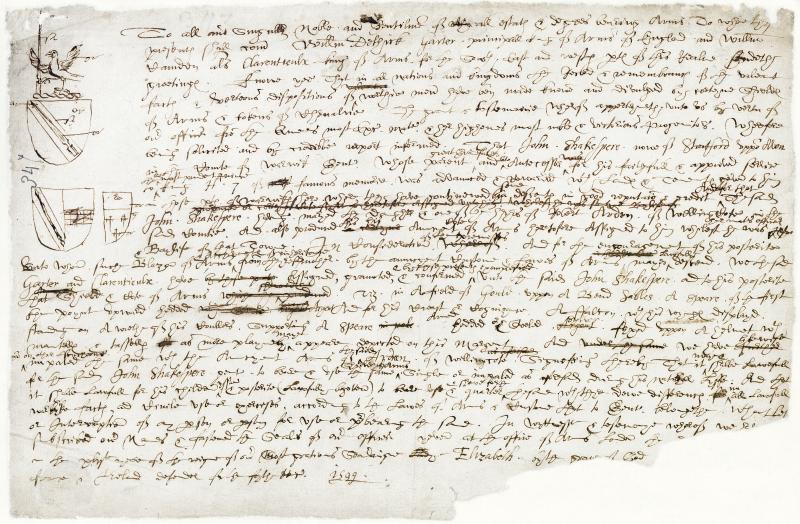
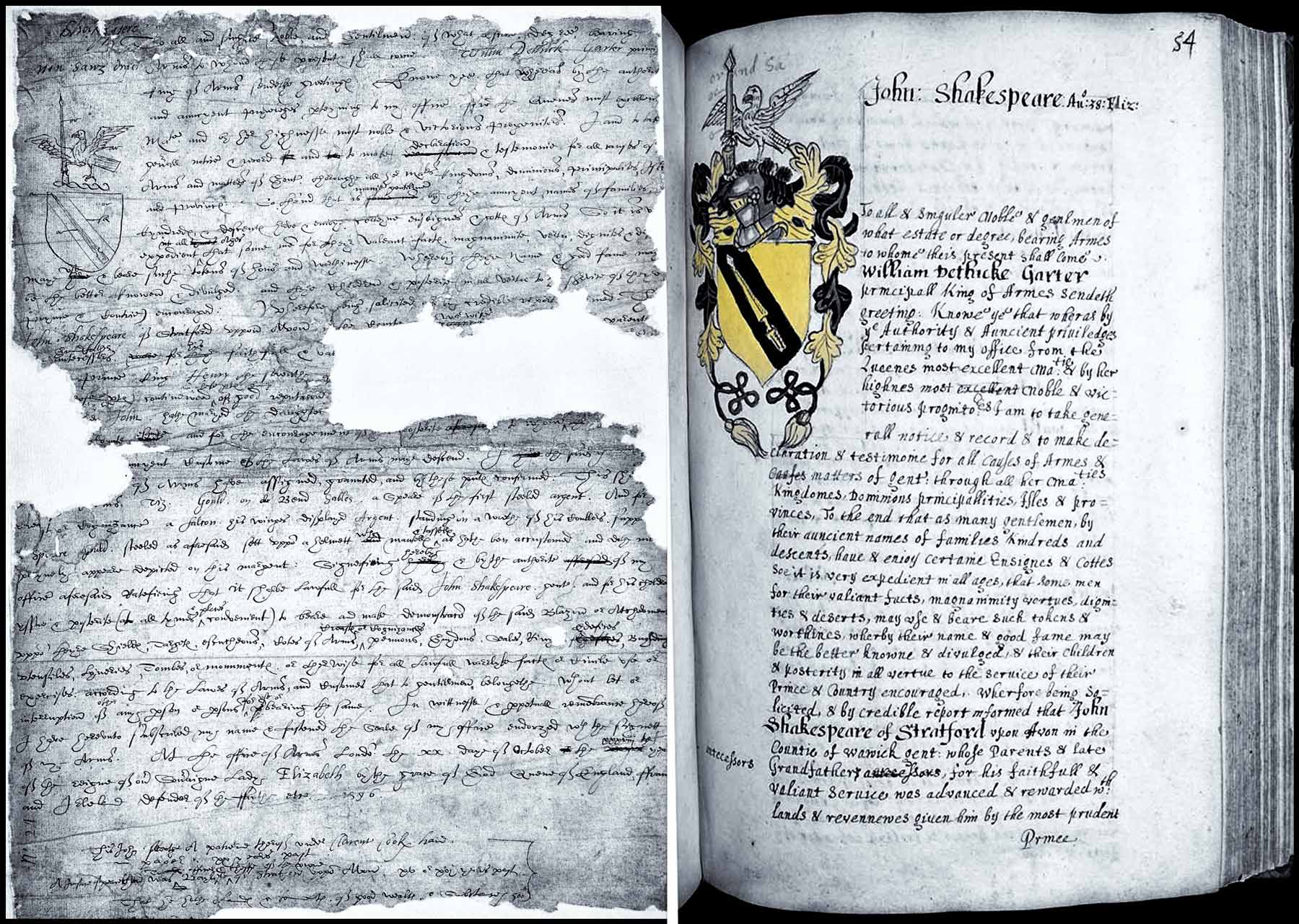
These are the arms of the canon playwright. (transcription) These are William Shakespeare of Stratford’s arms, accounted for by the unimpeachable authority of the College of Heralds. Like the two draft grants of arms from 1596, this draft exemplification of arms from 1599 is in the handwriting of William Dethick, Garter King of Arms. In it, William Dethick and fellow herald William Camden accept John Shakespeare’s application to impale, or combine, the arms of Arden with his own. John Shakespeare’s wife–William’s mother–was from the local Arden family, a step up from the Shakespeares. Including the Arden arms would add lustre to the Shakespeare family name.

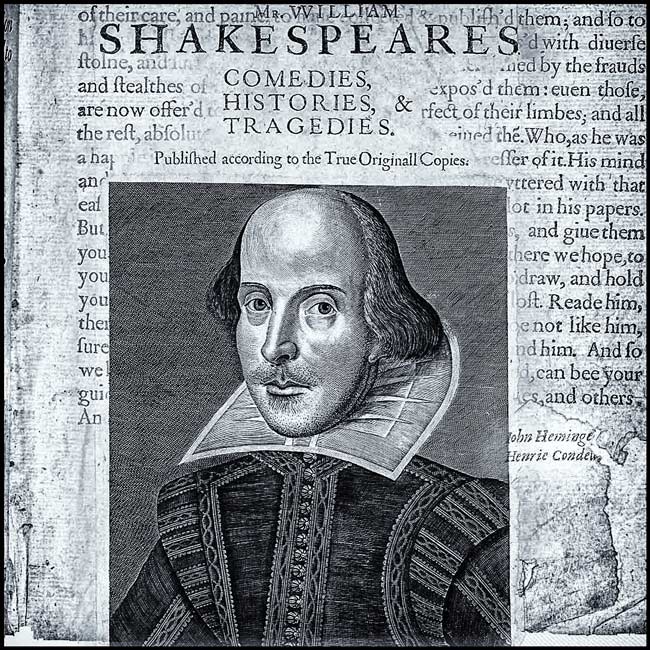
The evidence available on this site demands an unequivocal attribution of the work in the First Folio to William Shakespeare of Stratford upon Avon. The Prima Facie Case constructs a conclusive path from Stratford to the edition of Shakespeare’s plays published as The First Folio in 1623.1

It identifies the member of the LCM and KM, credited by his colleagues and partners as the author of Macbeth and Coriolanus, is also the man who was born in April 1564 to John and Mary Shakespeare in Stratford upon Avon. This is the simplified core of a prima facie case which dismissed all alternative candidates for the authorship of canonical Shakespeare.

Behind it are hundreds of items of tangible evidence—documents collected on the Folger’s Shakespeare Documented site. Alongside stands all the newest (and oldest) stylometry, the monument in Holy Trinity Church, the eulogies, the title pages and the contemporary references. The evidence admits no disguised candidates—no fantastically improbable conspiracy theories hiding their existence.

Academic research is also unequivocal today. New stylometry is able to isolate Shakespeare’s contributions to work that does not bear his name. It can algorithmically isolate the work of his peers and collaborators where it appears in the canon. How playwrights collaborated on Bankside is now the frontier of research into Early English Theatre. No recent stylometric analysis, however, has shown a hint of promise to any fabricated impostors. Just the opposite. All alternative period playwrights and poets, male or female, English or foreign, are ruled out. The same analysis which identifies Marlowe as an early collaborator rules him out as an alternative author for the rest of the canon. His shade can rest in peace now the reason for his resurrection has blown away. All the aristocratic pretenders, never the strongest, gone, Bacon gone.

Where else is there to look for a man to reinvent theatre? Nowhere. Will Shakespeare of Stratford upon Avon was Will Shakespeare of London—Will Shakespeare of London was Will Shakespeare of Bankside and the credit for the greatest achievement of the English written word belongs to him.
Articles in this Section

1. Named on title pages

A Prima Facie Case for Shakespeare
Nine evidentiary links connect the author of the works in the First Folio1 to William Shakespeare, born in April 1564 to John and Mary Shakespeare of Henley Street, Stratford upon Avon. Taken individually, each link is significant. Taken…

Shakespeare at the Globe

AI response to PFC
No large language models had anything to do with formulating the PFC, which precedes their existence. This is AI responding to the evidence and argument. We asked Gemini AI Pro to analyze the…

Brief History
James Shapiro’s book on authorship, Contested Will1 contains an excellent history of the…

The Role of Evidence
Every contention positing an alternative candidate, whether it be an Earl, a woman, a Spanish novelist or an alien, is forced to bypass the requirement for tangible evidence. In 150 years of trying, no…

What is a Prima Facie Case?
According to Harold Love in his book Attributing Authorship,1
No matching items

Footnotes

  1. William Shakespeare, Mr. William Shakespeares Comedies, histories & tragedies, published according to the true originall copies. London, printed by Isaac Jaggard and Edward Blount, 1623., (London: William Jaggard, Edward Blount, L. Smithweeke, and W. Aspley, 1623, 1623).↩︎

An End to Doubt
A Prima Facie Case for Shakespeare