Spurious Correlation
Fitting pieces from different jigsaws together
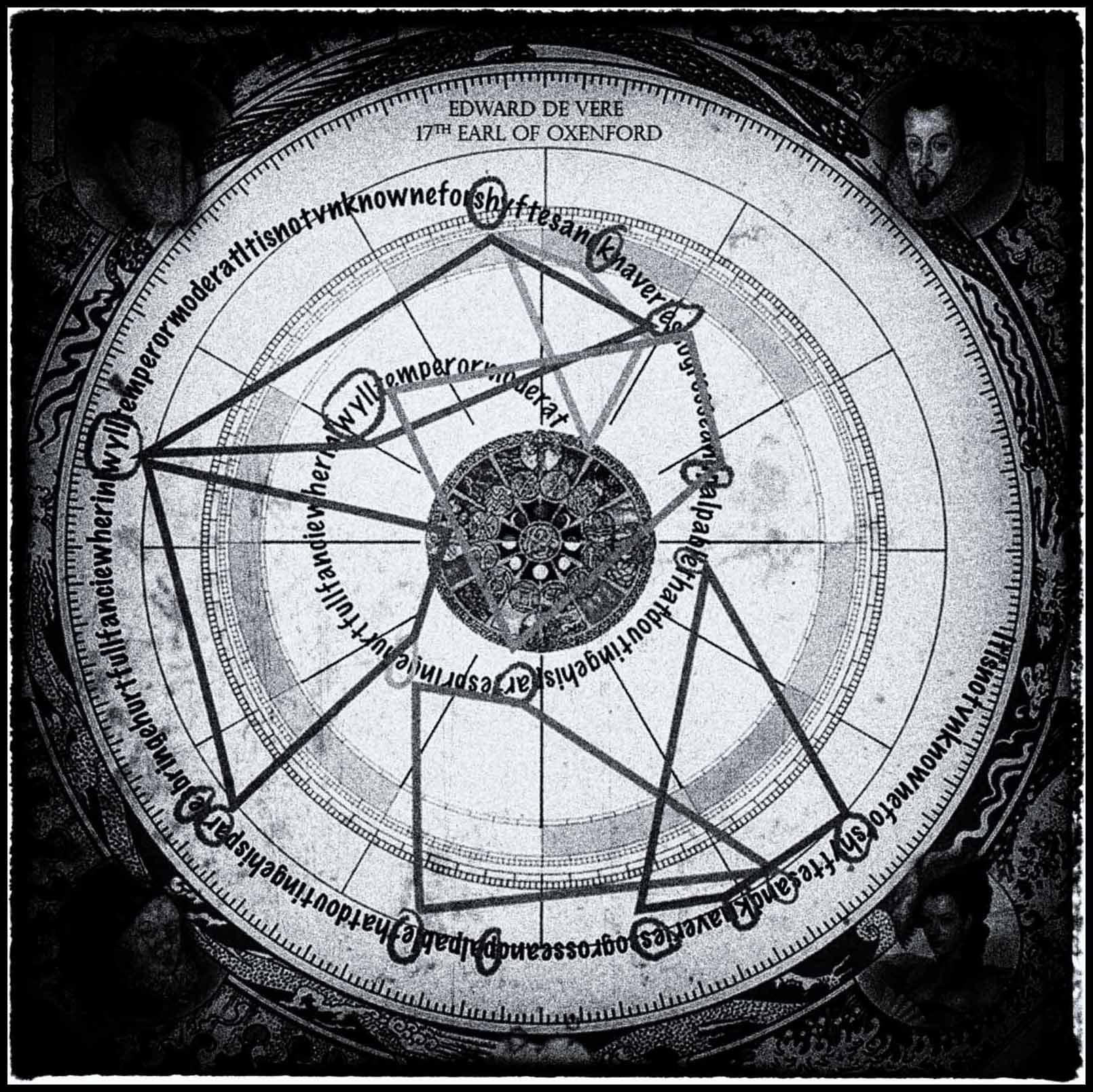
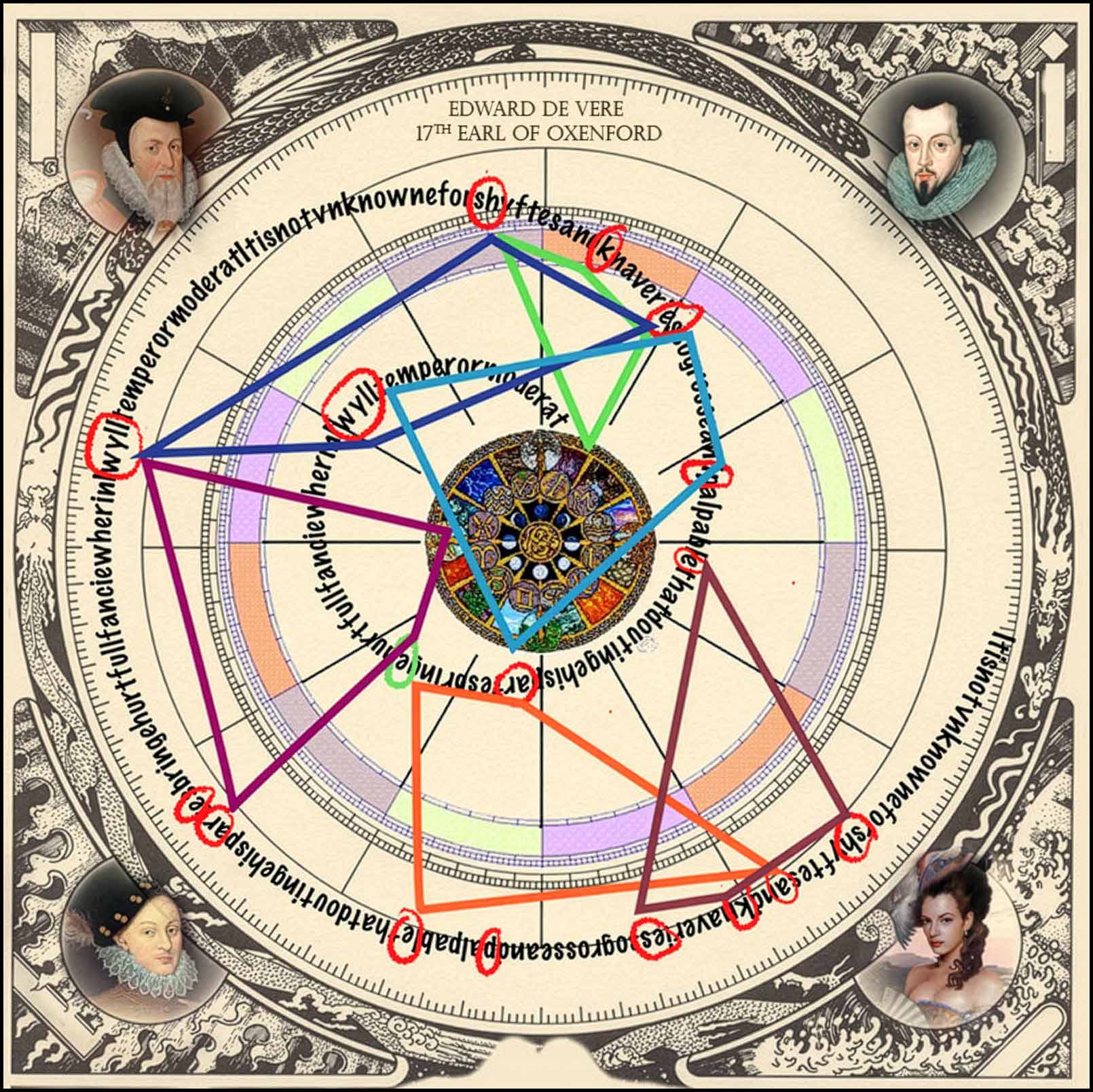
An example of correlation that is both spurious and incongruent. At the height of the code debate, when Doubters were finding hidden codes that weren’t actually hidden and cryptograms that weren’t actually encrypted, all of which pointed at their candidate of course, we made a satirical one of our own which showed the names Wyll Shakespeare coinciding with the nodes on Oxford’s birth charts. Perfectly acceptable, it seemed. No one raised any objections. ⌕
In the pursuit of a candidate’s pretensions to a body of work on which they have no claim, it becomes immediately obvious that narrative synthesis by itself will not be enough. To avoid the accusation of writing fiction, the alternative candidate needs plausible support from alternative explanations of real events. Spurious Correlation does this work.
The Authorship Question has enough spurious correlation for a university course of study in the subject. After keystone principles in an alternative “hypothesis” are established, facts and incidents which cannot divorced from reality are spuriously correlated out of the discussion to redirect their import from Bankside and Shakespeare to Oxford and Essex or whoever is the chosen one.
Shakespeare’s linguistic Warwickshire expressions have all been individually correlated with single occurrences outside Warwickshire as if that ruled out any connection. A Warwickshire dialect can’t be dismissed by finding an alternative instance for each word in another part of the country. You could probably extend this technique to prove Diderot didn’t speak French.
Here is a typical internet exchange, recent and active at the time of writing. The subject is the impossibility of the Earl of Oxford continuing to produce apparently new work for The Globe, at the rate of two plays a year having died in 1604. The problem being addressed is the existence of topical references and themes in plays written after the Earl of Oxford’s death.
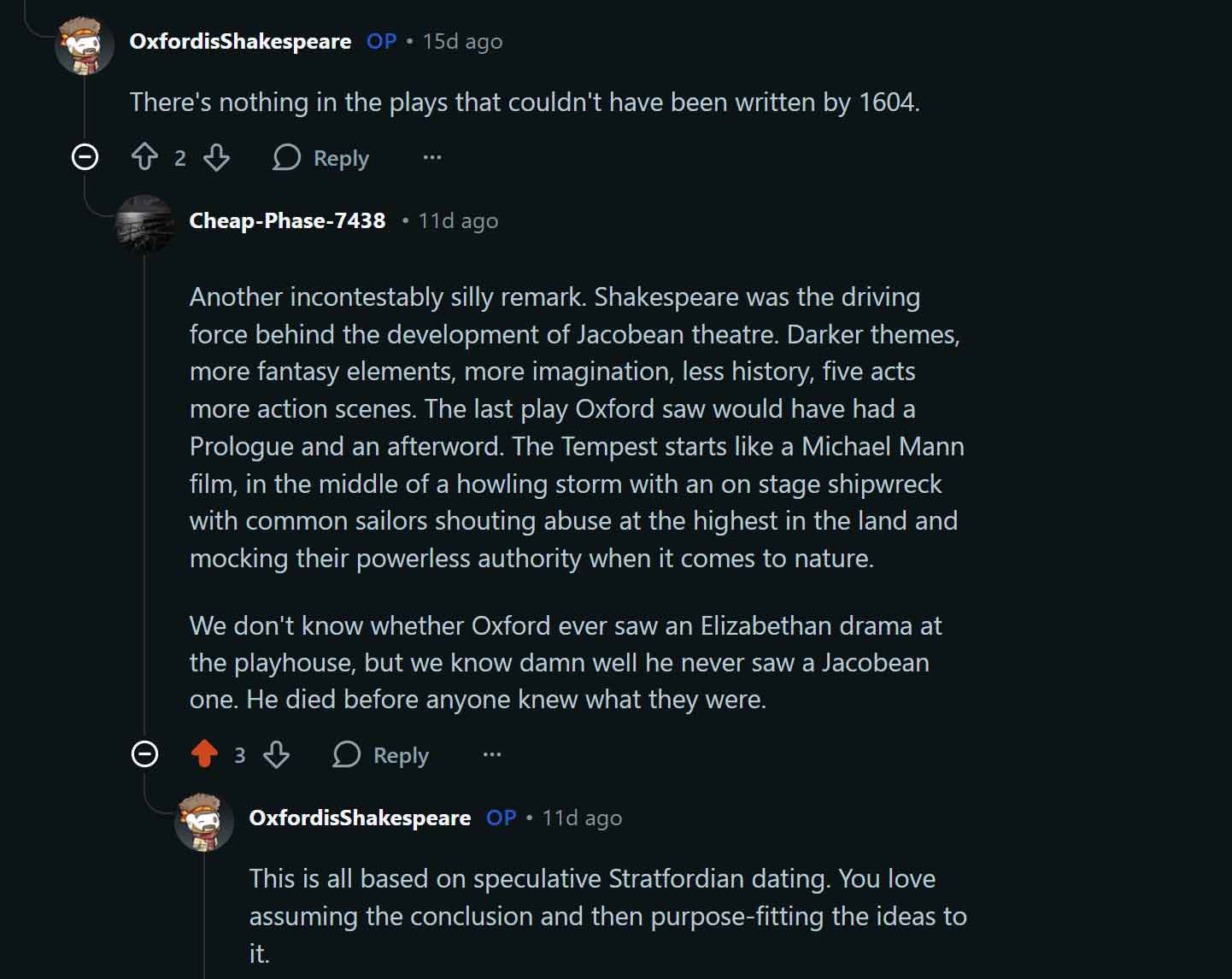
The poster oxfordisshakespeare makes a statement. It is a central piece of Oxfordian doctrine—“there is nothing in the plays that couldn’t have been written by 1604”. This, as Cheap-Phase-7488 says, on the face of it (prima facie), is manifestly untrue. Without inventing things or interfering with what history records, we can contradict this by pointing out that Shakespeare and Fletcher (who didn’t appear on Bankside until the Earl was dead) collaborated on Henry VIII, described as a “new play” when its stage effects set the theatre’s roof on fire and burnt the building to the ground in less than two hours on 29th June 1613. A New Play. New plays commanded a premium. 1613 is almost a decade after the Earl died. The fire was widely recorded. The play, unlike the Shakespearean Apocrypha, was included in the First Folio edition of his works, compiled by his colleagues and published in 1623. It appears to be (in nonSAQ terms ‘it is’) a contradictory milestone with sufficient factual content to dismiss Oxford’s entire claim.
Everything depends on the pivot. “it’s not me who has invented the dating scheme, it’s you”. The task for the Oxfordian is the transformation of the chronology of the plays accepted by all Shakespeare scholars. Here is how they do it.
First create the space for doubt. Some scholars favour the idea that Macbeth may have been performed before King Lear in 1606. Now inflate this disagreement to imply nobody agrees when the plays were written—veteran defenders of evolution versus intelligent design will find this depressingly familiar. The Doubter uses a minor disagreement on detail to ascribe the value of infinity to doubt. Posters like oxfordisshakespeare use their definition of doubt to grant themselves the latitude to move objects from substantial consensus, supported by scholarship and the historical record, to their own fictional version of events designed to fit the Earl’s inconvenient demise before a third of the canon was written.
Research historical events to provide correlative fodder. Replace everything that anchors the plays into their timeline with suggestive alternative explanations. The task is to recorrelate historical events referred to in the plays with other, similar historical events to which your candidate might have a biographical claim or, at the very least, was alive to have been able to write about them.
Spurious Correlation, forcing or breaking relationships between one thing and another with measurably valid but unrelated similarity, is how you turn evidence for a into evidence for b. It is how you move one witness off the historical stage and bring on another, less damaging, but notionally correlated to the evidence you are trying to dispose of.
It’s how you move the associations with one famous shipwreck, still current in the news when a play appears, to another that occurred before any of the groundlings at the première were born. You can use it to change a convincing witness, like Thomas Russell, overseer of Shakespeare’s will, by displacing him with another Thomas Russell 34 miles further away, then pretend to have cast doubt on the probative testimony of his stepson. It is, sadly, also how you persuade parents to stop vaccinating their children. A mother asked in a medical internet group how she could find “medical practices that leaned off vaccination”. A medical professor replied “look for the one with the highest child mortality rate. That’s your guy.”
Doubter evidence, when it is being related to facts from the historical record, is almost entirely made of spurious correlations and is used in argument as if correlation and corroboration were the same thing. They are not. Nor are they the same as fanciful inventions such as bizarre arithromancy usually involving the number 171 or finding monkey faces in the capitals on Shakespeare’s monument.2 Spurious correlation is intended to suggest that there is actual evidence which can’t be appreciated without the correct perspective. What makes scholars and historians incapable of looking at the evidence with correct perspective is the doubter definition of confirmation bias. The Dunning Kruger Club is a modern psychological explanation of everything that Lewis Caroll was satirising in Alice through the Looking Glass. Carrol was a scientist and a mathematician, a pioneer of linear algebra who hated the pseudo-scientific challenges on the works of other scientists like Darwin.
The world of Shakespeare Doubt is another Looking Glass World. Like the Cheshire Cat when faced with an impasse, they will all disappear like our reddit poster above.
Correlation Dashboard
A Forensic Study in Binary Coincidence
Footnotes
Eleanor Hayes, “How Science Proved Edward de Vere Was William Shakespeare,” https://deveresociety.co.uk/book/how-science-proved-edward-de-vere-was-william-shakespeare/, September 2018.↩︎
Alexander Waugh, “Thy Stratford Monument Revisited,” De Vere Society, de Vere Society Newsletter, October 2014.↩︎