Beyond Belief
Disposing with 400 years of Shakespeare Scholarship
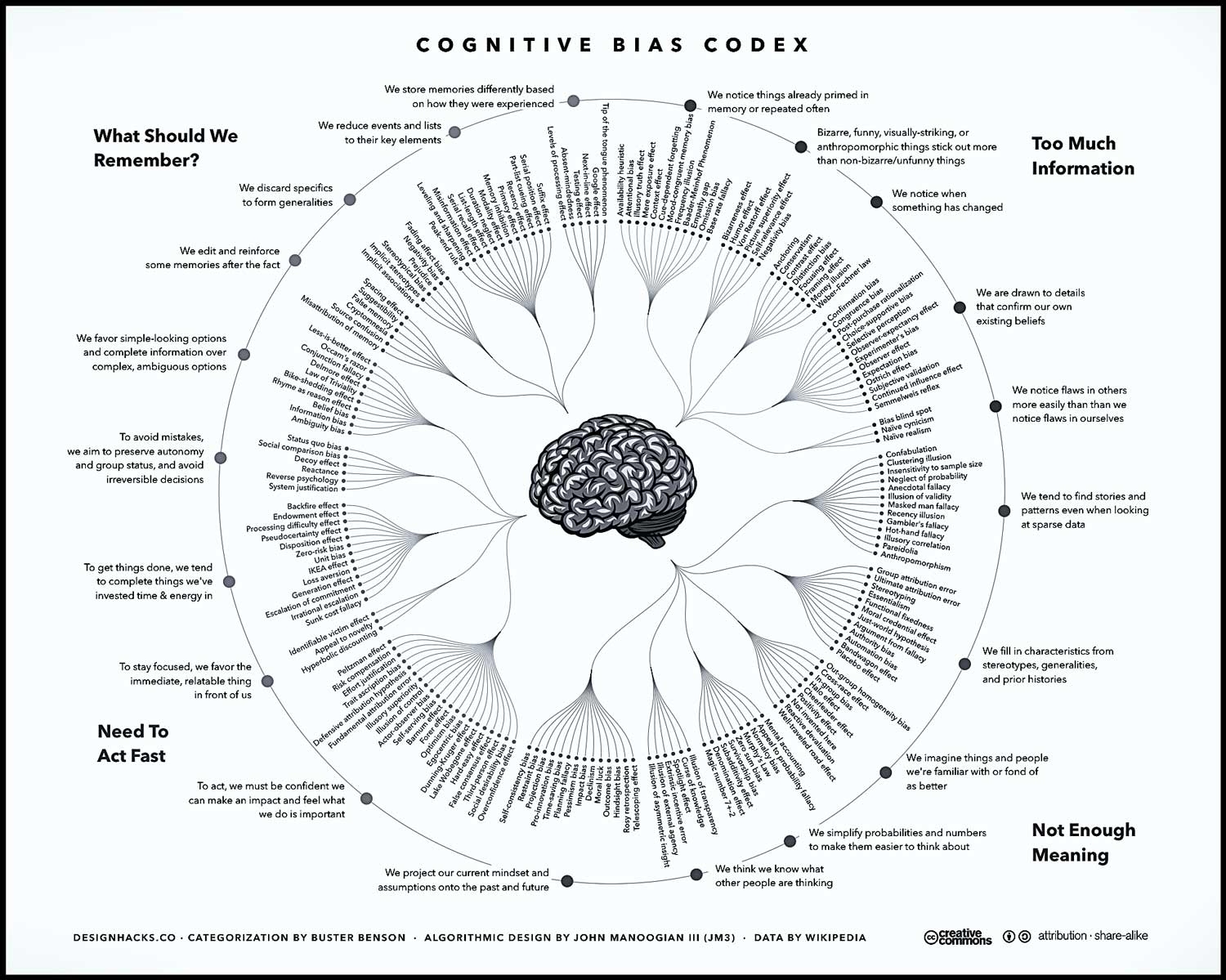
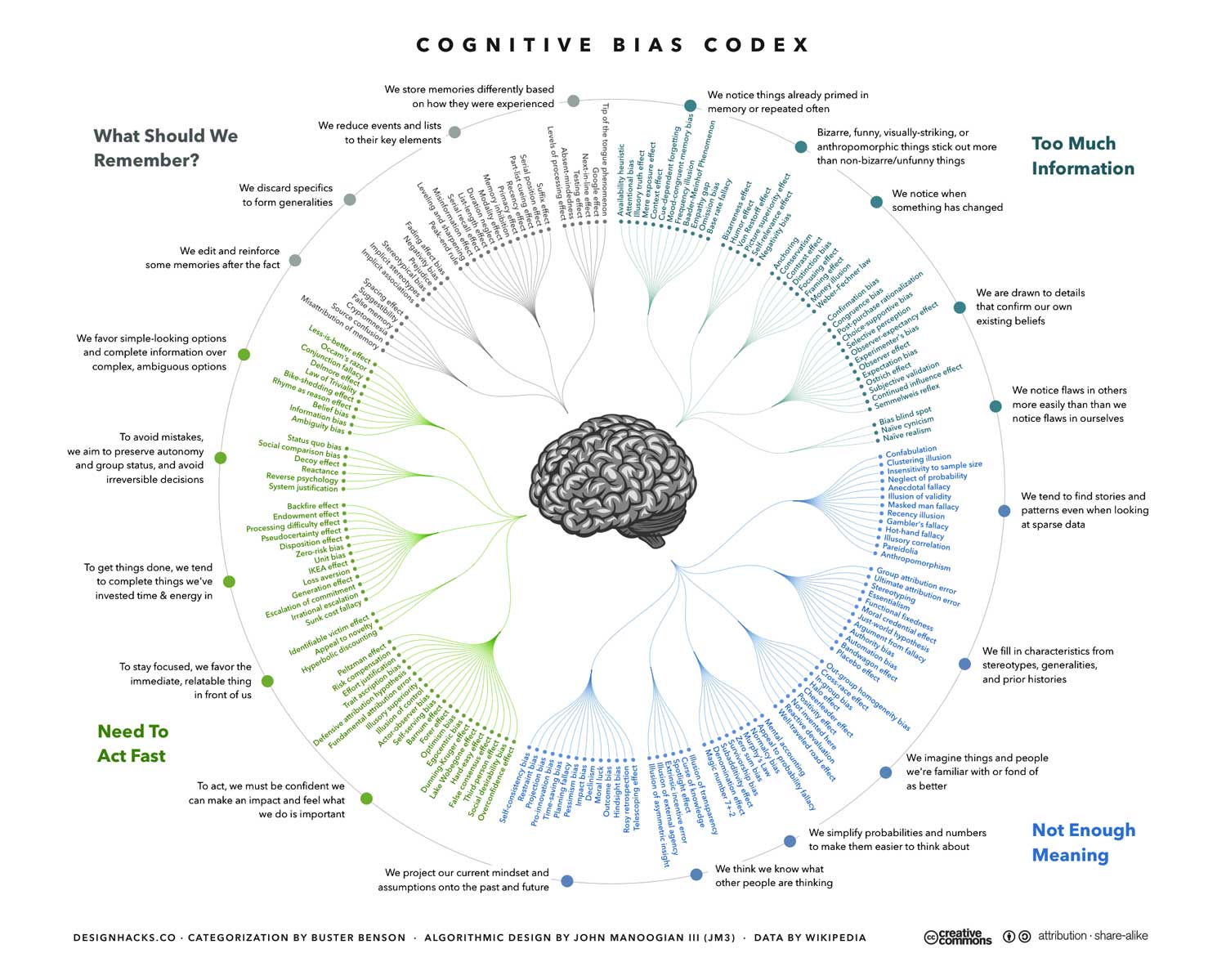
The Cognitive Bias Codex will help locate the operation of unwarranted assumptions or data conclusions in everyone’s arguments. No one is immune to Cognitive Bias which makes it a handy tool for dismissing inconvenient truths. When abused, it simply become a conjuror’s magic wand used to make evidence disappear where counter argument fails and counter evidence does not exist. ⌕
General admiration of Shakespeare’s work and scholarly scrutiny have not always been in step nor did they grow in a synchronised fashion. The Bankside theatre-goer became used to two new plays every year from Will and half a dozen almost as good from other Bankside playwrights.
After Shakespeare died in 1616 Bankside’s ‘epoch of concentration’1 began to wane. Performances and study ebbed then stopped entirely during The English Civil War. In the 100 years which followed, Shakespeare’s reputation rose to the point subsequently described as ‘bardolatry’ and serious scholarship has kept pace in growth and popularity ever since.
Accessible academic sources like EThOS2 suggest that in the UK alone, there are around 1200 Shakespeare-based PhD theses in preparation at any one time with topics that shift, often quite radically, over time. Currently the trend leans toward applied and intercultural Shakespeare, with an interest in Shakespeare as a paradigm of cultural sustainability.
There are still only two examples of authorship-themed PhD theses (and we looked at one of those in detail. With upwards of 30,000 UK theses seeing no need to challenge the attribution to Shakespeare–350 years of scholarship ignoring or denying the possibility of a hidden author–it’s fair ask what sort of confidence is sustaining the idea that two post graduate students are correct with the 29,998 others all suffering from the same delusion.
Doubter explanations centre on two ideas.
Confirmation bias. Mistaken precepts, unquestioned by appropriately qualified investigation which then become baked into dogma, protected by an inflexible, over-invested, orthodox Academy.
Misleading hard evidence accepted as confirmatory, claiming one thing but when subjected to a particular type of detailed 3 investigation, can be shown to mean another.
One of the great paradoxes in fringe theory acceptance is that confirmation bias always affects only the 99.999*% of scholars, academics, scientists, educational professionals, handwriting analysts etc, who disagree with the fringe theory in question. Only true sceptics are immune.
The same certainties, Doubters call it ‘orthodoxy’, are always at work when comes to explaining which way evidence points. An engraving of Shakespeare as a preface to his work? It’s there to direct you cryptically to Oxford/Bacon/Marlowe. How could you be so foolish as to miss the clues? A share in the acting troupe that produces the plays? A blind created by a government anxious to strengthen their cover up, it being essential not to sully the country’s reputation by having foreigners think its high and mighty wrote for the common stage. Evidence that the stepson of a neighbour provided all the evidence they claim does not exist? It must have been a different neighbour with the same name living only forty miles further away. Conformation bias dismissed by conjuring alternative evidence into existence is more like using a magic wand than using critical discretion.
Though they call themselves Doubters, it’s also fair to ask what sort of doubt exists in the minds of people who can advance the claims of the most absurd interpretations of simple matters of fact when the only purpose is to avoid the implication that hard evidence supports an contradictory fact. Where is the scepticism when assessing the ludicrously over-engineered explanations to explain away obvious connections to the canon author. Reading Alexander Waugh, trying to recorrelate evidence for Shakespeare with Oxford’s CV, anyone can watch the elastic logic taken far beyond breaking point. Diana Price, who styles herself an independent scholar, invents a whole new metric–Literary Paper Trails*** to invalidate evidence by attempting to move it into categories of irrelevance entirely of her own design.
An Authorship MOOC
Still available on Coursera,4 Ros Barber, a writer and teacher of creative writing, put together an authorship MOOC trying to excite new followers in a four week long exploration of the issues. The discussions that occurred when it first ran, in 2021, however, have disappeared behind pages and pages of empty threads.
Instead of an investigation into authorship, what we have is a long series of suggestive insinuations that are polished to crystallise doubt. Barber forbids her participants from claiming anything is ‘true’ and purposely uses the sanction to impute that all scholarship outside her authorship bailiwick might be unreliable.
Yet each new doubt-oriented proposition is individually insignificant. Many collapse immediately when subjected to detailed scrutiny. Alexander Waugh appears in person with his highly improbable discoveries 5, offering worn-out malt-broking arguments which fail in fact, significance and relevance. Like many of the main doubter contentions, almost all of which Barber will air, they are simple ad hominem manipulations designed to make Shakespeare look like a different individual to the Bankside playwright. To disqualify him on appearances rather than evidence. That’s the purpose of the whole course, to synthesise a mystery play in which poet and playwright require separate entrances.
- Yet outside inference, supposition and guesswork, there is no support for any such idea.
After four weeks Dr Barber was leading her learners through an examination of the stitching on a four hundred year-old engraving in the hope of finding its hidden messages.
Yet she fails to address the crucial question of why The British Library has recently fully authenticated Hand D as Shakespeare’s, completing a chain of evidence which kills off the whole debate. To her credit, she is the first doubter to give any serious consideration to the implications of Hand D, yet her assessment of the case falls woefully short when it comes to addressing the scholarship that now supports that attribution.
Almost all of the course modules should be assessed not as authorship scholarship but as tests of anti-Shakespearean techniques in the overstatement of probabilities based on porous or false assumptions.
Dr Barber did not invite anyone to make Shakespeare’s own claim to his work and she could not have delivered a more feeble effort in making it herself. Items of evidence for Shakespeare are either challenged by the presentation of suggestive minutiae (rather than examined in their context) or waved away as part of conspiracy to confuse and conceal the truth from everyone not possessed of the true eye for detail.
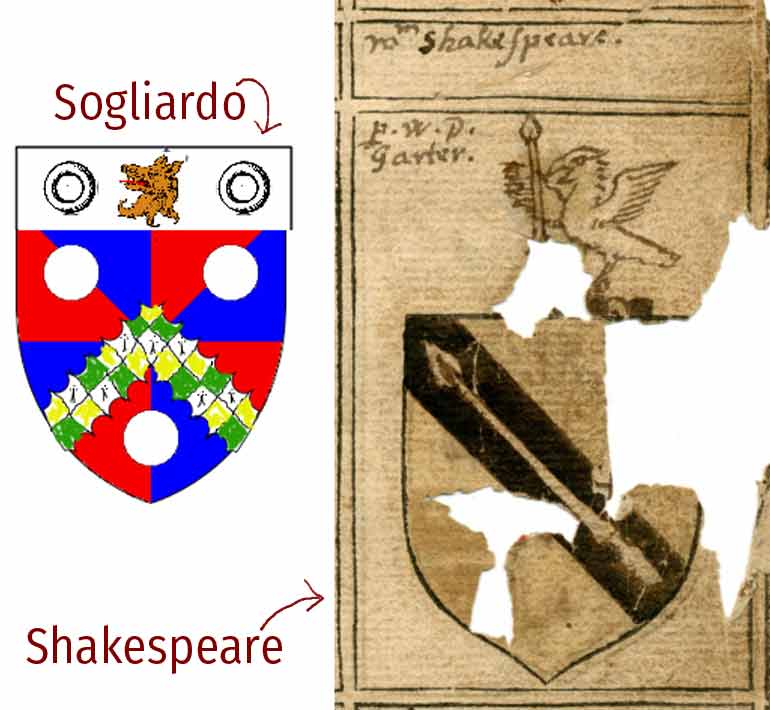
Improbably, this includes almost everyone who studies and writes about Shakespeare (or ever has). Confirmation bias is the cause. Confirmation bias is certainly at work, but something more, too. In the first run she accepted a correction on an issue of Shakespeare’s arms and their resemblance to a those of a character of Jonson’s called Sogliardo. As the course participant went to the trouble of producing diagrams which demonstrated the error, (and dismissed the claim it supported). Although she promised to change the lesson, no changes were made.6
Footnotes
Matthew Arnold and Walter Pater, “Function of criticism at the present time,” nyu, New York, London, 1895.↩︎
EThOS (E-Theses Online Service) is the British Library’s database of UK doctoral theses. It holds records for over 600,000 theses, allowing researchers to search theses from UK universities from the 1700s to present day. Sadly, as at April 2026, the database is unavailable after a cyber attack.↩︎
For ‘detailed’ read ‘verbose, fanciful, ill-thought out but cunningly suggestive in the hands of a skilled salesperson’↩︎
There are many such Waugh discoveries, such as Shakespeare hoarding malt in a time of famine, Jonson designing monkey faces into the monument as an insult, and Shakespeare (Oxford, really) being buried in Westminster Abbey. we have given up rebutting each new idea. Deconstruction in detail of a few of them shows how they all work. Look at the fantastical, intricate and improbable explanations of Swan of Avon for example.↩︎
Barber promised to include the artwork, but a few weeks after the debate moved on, the there was still no sign of it. Oxfraud contemporary coverage.↩︎