Spelling argument
Spelling variants in Early Modern English
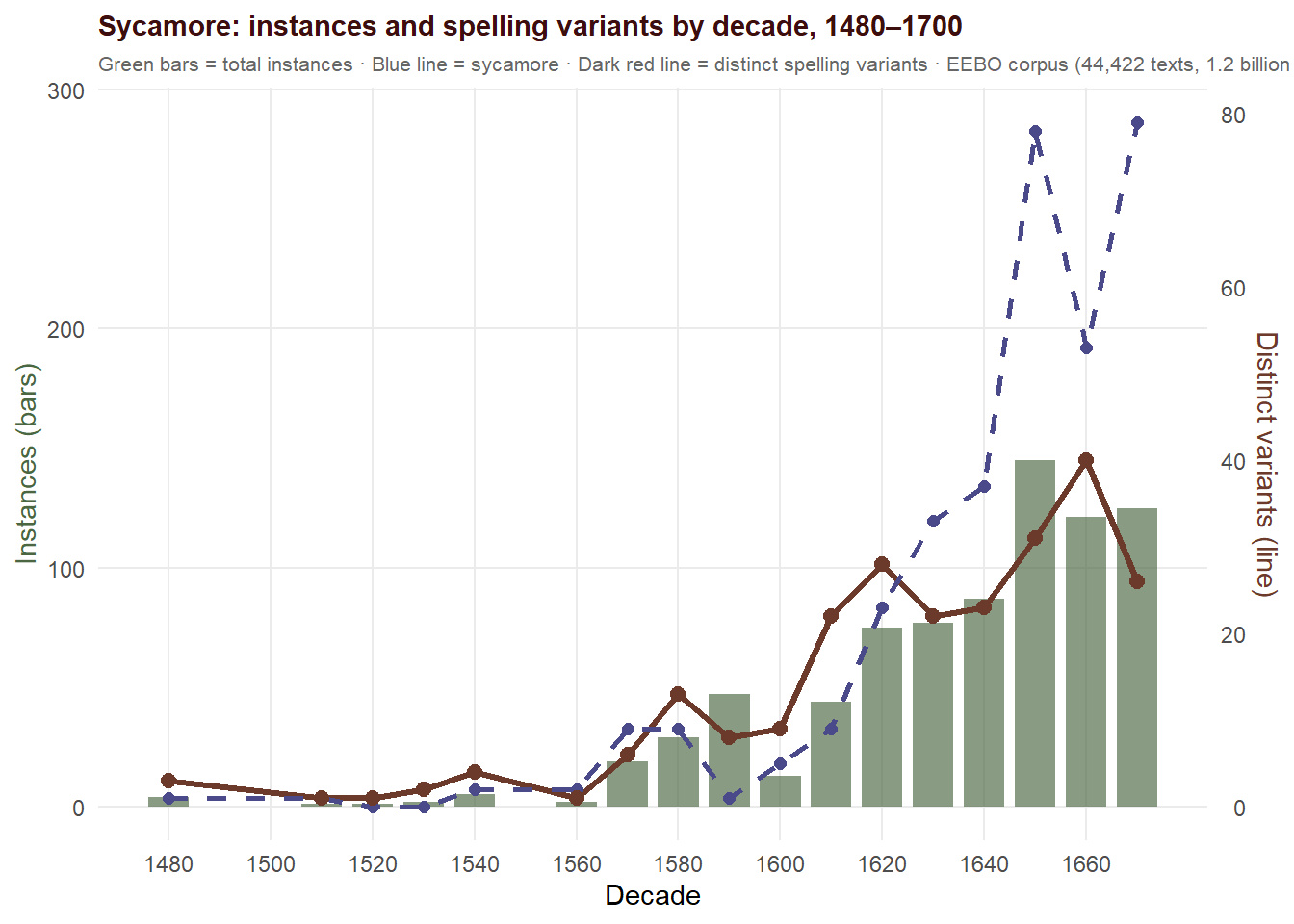
Sycamores feature elsewhere in the authorship argument. We’ve not really chosen the trees for their Authorship context, however. Here they feature as a side effect.The word ‘sycamore’ sits close to the median point for numbers of spelling variants in EEBO. A search for all variants produces 112 tokens in 1.2 billion words. Tokens include spellings containing hyphens. It’s hardly surprising that a new non-native invasive species should acquire numerous spelling variants but the whole language moves across the Early Modern period in a steady progression from chaos to standardisation.
At the time Shakespeare began writing for the theatre, idiosyncratic spellings were the norm. Writers, printers, scribes and compositors spelled what they heard and said, as they remembered, and as the moment took them. Exotic spelling in manuscript can be used to profile writers phonetically if they can be shown to be unique or at least very rare or part of an unusual rhymed pair. Once the work is typeset for print, other forces, typesetters, proof readers and printers themselves have intervened.
Attempts to argue significance into one spelling or another, therefore, require careful research, usually with a bit of math involved. The spelling of ‘scilens’ in the handwritten fragment Hand D for example, can be confidently linked to Shakespeare as it appears nowhere else in his lifetime other than in his work. It features as a character’s name, less likely to be changed by scribes and typesetters, in Coriolanus and Henry IV ii. Checking out all the occurrences of expressions like “come by fits” in the quest for rare expressions however, requires careful string searches to accommodate variants and filters to rule them out as common expressions—a skill Deniers seeking to isolate them to prove links to their candidate have still to acquire.1
During Shakespeare’s lifetime, with the increase in literacy and the massive increased in printed matter, number of spelling variants for individual words begin with a steep climb then standards can be seen evolving as the number of variations shrink with time. When dictionaries, like Johnson’d appear in eighteenth century, standardisation dramatically reduced variation but that data lies outside EEBO’s range. What EEBO does show, however, is that the growth of publishing and printing organisations, creating larger, more successful companies introduced standardisation as a matter of common sense and corporate necessity.
Shakespeare’s name appears in 38 recorded variants across contemporary documents. No evidence exists to support arguments that variations of the spelling of Shakespeare’s name indicate the existence of more than one Shakespeare. As with so many Authorship issues, the evidence points strongly in the opposite direction. The Oxfordian argument that “Shaksper” and “Shakespeare” represent different people is based on no more than the existence of different spellings between printers, ecclesiastical and civic records where the variation is no more than norm.
The word ‘sycamore’ — a tree, with no identity to protect and no pseudonym to conceal appears in 112 different spellings in the EEBO corpus. ‘Melancholy’, a word in daily use by every literate Elizabethan, appears in 305 distinct forms. Deniers would have us believe simultaneously that ‘sycamore’ concealed 112 botanical identities, and that melancholy was written by 305 different minds.
The chart shows the rise and fall of variation of the spelling of ‘sycamore’ The increase in standardisation can be seen in the growth if the winning variant and the start of the corresponding drop in the number of variants. The data table from which that chart is constructed is below it. You can see here that despite the progress of standardisation, writers and publishers can favour the own variant and be consistent in its use. If you sort the table by year you can see the modern spelling establish itself between 1610 and 1630 as the early variants disappear. Some new variants show up but by 1675, the modern spelling is established, though it would have to wait another 100 years before anyone called it ‘correct’.
Footnotes
Check out Shakespeare’s Fingerprints (Michael Brame and Galina Popova, Shakespeare’s Fingerprints, (Adonis Ed: Vashon Island, Wash., 2002)) which connect the Earl of Oxford to almost everything written in Shakespeare’s lifetime up to, and including the King James Bible.↩︎