Shakespeare and hyphens
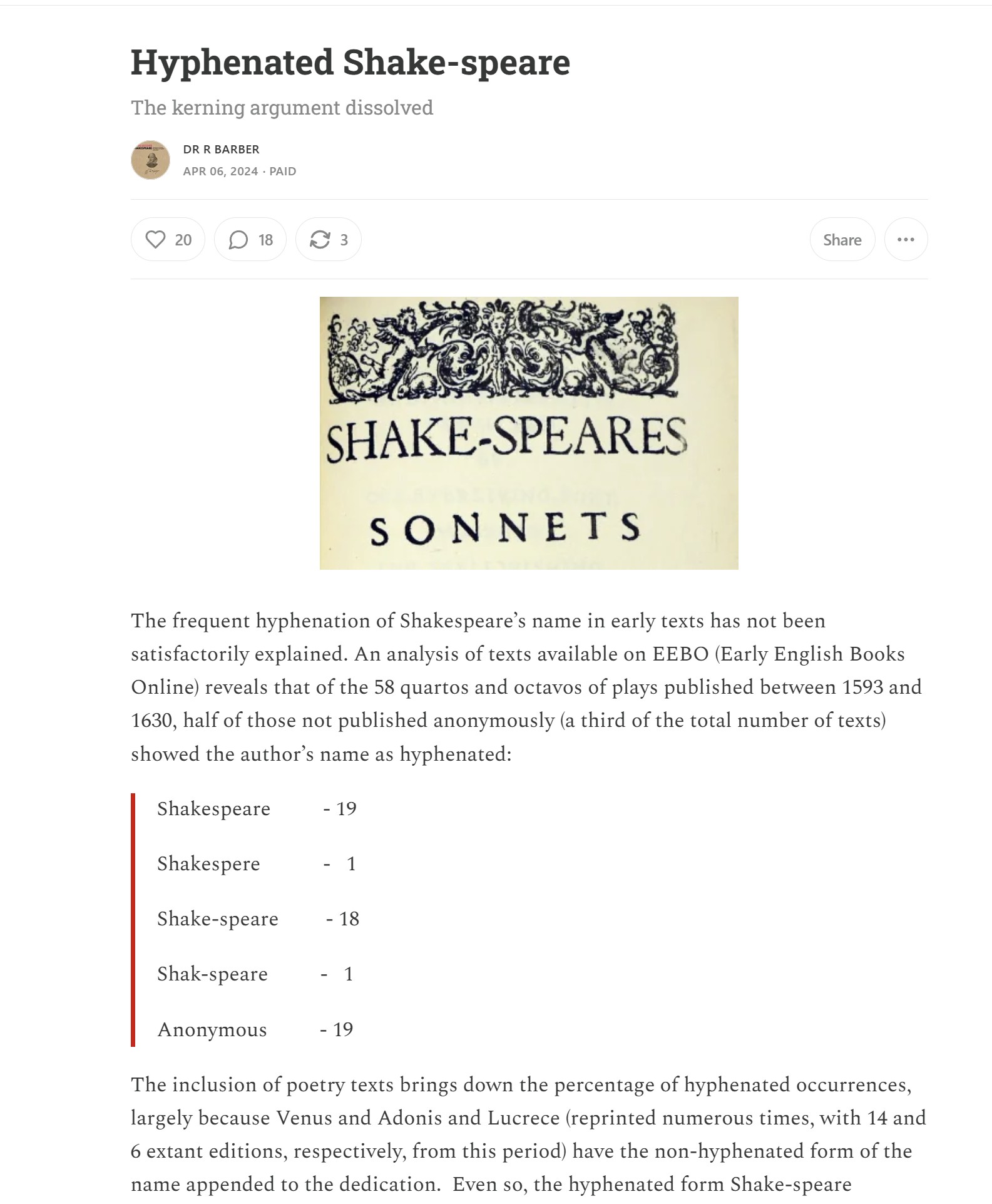
Since the earliest days of doubt, the spelling of Shakespeare’s name with a hyphen on some of the quarto editions has been interpreted, with no basis in reality, as a clue indicating a hidden author. Oxfordians like Alexander Waugh chose to call him Shagsper, Marlovians like Ros Barber call him Shaksper and attempt to treat him as a separate person with a separate career. A wool brogger, a play broker, a money lender, a farmer, a jack of all trades, all without evidence. All in direct contradiction of what is plainly in front of their eyes—the life scholars attribute to him, and the life Lena Orlin describes in detail.1
Spelling was not standardised. Often left to the typesetter who had no reference other than his own knowledge, arguments can still rage about how many different Shakespeares existed and how the hyphen got there. Was it to spread the ink evenly or to avoid breaking the adjacent glyph. Was it a time honoured signal of a pseudonym?
None of the above.
EEBO can dispense with claims like this with simple frequency analysis but unlike the table above, where the data has been pruned like a show poodle, torturing results until they take on helpful forms is not allowed. The table below shows 34 variations of spelling of Shakespeare’s name in print up to the year 1700. All bar two refer, without the smallest inflection of doubt, to the author of the plays, the armigerous playwright from Stratford, or to members of his family. A fraction of the names are hyphenated, around 1 in 50.
Scroll the down the table to see the distribution of ‘Cartwright’ and ‘Arrowsmith’. Cartwright has the same number of variant spellings as Shakespeare and Arrowmith,2 in contrast, is more unusual and has only eight. They are each a combination of two words between which, not coincidentally, hyphns will sometimes be found, Arrowsmith most frequently.
Hyphenated spelling and wild variations are simply par for the period and this table and its grown up companion, extracting all 1,145 mentions of Shakespeare in their context, demonstrate why we do not need to take down a book from the conspiracy shelf to explain it.
Shakespeare, Cartwright & Arrowsmith
Interesting that ‘Cartwrightists’ and ‘Cartwrightisme’ make it into EEBO but ‘Shakespeareans’ don’t. Their time was coming though. There’s a playwright named William Cartwright listed among the “Sons of Ben” according to Wikipedia but no Cartwrightists. List them in the comments if you find any…
| Shakespeare | |||
|---|---|---|---|
| No. | Query result | No.of occurrences | Percent |
| 1 | Shakespeare | 850 | 71.97% |
| 2 | Shakespear | 133 | 11.26% |
| 3 | Shakespears | 37 | 3.13% |
| 4 | Shakspear | 29 | 2.46% |
| 5 | Shake-speare | 22 | 1.86% |
| 6 | Shakspeare | 20 | 1.69% |
| 7 | Shakespeares | 19 | 1.61% |
| 8 | Shake-spear | 6 | 0.51% |
| 9 | Shake-speares | 6 | 0.51% |
| 10 | Shakespere | 6 | 0.51% |
| 11 | Shackspear | 5 | 0.42% |
| 12 | Shakesphear | 5 | 0.42% |
| 13 | Shakespeer | 4 | 0.34% |
| 14 | shakspears | 4 | 0.34% |
| 15 | Shackspeers | 3 | 0.25% |
| 16 | Shak-speare | 3 | 0.25% |
| 17 | Shakespar | 3 | 0.25% |
| 18 | Shakespeere | 3 | 0.25% |
| 19 | Shake-spears | 2 | 0.17% |
| 20 | Shakspeares | 2 | 0.17% |
| 21 | Shaksphear | 2 | 0.17% |
| 22 | Shack-spear | 1 | 0.08% |
| 23 | Shackespeers | 1 | 0.08% |
| 24 | Shackspeare | 1 | 0.08% |
| 25 | Shackspears | 1 | 0.08% |
| 26 | Shackspeer | 1 | 0.08% |
| 27 | Shak-spear | 1 | 0.08% |
| 28 | Shakesp | 1 | 0.08% |
| 29 | Shakespea | 1 | 0.08% |
| 30 | Shakespeaks | 1 | 0.08% |
| 31 | Shakesperum | 1 | 0.08% |
| 32 | Shakespheare | 1 | 0.08% |
| 33 | Shakesphere | 1 | 0.08% |
| 34 | Shakesprear | 1 | 0.08% |
| 35 | Shaksper | 1 | 0.08% |
| 36 | Shaksperus | 1 | 0.08% |
| 37 | Shakspher | 1 | 0.08% |
| 38 | Shaksphere | 1 | 0.08% |
| Cartwright | |||
| No. | Query result | No.of occurrences | Percent |
| 1 | Cartwright | 2904 | 85.89% |
| 2 | Cartwrights | 254 | 7.51% |
| 3 | Cartwright. | 57 | 1.69% |
| 4 | Cartwrightes | 47 | 1.39% |
| 5 | Cart-wright | 23 | 0.68% |
| 6 | Cartwrighti | 12 | 0.35% |
| 7 | Cartwrightists | 10 | 0.30% |
| 8 | Cartwrightus | 10 | 0.30% |
| 9 | Cartwrite | 10 | 0.30% |
| 10 | Cartright | 7 | 0.21% |
| 11 | cart-wrights | 5 | 0.15% |
| 12 | Cartwrightum | 5 | 0.15% |
| 13 | Cartwrith | 5 | 0.15% |
| 14 | Cartwrighte | 4 | 0.12% |
| 15 | Cartwrightian | 4 | 0.12% |
| 16 | Cartrite | 2 | 0.06% |
| 17 | Cartwright- | 2 | 0.06% |
| 18 | Cartwrighto | 2 | 0.06% |
| 19 | Cartwrites | 2 | 0.06% |
| 20 | Cartwritus | 2 | 0.06% |
| 21 | Cartrights | 1 | 0.03% |
| 22 | Cartrit | 1 | 0.03% |
| 23 | Cartwrightin | 1 | 0.03% |
| 24 | Cartwrights. | 1 | 0.03% |
| 25 | Cartwrighttisme | 1 | 0.03% |
| 26 | Cartwrightus. | 1 | 0.03% |
| 27 | Cartwrigt | 1 | 0.03% |
| 28 | Cartwrigts | 1 | 0.03% |
| 29 | Cartwrigtus | 1 | 0.03% |
| 30 | Cartwriht | 1 | 0.03% |
| 31 | Cartwrit | 1 | 0.03% |
| 32 | Cartwritghts | 1 | 0.03% |
| 33 | Cartwrithe | 1 | 0.03% |
| 34 | Cartwritian | 1 | 0.03% |
| Arrowsmith | |||
| No. | Query result | No.ÿof occurrences | Percent |
| 1 | Arrowsmith | 143 | 78.57% |
| 2 | Arrowsmiths | 23 | 12.64% |
| 3 | Arrowsmith. | 6 | 3.30% |
| 4 | Arrow-smith | 5 | 2.75% |
| 5 | arrow-smitten | 2 | 1.10% |
| 6 | Arosmith | 1 | 0.55% |
| 7 | Arowsmith | 1 | 0.55% |
| 8 | Arrow-smiths | 1 | 0.55% |
Footnotes
Lena Cowen Orlin, The Private Life of William Shakespeare, (OUP Oxford: Oxford, 2021).↩︎
I have left the the vulgar nouns in the cartwrights and the obvious false positive in Arrowsmith rather than tamper with the output data.↩︎