J. Thomas Looney
Drawing wings on the elephant
Like the elephant in the adage, the Authorship question can look different to blind people in the room. One feels a rope, another feels a tree and one, at the trunk, can feel a snake. Turning on the lights allows everyone with sight to describe what is there and see how they have been misled. But what if someone has, in the dark, improved their impressions by creating wings on the elephant? J Thomas Looney had a big idea, like most authorship pioneers, it stemmed from a combination of arrogance, a lack of self-appraisal skills and an inexplicable and complete disdain for genuine scholarship. He thought to himself, as thousands have since “if I can’t recognise the playwright in the plays, then the playwright must be someone else”. So, blithely ignoring the consequence–that every scholar and historian who had ever written on Shakespeare must be completely in the wrong–he looked for an alternative candidate in an already crowded field. After long months of research, he found one who better suited the playwright of his imagination.
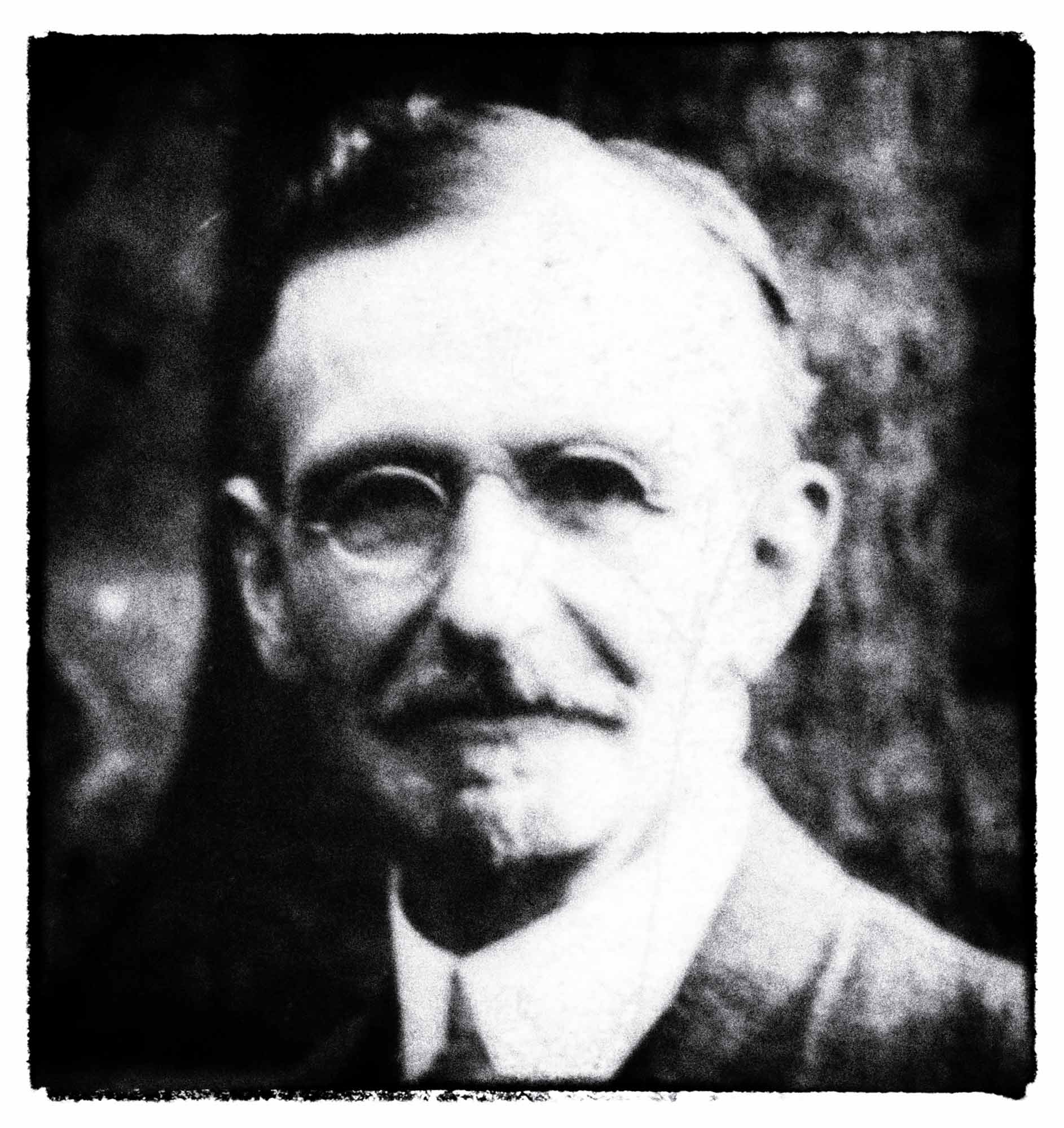
Thomas Looney
He picked Edward de Vere, Earl of Oxford. He did not allow himself to be discouraged by the fact that Oxford died in 1604 before a third of the canon was written. Everybody was wrong about the timeline too, he argued. The Tempest appeared to have secure moorings in 1610, so Looney just threw it out of the canon to help his proposition (that everything was written before 1604). Shakespeare, he argued, was Oxford’s pseudonym (though what he then describes is an allonym). And the Elizabethan and Jacobean men in grey doublets conspired to keep the true author’s identity a secret.
Born into a humble background, in 1899 young Looney went into exile in the small community of Low Fell. Like Will’s own, not a promising background for a worldbeater, you might think. Devout when young, Looney lost his faith and became caught up in a short-lived religious sect called the Church of Humanity. The Church embraced positivism and the work of man. In particular, the positivists liked the work of Shakespeare. Looney himself funded a bust of the Bard for the Church’s place of worship.
A disenchantment with Looney’s objects of worship seems to have taken place during the First World War as he became perplexed by the lack of positivism in Shakespeare’s private life. Instead of turning to another object, Chaucer or Milton for example, Looney became fixated on the idea that Shakespeare might have been someone else. Like all founding conspiracy theorists, he found his man and his man was unique — how else could he have created headlines? He chose Edward de Vere, 1st Earl of Oxford.
He published Shakespeare Identified1 in 1920.
His new candidate was everything that Will was not. Aristocratic, famous at court, a traveller, a spender of vast sums of money, a man bathed in the ancient virtues of chivalry and a true positivist. At least on the surface.
to plunge headlong into this unexplored domain in search of a man, who, on poetic grounds alone for that I deemed to be essential might be selected as the possible author of the world’s greatest dramas, seemed, at first, a well-nigh hopeless task. The only way was to compensate, if possible, my lack of knowledge by the adoption of some definite system. What was possibly a faulty piece of reasoning served at this point in good stead. I argued that when he entered upon the path of anonymity, wherein he had done his real life’s work, he had probably ceased altogether to publish in his own name ; and that, dividing his work into two parts, we should find the natural point of contact between the two, the point, therefore, at which discovery was most likely to o take place, just where his anonymous work begins. p136
He created a profile of the ideal author of the canon, central dogma that his followers all accept without question and have worked hard to extend:
we may say of Shakespeare that he was :
- Apparently eccentric and mysterious.
- Of intense sensibility a man apart.
- Unconventional.
- Not adequately appreciated.
- Of pronounced and known literary tastes.
- A lyric poet of recognized talent.
- Of superior education classical the habitual associate of educated people.*
Having come up with almost the same list following two different “analytical” approaches, Looney is convinced he is on the right track and begins the process of seeing things that aren’t really there but drawing them into his picture anyway, bending his analysis to suit the conclusion he knows he is heading towards. He picks Oxford’s misogynistic sonnet as his comparator with Shakespeare, connects the haggard hawks, as if the subject of one metaphor were enough to transfer the entire ownership of the canon. And he starts to build out his winged elephant.
Looney pioneers the Doubter technique of selective searching. He finds a poem Oxford has written in what has become known as the Venus & Adonis stanza. A quick scan of Palgrave’s Golden Treasury (once in the school desks of most English readers of a certain age 2) reveals only one other anonymous example besides Oxford’s so he credits Oxford as a pioneer. His search continues to connect his Lord to Shakespeare across the watershed of Oxford’s decision to publish anonymously. Terry Ross points out that in The Paradise of Dainty Devices, across three editions, Oxford wrote only one of the 17 poems using V&A metre. For the rest of Oxford’s undisputed oeuvre, he displays little in common with Shakespeare. He doesn’t write in blank verse, Shakespeare’s most used verse form, he never writes in rhyme royal like Shakespeare’s Lucrece nor does he ever use Shakespeare’s third (post-V&A) choice, heroic couplets. Looney’s foundational observations are all mistaken.
In his book, Looney rehashed all the Baconian argument that had survived the purges of the 1890s. He ‘deduced’ from the plays that Shakespeare was a courtier, superbly educated, trained in the law, a traveller to Italy and so on. He claimed that events in the plays, when tied to corresponding events in the life of De Vere, constituted proof of his theory. He ‘deduced’ in other words, that the writer of the plays was a perfect match for De Vere.
And if his choice had died in 1604—well the plays that came along afterwards were remnants, completed by an anonymous collaborator, updates with suitable topical reference, kept in a drawer until the time was right. The magical custodian must have been able to write their additions and revisions in a style indistinguishable from Shakespeare’s and it’s a great pity that Thomas didn’t spend more time trying to uncover this paragon, rather than trying to detach Will from credit for his work.
Whenever the work itself is tested against the theory, the theory springs apart, offering almost no resistance, often defeating itself without the need for external argument.
"our case will either stand or fall" as readers are convinced that De Vere’s poetry does in fact "contain the natural seed and clear promise" of Shakespeare’s verse ..."
A fail, right at the outset. Stylistic tests prove there are unbridgeable gulfs between the work of Shakespeare and De Vere. So lacking in acuity were Looney’s analytical skills that he failed to spot that a number of the poems on which he was basing his case were not written by De Vere at all. Joseph Sobran,3 writing in Alias Shakespeare, (reviewed by David Kathman here) — a better dressed but no less incompetent stylistic analysis, made the same error 80 years later, confusing De Vere’s work with Thomas Churchyard’s and, of course, mistaking both of them for the young Will Shakespeare.
Once he starts rewriting history, there is no stopping J. Thomas. Accounting for the complete absence of any contact between Oxford and the Elizabethan stage, he opines:
“One of the greatest obstacles to the acceptance of our theory of the authorship of Shakespeare’s plays will be a certain established conception of the mode in which they were produced and issued; a conception which arose of necessity out of the old theory … [and] demands a difficult revolution in mental attitude.”
“The difficult revolution in mental attitude” required here is a belief in sorcery and the effectiveness of J Thomas’ magic wand. The one that makes inconvenient evidence disappear.
Footnotes
J. Thomas Looney, "Shakespeare" identified in Edward De Vere, the seventeenth earl of Oxford, (Cecil Palmer: London, March 1920).↩︎
The Golden Treasury is one of the most loved anthologies of English poetry ever published. The book was meticulously compiled by poet and scholar Francis Turner Palgrave, in collaboration with Alfred Tennyson, who was then poet laureate.It is arranged chronologically in four books which each celebrate a different era in the evolution of English poetry, from Elizabethan to the 19th century. All the greats are here, including Shakespeare and Milton, Marvell and Pope, Wordsworth and Keats. First published in 1861, it became the standard anthology for over 100 years.↩︎
Joseph Sobran, Alias Shakespeare: Solving the greatest literary mystery of all time, (The Free Press: New York, 1997).↩︎