Sisyphean
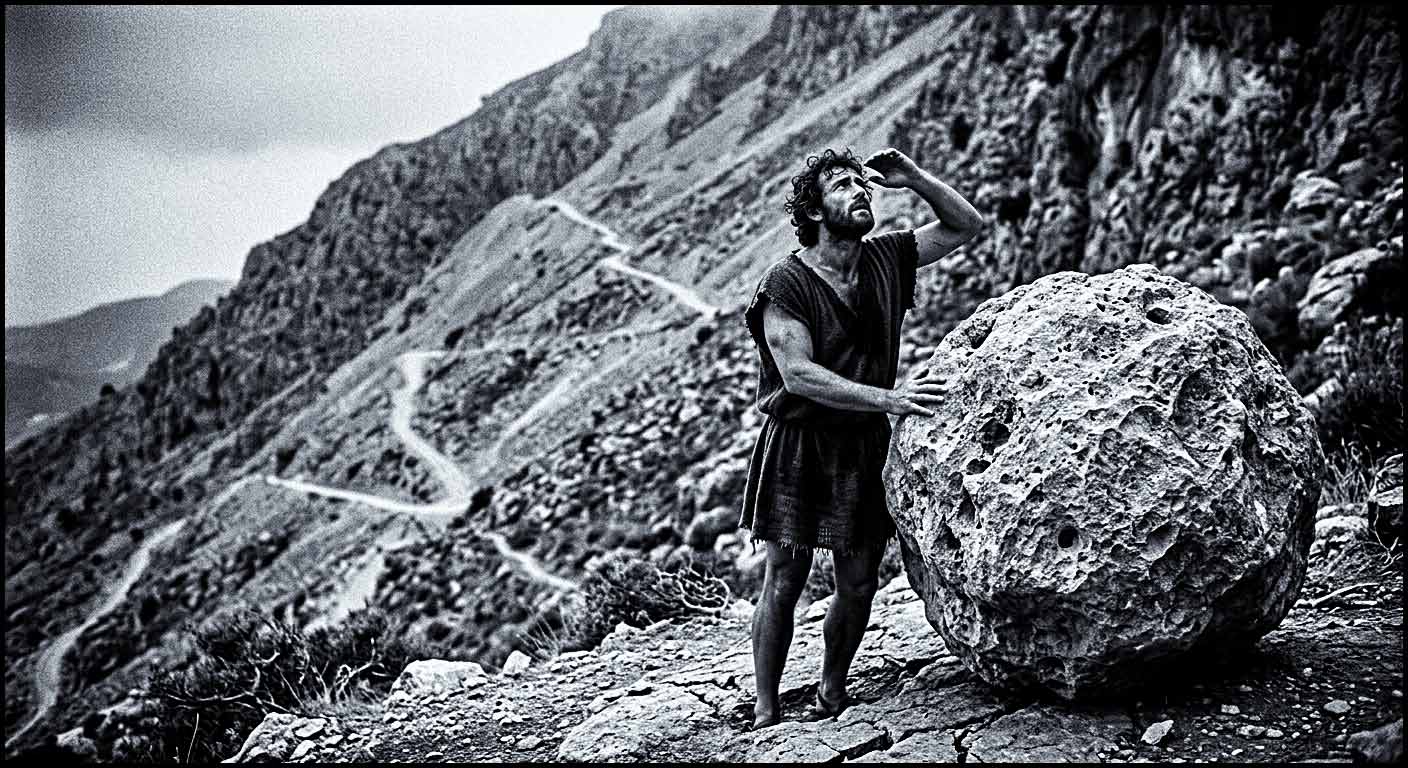
Oh dear. Another futile assault on Shakespeare’s authorship by Dr. Stritmatter, Ph.D. He keeps trying to shift the paradigm–Mount Everest–with spades of wet tissue paper. A self-driven Sisyphus, he’s labored mightily to roll his Big Rock up the hill, to drop it on the Orthodoxy. It’s his dream to squash us flat. He is joined in his futile labours by a crew of fellow cultists—“an hundred Sisiphi at once, rowling so many restlesse stones”—but chiefly here by Gary Goldstein, Robert Prechter, and Bryan Wildenthal. The volume as whole is marked by that peculiar Stritmatterly blend of pomposity, credulity, and arithmetical incompetence.
Dr. Stritmatter has long insisted (against all evidence) that the markings, by a series of unknown hands, in a Geneva Bible once owned by the Earl of Oxford, mirror Shakespeare’s scriptural allusions. Not so. They are almost an anti-match. Whole swathes of Shakespeare’s most alluded-to verses, chapters, even books, go unmarked, while huge tracts of the Apocrypha, which the poet-playwright barely noted, are a thicket of Xs and underlinings.
In this new rock—er, book, Stritmatter’s arithmetic remains shaky, but here at least he’s more or less comparing text to text. He has discovered Early English Books Online, “the definitive online collection of early printed works in English, and works printed in England” from 1473 to 1700. It includes over 132,000 titles, which is virtually everything. What he hasn’t discovered is how to use it. He hasn’t a clue what to look for, or how to structure a search—and that ignorance (as we shall see) proves fatal to his work.
His methods are naive and impressionistic, merely what MacDonald Jackson has called the “uncontrolled accumulation of parallels between a disputed work and an authorial candidate whom the scholar favours.” True stylometric studies go much deeper, into pause patterns and word adjacency networks. By comparison, this stuff is childish dot-to-dottery. For all his pseudo-scholarly posturing, Stritmatter hasn’t a clue how stylometric analysis is done: he appears like a stargazer trying to refute astrophysics, armed only with a cardboard mailing tube for a telescope. It’s no wonder he’s ignored. Nothing daunted, he sets out to show that “there is Salmons in both” Oxford and Shakespeare. And of course, he finds what he’s looking for. He’s assembled a sad little list of banalities that appear both in Shakespeare’s work and in Oxford’s tiny oeuvre (which is plumped out by larceny from other poets), calling these bitlets “unusual common phrases” Unusual and common? “That is, hot ice, and wondrous strange snow.”
And to this reader, very tragicall mirth.
Stritmatter’s conceit of what a ”parallel” might be beggars belief. To take just one: he matches “I have little and seek no more” with Shakespeare’s “Little joy I have / To breathe this news … I speak no more than every one doth know.” That modest ellipsis conceals a cut of eight-and-a-half lines [!] of blank verse. This goes beyond mere wishful thinking into the realm of the delusional.
And as for his statistics—Seriously, what the good doctor needs is a freshman tutorial on using EEBO. He has no idea how it works. I have been through his tables, tested dozens of his figures. All of them are undercounted, some drastically. Some of his results are obvious oversights (or flat-out cheats); others, perplexing.
To begin with, he’s bad at searching. Sometimes he appears to be ignoring variant spellings; nearly always, variant forms. For example, Stritmatter tells us that “EEBO returns only ten hits in ten records (1473-1623) for the search ‘world afford,’” and 34 in 29 records for “world affords.” Hey, what happened to “affordeth”? Did he deliberately ignore it, to suppress the numbers? Or is he absolutely ignorant of Early Modern English verb forms? Counting all variant spellings and grammatical forms of “world afford,” there are 151 instances in 128 books. But wait! What about forms like “will afford”? Or “can scarcely afford”? Since Strimatter counts Shakespeare’s “The spacious world cannot again afford” among his “strongest parallels” with Oxford’s “That world affords,” we must look at “world NEAR afford.” The score leaps to 475/347. I wouldn’t call that rare.
As a rule, his searches are designed to gerrymander, to draw a tight little box around the earl and the playwright, excluding all others. “An EEBO search … (1473-1600) returns only four hits in three sources for the term ‘haggard hawk,’” he crows, proving to himself the rarity and exclusivity of the motif. The actual count is 21 hits in 16 records. He smugly claims that none but Oxford and his alter ego “Shakespeare” ever “associate … the behavior of the ‘haggard hawk’ with human emotions or situations.”
Oh, really? A search for “haggard” on its own, unlimited by “hawk,” from its first appearance in 1566 to 1580, turns up 176 hits in 26 books. Turberville’s 1575 book on falconry accounts for 128 of those. There’s one in a glossary. All the rest— 47 hits in 24 books—refer to human bad behavior. Indeed, the earliest use in English that I found described a human, not a hawk. As noun and adjective, the word caught on at once, and remained a commonplace for “wild, strange; froward, contrarie, crosse” people, especially women: “the haggarde disposition of his mistres”; “the straunge and haggarde nature of loue”; “she is not of haggards kind, Nor hart so hard”; “those which are so coyishe & wilde, or so haggarde like”; “Yee haggards straunge, therefore adiew / Goe seeke some other for thy mate”; “For Haggard like, she will not stoope.” Oxford’s imagery is unexceptional.
But there’s something more than willful blindness going on here. Stritmatter finds only 14/14 hits for “When I am alone.” In fact, there are 24/24 from Chaucer onward, including one each in Oxford and Shakespeare, and one in his precious Geneva Bible. Esther xiv.16, speaking of her crown: “I hate this token of my preeminence, which I beare vpon mine head, … I abhorre it as a menstruous cloth, and that I weare it not when I am alone by my self.” Unmarked, of course: the entire chapter is as virgin snow.
But I digress. Alternate spelling accounts for only one of those ten missing hits. What is happening to his results?
The key to the riddle is found in one ridiculous set of parallels, foregrounded proudly. In a 1602 letter, Oxford uses the Latin proverb “Finis coronat opus” (“The end crowns the work”). I’ll bet his secretary thought of that, and spelled it for him. Stritmatter is thrilled that Shakespeare uses three different versions of that proverb in his work, even though not one of them is Latin. In the Folio version of 2 Henry VI, there’s a typographically mangled version of the French, “La fin Corrone les eumenes [les oeuvres].” The Anglo-French “the fines the Crowne” appears in All’s Well That Ends Well; and “the end crownes all,” in Troilus and Cressida (1609 & 1623). The English and French appear nowhere in Oxford’s poetry or letters; the Latin, nowhere in Shakespeare.
Indeed, until the later 17th century, as far as I can tell, the French proverb appears in print only in Shakespeare (1623) and in G. D. L. M. N.’s The French alphabeth (1592), where it comes with a handy translation: “La fin couronne l’oeuure. The end doth crowne the worke.” That book, whose pseudonymous author is G. Delamothe, was published by Shakespeare’s Stratford contemporary Richard Field, and may have given the playwright that proverb (and perhaps a name in Love’s Labours Lost?).
Shakespeare’s use of “the end crownes all” is the very first recorded in EEBO, though a translator of The Ship of Fooles (1509) simply and succinctly writes “For the ende crowneth.” Shakespeare’s “The fines the Crowne” is unique.
Nonetheless, Strit’s absolutely thrilled by the coincidence.
“By any measure this proverb is rare before 1623. In the Latin version, [only] Henri Estienne (1607), Edmund Bolton (1610), and Gerard Malynes (1622), use ‘finis coronat opus’ before the publication of All’s Well in 1623.” Wait, what? What happened to the anonymous author of A dialogue or speaking together of two personages (1582), William Watson (1602), Otto van Veen (1608), Thomas Milles (1608), Sir Edward Hoby (1615), and Crispijn van de Passe (1615)?
Three out of nine.
You will note that Shakespeare nowhere uses “work.” Nevertheless, it’s “The end crowns the work” that Stritmatter looks for, not the “The end crowns all” “In English,” says Dr. Stritmatter, “only Sébastien Michaelis (1613) and George Hakewell {Hakewill, actually] (1621) are known to do so [include that proverb}.”
What!? I find 27 titles that do so. The first is by Daniel Tossanus (1583): “the end crowneth ye worke.” Among other items, the list includes G. Delamothe’s The French alphabeth (1592), as noted; that terribly obscure play The Spanish tragedie by Thomas Kyd (1592: “The end is crowne of euery worke”); John Bodenham’s, Bel-vedére, or, The Garden of the muses, which is a commonplace book, for heaven’s sake, a list of popular sententiae (1600); George Chapman’s inconspicuous Homer (1611); Constantia Munda, in the gloriously titled The vvorming of a mad dogge: or, A soppe for Cerberus the iaylor of Hell (1617); the great jurist Sir Edward Coke (1618); and Charles Fitz-Geffry (1620): “But the end is the Crowne of the whole work; and the last Act (if any) carrieth away the Applause.”
Oblivious to the end, Stritmatter writes, “Evaluating this evidence honestly requires assessment of prior probabilities.” No. Evaluating this evidence honestly requires the ability to reason and to count.
Three out of nine. Two out of twenty-seven.
What the devil is going on here?
Only part of this grievous deficiency comes down to Stritmatter’s unintelligent search tactics, though a badly stated search will miss variants like “end doth crowne “ and “crowne of euery worke.”
The truly devastating error lies elsewhere, at the very foundations of his research. From the screen shot on p. 11, and by exactly which authors’ names he didn’t find, I could tell that he’s been using an incomplete, perhaps antiquated version of EEBO, EEBO lite. As he should have known—he supposedly studied for his doctorate—EEBO comprises two collections. EEBO-TCP Phase I is freely available to everyone who searches, on any device, from anywhere. It is not tied to any provider. But EEBO-TCP Phase II is “available only to EEBO-TCP partners.” Buried deep in the Help pages is the quiet bombshell: “Your institution may not be subscribed to all EEBO subsets.”
It appears that Coppin State is not.
EEBO-TCP Phase II accounts for three-fifths of all the titles in their database. So Dr. Stritmatter has been merrily searching away, without realizing that his corpus is missing more than half its texts. He’s been calling the winners of an election, in which three-fifths of the ballots have been randomly destroyed. He’s not playing with a full deck.
That noise you hear is the thunk-thunk-thunking of the Big Rock, bounding down and down and down the hill to the very bottom, and into the swamp.
This study is hopelessly, irrevocably, fatally flawed.
The honorable thing would be to withdraw the book, with refunds and apologies.
The rational thing to do would be to stop rolling that stone.
Being Sisyphus, there’s no hope.